












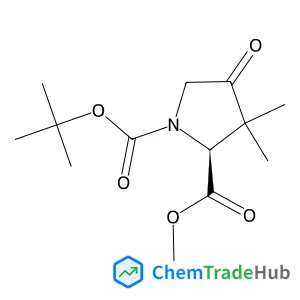
2-Methyl 1-(2-methyl-2-propanyl) (2S)-3,3-dimethyl-4-oxo-1,2-pyrrolidinedicarboxylate
CAS Number:
478698-30-5
Molecular Formula:
C13H21NO5
E. R. Jones, M. Semsarilar, P. Wyman, M. Boerakker, S. P. Armes
RAFT dispersion polymerization of benzyl methacrylate (BzMA) has been used previously (E. R. Jones, et al., Macromolecules, 2012, 45, 5091) to prepare poly(2-(dimethylamino)ethyl methacrylate)-poly(benzyl methacrylate) (PDMA–PBzMA) diblock copolymer nanoparticles in ethanol via polymerization-induced self-assembly (PISA). However, the rate of polymerization was relatively slow, with incomplete monomer conversions being obtained when targeting higher mean degrees of polymerization (DP) even after 24 h at 70 °C. Herein we examine the effect of the addition of up to 20% w/w water co-solvent on the kinetics of BzMA polymerization for this PISA formulation. Significantly faster polymerizations were observed: for a target DP of 200, 90% BzMA conversion was achieved within just 6 h in the presence of 20% w/w water, compared to only 35% conversion in anhydrous ethanol under the same conditions. This rate enhancement enables much higher mean DPs to be obtained for the core-forming PBzMA and is attributed to greater partitioning of the BzMA monomer within the particles, which increases the local monomer concentration. However, the presence of water adversely affected the evolution of copolymer morphology from spheres to worms to vesicles when employing a relatively short PDMA chain transfer agent, with only kinetically-trapped spheres being obtained at higher levels of added water. Aqueous electrophoresis studies indicate that the PDMA stabilizer chains acquired partial cationic charge in the presence of water. This leads to more efficient inter-particle repulsion, thus preventing the sphere-sphere fusion events required for an evolution in morphology. In summary, the addition of water to such PISA formulations allows the more efficient synthesis of spherical nanoparticles, but should be used with caution if either diblock copolymer worms or vesicles are desired.
DOI: 10.1039/C5CP00768B
M. Zachariah, M. Romanini, P. Tripathi, J. Ll. Tamarit, R. Macovez
DOI: 10.1039/C5CP02345A
G. Gerogiokas, M. W. Y. Southey, M. P. Mazanetz, A. Hefeitz, M. Bodkin, R. J. Law, J. Michel
DOI: 10.1039/C5CP90084K
Ilia Kaminker, Morgan Bye, Natanel Mendelman, Kristmann Gislason, Snorri Th. Sigurdsson, Daniella Goldfarb
DOI: 10.1039/C5CP01624J
Zhenzhen Feng, Yuli Yan, Guangbiao Zhang, Jueming Yang, Chao Wang
DOI: 10.1039/C5CP00972C
Changshun Deng, Bin Li, Lihui Dong, Feiyue Zhang, Minguang Fan, Guangzhou Jin, Junbin Gao, Liwen Gao, Fei Zhang, Xinpeng Zhou
DOI: 10.1039/C5CP00745C
Renjith Bhaskaran, Manabendra Sarma
DOI: 10.1039/C5CP00126A
Tao Zhang, Zhiguang Xu, Zengxiao Cai, Qipeng Guo
DOI: 10.1039/C5CP01157D
Mandeep Kaur, Sandeep Singh
DOI: 10.1039/C5CP00540J
(5-Sulfamoyl-3-pyridinyl)boronic acid is primarily used in chemical synthesis, p...
Benzyl 2-methyl-2-(methylsulfonyl)-4-pentenoate is typically synthesized via est...
When handling 8-Fluoroquinolin-6-ol (CAS: 209353-22-0), it is important to use p...
1,3-Dibromo-5-(2-methyl-2-propanyl)benzene (CAS: 129316-09-2) is a crystalline c...
Ethyl 7-chloro-4-oxo-1-(1,3-thiazol-2-yl)-1,4-dihydro-1,8-naphthyridine-3-carbox...
When handling Delta-7-Avenasterol (CAS: 23290-26-8), it is important to wear app...
Proper handling involves the use of personal protective equipment such as gloves...
When handling 2-Methyl-2-proanyl 4-[(2-aminophenyl)amino]-1-piperidinecarboxylat...
N-Methyl-4-chlorobenzylamine hydrochloride (CAS: 65542-24-7) is a organic compou...
[2-(Dodecyloxy)ethoxy]acetic acid (CAS: 27306-90-7) is generally considered safe...

Polymer Chemistry welcomes submissions in all areas of polymer science that have a strong focus on macromolecular chemistry. Manuscripts may cover a broad range of fields, yet no direct application focus is required.
![2-Methyl-2-propanyl 4-oxo-3,9-diazabicyclo[4.2.1]nonane-9-carboxylate structure](https://static.chemtradehub.com/structs/131/1312456-05-5-9a15.webp "2-Methyl-2-propanyl 4-oxo-3,9-diazabicyclo[4.2.1]nonane-9-carboxylate structure")
![4-Fluoro-2-(4-{[(3S,4R)-4-(2-hydroxy-2-propanyl)-3-pyrrolidinyl]amino}-6,7-dimethoxy-2-quinazolinyl)phenol hydrochloride (1:1) structure](https://static.chemtradehub.com/structs/143/1431697-96-9-619c.webp "4-Fluoro-2-(4-{[(3S,4R)-4-(2-hydroxy-2-propanyl)-3-pyrrolidinyl]amino}-6,7-dimethoxy-2-quinazolinyl)phenol hydrochloride (1:1) structure")
![2-Azaspiro[4.5]decane-3,8-dione structure](https://static.chemtradehub.com/structs/914/914780-96-4-e94b.webp "2-Azaspiro[4.5]decane-3,8-dione structure")
![[3-Fluoro-4-(1-pyrrolidinylcarbonyl)phenyl]boronic acid structure](https://static.chemtradehub.com/structs/874/874289-09-5-e3d4.webp "[3-Fluoro-4-(1-pyrrolidinylcarbonyl)phenyl]boronic acid structure")





