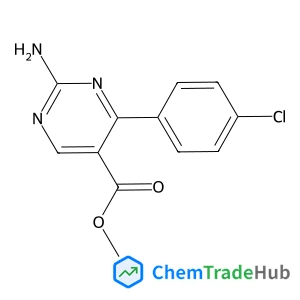
Methyl 2-amino-4-(4-chlorophenyl)-5-pyrimidinecarboxylate
CAS Number:
1133115-56-6
Molecular Formula:
C12H10ClN3O2
A graphical abstract is available for this content
Paweł Tecmer, Cristina E. González-Espinoza
DOI: 10.1039/C8CP00048D
Sumit Bawari, Nisheal M. Kaley, Shubhadeep Pal, Thazhe Veettil Vineesh, Shamasree Ghosh, Jagannath Mondal, Tharangattu N. Narayanan
DOI: 10.1039/C8CP01020J
Basudeb Dutta, Joydeep Datta, Suvendu Maity, Chittaranjan Sinha, Di Sun, Partha Pratim Ray, Mohammad Hedayetullah Mir
DOI: 10.1039/C8CP04569K
Jingxiang Guo, Jeremy C. Palmer
DOI: 10.1039/C8CP04237C
Alicja Domaracka, Rudy Delaunay, Arkadiusz Mika, Michael Gatchell, Henning Zettergren, Henrik Cederquist, Patrick Rousseau, Bernd A. Huber
DOI: 10.1039/C8CP01179F
Liang Pu, Zhong Zhang, R. Bruce King, Wesley D. Allen
DOI: 10.1039/C7CP08673C
Kyunggu Kim, Hochun Lee
DOI: 10.1039/C8CP03155J
Ho-Il Ji, Hyoungchul Kim, Hae-Weon Lee, Byung-Kook Kim, Kyung Joong Yoon
DOI: 10.1039/C8CP01880D
Xiangyang Duan, Chao Ma, Wentao Jin, Xiaoman Ma, Su-Huai Wei, Jinying Yu
DOI: 10.1039/C8CP02494D
Rachael Knoblauch, Brian Bui, Ammar Raza, Chris D. Geddes
DOI: 10.1039/C8CP02675K
2-Methylbenzene-1,4-diamine dihydrochloride (CAS: 615-45-2) should be stored in ...
(1S,4S)-2,5-Diazabicyclo[2.2.1]heptane dihydrobromide is generally considered sa...
(6-Chloropyridazin-3-YL)methanamine finds applications in the pharmaceutical ind...
2-Fluoro-3-methylphenol is primarily used in the synthesis of pharmaceuticals, p...
When handling 3-Methoxy-4-nitrobenzonitrile, it is important to wear appropriate...
When handling 1,3-Oxazolo[4,5-b]pyridine-2(3H)-thione (CAS: 211949-57-4), it is ...
4-Ethynylbenzamide (CAS: 90347-86-7) falls under various regulatory guidelines i...
3-(2-Ethylphenyl)-2-thioxo-4-imidazolidinone is primarily used as an intermediat...
(2-Fluoro-6-methoxyphenyl)acetic acid, also known as 4-fluoro-3-methoxybenzoic a...
Market trends for 2-[4-(Hydroxymethyl)phenoxy]ethanol (CAS: 102196-18-9) indicat...

Physical Chemistry Chemical Physics (PCCP) is an international journal co-owned by 19 physical chemistry and physics societies from around the world. This journal publishes original, cutting-edge research in physical chemistry, chemical physics and biophysical chemistry. To be suitable for publication in PCCP, articles must include significant innovation and/or insight into physical chemistry; this is the most important criterion that reviewers and Editors will judge against when evaluating submissions. The journal has a broad scope and welcomes contributions spanning experiment, theory, computation and data science. Topical coverage includes spectroscopy, dynamics, kinetics, statistical mechanics, thermodynamics, electrochemistry, catalysis, surface science, quantum mechanics, quantum computing and machine learning. Interdisciplinary research areas such as polymers and soft matter, materials, nanoscience, energy, surfaces/interfaces, and biophysical chemistry are welcomed if they demonstrate significant innovation and/or insight into physical chemistry. Joined experimental/theoretical studies are particularly appreciated when complementary and based on up-to-date approaches.
![trans-2-{[(Tert-butoxy)carbonyl]amino}cyclobutane-1-carboxylic acid structure](https://static.chemtradehub.com/structs/951/951173-25-4-27cd.webp "trans-2-{[(Tert-butoxy)carbonyl]amino}cyclobutane-1-carboxylic acid structure")
![(1R,6R)-6-({[(2-Methyl-2-propanyl)oxy]carbonyl}amino)-3-cyclohexene-1-carboxylic acid structure](https://static.chemtradehub.com/structs/865/865689-24-3-5fef.webp "(1R,6R)-6-({[(2-Methyl-2-propanyl)oxy]carbonyl}amino)-3-cyclohexene-1-carboxylic acid structure")