


Synthesis and conductivity of hyperbranched poly(triazolium)s with various end-capping groups
Literature Information
Publication Date
2015-11-17
DOI
10.1039/C5PY01735A
Impact Factor
5.582
Authors
Jianhua Wu, Jie Chen, Junfang Wang, Xiaojuan Liao, Meiran Xie, Ruyi Sun
View Original
Abstract
A series of novel hyperbranched poly(triazolium)s with different terminal groups were synthesized by alkylation and anion exchange reactions of the corresponding hyperbranched poly(triazole)s, which were obtained from an AB2-type monomer via Cu(I)-catalyzed azide–alkyne cycloaddition polymerization. The hyperbranched poly(triazolium)s showed high thermal stability with decomposition temperatures of 328–361 °C, and good flexibility, with glass transition temperatures (Tg) ranging from −6.2 to −14.9 °C. Among them, an oligo(ethylene glycol)-terminated hyperbranched poly(triazolium) presented the lowest Tg of −14.9 °C, the highest ionic conductivity (7.70 × 10⁻⁶ S cm−1 at 30 °C and 1.02 × 10⁻³ S cm−1 at 110 °C) and a wide electrochemical stability window of 6.0 V. Therefore, these hyperbranched poly(triazolium)s could act as new electrolyte materials.
Recommended Journals

Photochemical & Photobiological Sciences

Foundations of Chemistry

Mini-Reviews in Medicinal Chemistry

Advanced Engineering Materials

Nature Reviews Drug Discovery

Current Pharmaceutical Biotechnology

Physical Chemistry Chemical Physics

Lab on a Chip

Journal of Medical Biochemistry

Contact Lens & Anterior Eye
Related Literature
Subpicosecond surface dynamics in genomic DNA from in vitro-grown plant species: a SERS assessment
Cristina M. Muntean, Ioan Bratu, Nicolae Leopold, Cristian Morari, Luiza Buimaga-Iarinca, Monica A. P. Purcaru
2015-02-06
Paper
DOI: 10.1039/C4CP05425C
Understanding the microstructure of particle dispersion in confined copolymer nanocomposites
Wenliang Wang, Chen Zhang, Zhongjie Du, Jianguo Mi
2015-09-14
Paper
DOI: 10.1039/C5CP03915K
Diastereo-specific conformational properties of neutral, protonated and radical cation forms of (1R,2S)-cis- and (1R,2R)-trans-amino-indanol by gas phase spectroscopy
Aude Bouchet, Johanna Klyne, Otto Dopfer
2015-04-09
Paper
DOI: 10.1039/C5CP00576K
New data on photochemistry of the interstellar molecule: HNCS. Identification of the S⋯HCN complex
Justyna Krupa, Iwona Kosendiak, Maria Wierzejewska
2015-07-27
Paper
DOI: 10.1039/C5CP03663A
Prospects for plasmonic hot spots in single molecule SERS towards the chemical imaging of live cells
Darya Radziuk, Helmuth Moehwald
2015-01-08
Perspective
DOI: 10.1039/C4CP04946B
Correction: Is there an intramolecular hydrogen bond in 2-halophenols? A theoretical and spectroscopic investigation
Michael H. Abraham, Raymond J. Abraham, Abil E. Aliev, Claudio F. Tormena
2015-09-17
Correction
DOI: 10.1039/C5CP90167G
Mass partitioning effects in diffusion transport
Miljan Milosevic, Suhong Wu, Elvin Blanco, Mauro Ferrari, Arturas Ziemys
2015-07-07
Paper
DOI: 10.1039/C5CP02720A
Structural characterization of gas-phase cysteine and cysteine methyl ester complexes with zinc and cadmium dications by infrared multiple photon dissociation spectroscopy
Rebecca A. Coates, Christopher P. McNary, Georgia C. Boles, Giel Berden, P. B. Armentrout
2015-04-09
Paper
DOI: 10.1039/C5CP01500F
Surface enhanced vibrational spectroscopy and first-principles study of l-cysteine adsorption on noble trimetallic Au/Pt@Rh clusters
B. Loganathan, V. L. Chandraboss, S. Senthilvelan, B. Karthikeyan
2015-01-27
Paper
DOI: 10.1039/C4CP05170J
Why LiFePO4 is a safe battery electrode: Coulomb repulsion induced electron-state reshuffling upon lithiation
Bernardo Barbiellini, Hasnain Hafiz, Susmita Basak, Jun Liu, Thomas Richardson, Guojiun Shu, Fangcheng Chou, Tsu-Chien Weng, Dennis Nordlund, Dimosthenis Sokaras, Brian Moritz, Thomas P. Devereaux, Ruimin Qiao, Yi-De Chuang, Arun Bansil, Zahid Hussain, Wanli Yang
2015-09-03
Paper
DOI: 10.1039/C5CP04739K
You might also like
Compound Q&A
Is 2-(2-chloroacetamido)-3-phenylpropanoic acid (CAS: 7765-11-9) safe?
2-(2-Chloroacetamido)-3-phenylpropanoic acid (CAS: 7765-11-9) is generally consi...
7765-11-92-(2-chloroacetamido...
Compound Q&A
Is 2-(Benzyloxy)-5-bromobenzoic acid (CAS: 62176-31-2) safe?
2-(Benzyloxy)-5-bromobenzoic acid can be handled safely if appropriate precautio...
62176-31-22-(Benzyloxy)-5-brom...
Compound Q&A
What is (4-Methyl-1,2,5-oxadiazol-3-yl)methanamine hydrochloride (CAS: 1159825-48-5)?
(4-Methyl-1,2,5-oxadiazol-3-yl)methanamine hydrochloride is a chemical compound ...
1159825-48-5(4-Methyl-1,2,5-oxad...
Compound Q&A
What is 2-(5-Hexylthiophen-2-yl)-4,4,5,5-tetramethyl-1,3,2-dioxaborolane (CAS: 917985-54-7)?
2-(5-Hexylthiophen-2-yl)-4,4,5,5-tetramethyl-1,3,2-dioxaborolane (CAS: 917985-54...
917985-54-72-(5-Hexylthiophen-2...
Compound Q&A
Are there alternatives to 4-(8-Methyl-9H-1,3-dioxolo[4,5-h][2,3]benzodiazepin-5-yl)benzenamine (CAS: 102771-26-6) in synthesis?
While 4-(8-Methyl-9H-1,3-dioxolo[4,5-h][2,3]benzodiazepin-5-yl)benzenamine (CAS:...
102771-26-64-(8-Methyl-9H-1,3-d...
Compound Q&A
What is the market or research trend for tert-butyl 3-hydroxy-4,5,7,8-tetrahydro-2H-pyrazolo[3,4-d]azepine-6-carboxylate (CAS: 851376-80-2)?
The market for tert-butyl 3-hydroxy-4,5,7,8-tetrahydro-2H-pyrazolo[3,4-d]azepine...
851376-80-2tert-butyl 3-hydroxy...
Compound Q&A
How should waste containing 3,5-Diamino-1H-pyrazole-4-carbonitrile (CAS: 6844-58-2) be handled?
Waste containing 3,5-Diamino-1H-pyrazole-4-carbonitrile (CAS: 6844-58-2) should ...
6844-58-23,5-Diamino-1H-pyraz...
Compound Q&A
How is (6-Fluoro-3-pyridinyl)boronic acid (CAS: 351019-18-6) typically synthesized?
(6-Fluoro-3-pyridinyl)boronic acid can be synthesized through the reaction of 6-...
351019-18-6(6-Fluoro-3-pyridiny...
Compound Q&A
What industries use Dibenzyl carbonimidoylbiscarbamate (CAS: 10065-79-9)?
Dibenzyl carbonimidoylbiscarbamate (CAS: 10065-79-9) finds applications in vario...
10065-79-9Dibenzyl carbonimido...
Compound Q&A
What is the market or research trend for (beta,beta,2,3,4,5,6-~2~H_7_)Phenylalanine (CAS: 74228-83-4)?
The market for (beta,beta,2,3,4,5,6-~2~H_7_)Phenylalanine (CAS: 74228-83-4) is g...
74228-83-4(beta,beta,2,3,4,5,6...
Source Journal
Polymer Chemistry

CiteScore:
8.6
Self-citation Rate:
7.3%
Articles per Year:
457
Polymer Chemistry welcomes submissions in all areas of polymer science that have a strong focus on macromolecular chemistry. Manuscripts may cover a broad range of fields, yet no direct application focus is required.
Recommended Compounds
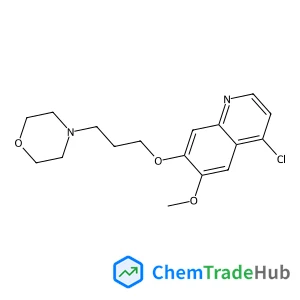
4-(3-((4-Chloro-6-methoxyquinolin-7-yl)oxy)propyl)morpholine
CAS Number:
205448-32-4
Molecular Formula:
C17H21ClN2O3
Recommended Suppliers






Disclaimer
This page provides academic journal information for reference and research purposes only. We are not affiliated with any journal publishers and do not handle publication submissions. For publication-related inquiries, please contact the respective journal publishers directly.
If you notice any inaccuracies in the information displayed, please contact us at support@chemtradehub.com. We will promptly review and address your concerns.