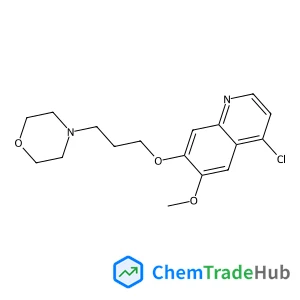
4-(3-((4-Chloro-6-methoxyquinolin-7-yl)oxy)propyl)morpholine
CAS Number:
205448-32-4
Molecular Formula:
C17H21ClN2O3
Viet Hildebrand, Erik Wischerhoff
Complementary to the well-established zwitterionic monomer 3-((3-methacrylamidopropyl)dimethylammonio)propane-1-sulfonate (SPP), the closely related monomers 2-hydroxy-3-((3-methacrylamidopropyl)dimethylammonio)propane-1-sulfonate (SHPP) and 4-((3-methacrylamidopropyl)dimethylammonio)butane-1-sulfonate (SBP) were synthesised and polymerised by reversible addition–fragmentation chain transfer (RAFT) polymerisation, using a fluorophore labeled RAFT agent. The polyzwitterions of systematically varied molar masses were characterised with respect to their solubility in water and aqueous salt solutions. Both poly(sulfobetaine)s show thermoresponsive behaviour in water, exhibiting phase separation at low temperatures and upper critical solution temperatures (UCST). For both polySHPP and polySBP, cloud points depend notably on the molar mass, and are much higher in D2O than in H2O. Also, the cloud points are effectively modulated by the addition of salts. The individual effects can be in parts correlated to the Hofmeister series for the anions studied. Still, they depend in a complex way on the concentration and the nature of the added electrolytes, on the one hand, and on the detailed nature of the spacer group separating the anionic and the cationic charges of the betaine moiety, on the other hand. As anticipated, the cloud points of polySBP are much higher than the ones of the analogous polySPP of identical molar mass. Surprisingly, the cloud points of polySHPP are also somewhat higher than the ones of their polySPP analogues, despite the additional hydrophilic hydroxyl group present in the spacer separating the ammonium and the sulfonate moieties. These findings point to a complicated interplay of the various hydrophilic components in polyzwitterions with respect to their overall hydrophilicity. Thus, the spacer group in the betaine moiety proves to be an effective additional molecular design parameter, apparently small variations of which strongly influence the phase behaviour of the polyzwitterions in specific aqueous environments.
Jérôme Warnant, Corine Gérardin, Patrick Lacroix-Desmazes
DOI: 10.1039/C4PY01502A
Andreas Wohlfarth, Angelika Manhart, Petra Räder, Patric Jannasch
DOI: 10.1039/C4PY01177E
Zai-Zai Tong, Rui-Yang Wang, Jie Huang, Jun-Ting Xu, Zhi-Qiang Fan
DOI: 10.1039/C5PY00004A
Lei Yu, Long-Hai Wang, Zong-Tao Hu, Ye-Zi You, De-Cheng Wu, Chun-Yan Hong
DOI: 10.1039/C4PY01363H
Ke Wang, Xiqi Zhang, Bin Yang, Zhen Li, Qingsong Zhang, Zengfang Huang, Yen Wei
DOI: 10.1039/C4PY01452A
Heng Wang, Yue Wang, Xichong Ye, Haruka Hayama, Hiroyoshi Sugino, Hideyuki Nakano
DOI: 10.1039/C6PY01737A
Mitsuhiro Shibata, Masaya Katoh, Hayato Takase, Ayaka Shibita
DOI: 10.1039/C5PY00401B
Yougen Chen, Nao Xiao, Moe Fukuoka, Kohei Yoshida, Qian Duan, Toshifumi Satoh
DOI: 10.1039/C5PY00277J
Peter Bellstedt
DOI: 10.1039/C6PY02076C
Xiangwen Yang, Xiaodong Zhuang, Yinjuan Huang, Jianzhong Jiang, Hao Tian, Dongqing Wu, Fan Zhang, Yiyong Mai
DOI: 10.1039/C4PY01408A
(5-Sulfamoyl-3-pyridinyl)boronic acid is primarily used in chemical synthesis, p...
Benzyl 2-methyl-2-(methylsulfonyl)-4-pentenoate is typically synthesized via est...
When handling 8-Fluoroquinolin-6-ol (CAS: 209353-22-0), it is important to use p...
1,3-Dibromo-5-(2-methyl-2-propanyl)benzene (CAS: 129316-09-2) is a crystalline c...
Ethyl 7-chloro-4-oxo-1-(1,3-thiazol-2-yl)-1,4-dihydro-1,8-naphthyridine-3-carbox...
When handling Delta-7-Avenasterol (CAS: 23290-26-8), it is important to wear app...
Proper handling involves the use of personal protective equipment such as gloves...
When handling 2-Methyl-2-proanyl 4-[(2-aminophenyl)amino]-1-piperidinecarboxylat...
N-Methyl-4-chlorobenzylamine hydrochloride (CAS: 65542-24-7) is a organic compou...
[2-(Dodecyloxy)ethoxy]acetic acid (CAS: 27306-90-7) is generally considered safe...

Polymer Chemistry welcomes submissions in all areas of polymer science that have a strong focus on macromolecular chemistry. Manuscripts may cover a broad range of fields, yet no direct application focus is required.

![N-[2,6-Di(9-anthryl)-4-oxido-8,9,10,11,12,13,14,15-octahydrodinaphtho[2,1-d:1',2'-f][1,3,2]dioxaphosphepin-4-yl]-1,1,1-trifluoromethanesulfonamide structure](https://static.chemtradehub.com/structs/122/1227374-64-2-cdb5.webp "N-[2,6-Di(9-anthryl)-4-oxido-8,9,10,11,12,13,14,15-octahydrodinaphtho[2,1-d:1',2'-f][1,3,2]dioxaphosphepin-4-yl]-1,1,1-trifluoromethanesulfonamide structure")