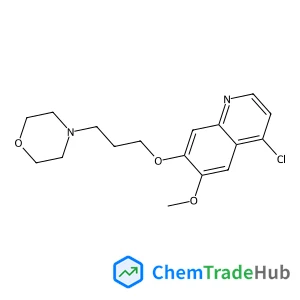
4-(3-((4-Chloro-6-methoxyquinolin-7-yl)oxy)propyl)morpholine
CAS Number:
205448-32-4
Molecular Formula:
C17H21ClN2O3
Yougen Chen, Nao Xiao, Moe Fukuoka, Kohei Yoshida, Qian Duan, Toshifumi Satoh
The present study describes the precise synthesis and thermoresponsive properties of two types of four-arm star-shaped poly(N-isopropylacrylamide)s (PNIPAM), i.e., the covalently linked one (3) and the non-covalently Ru(II)-chelated one (5). The atom transfer radical polymerization (ATRP) method was used to prepare the azido-terminated PNIPAM (1) arm using (2-azidoethyl)-2-chloropropionamide (AECP) as the initiator. 3 was subsequently prepared based on the click reaction of 1 with a multifunctional linker of tetra[(5-hexynyloyloxy)methyl]methane. For comparison, its linear counterpart 2 was also synthesized as a reference polymer by the same method using ethyl 5-hexynyloate. The four-arm star-shaped PNIPAM Ru complex 5, on the other hand, was prepared by a click-to-chelate approach, which involves the click reaction of 1 with 2,6-diethynylpyridine to produce the macroligand of 2,6-bis(1-PNIPAM-1,2,3-triazol-4-yl)pyridine (4) and the chelating reaction of RuCl3 with 4 to afford 5. The thermoresponsive properties of the resulting polymers were investigated using a UV-vis spectrophotometer by measuring the optical transmittance of the polymer solution with varying solution temperature and the cloud point (Tc) at 50% transmittance intensity in order to assess their thermoresponsive properties. The detailed thermoresponsive properties of these polymers, including the effects of the polymer terminal and core linkage and constituents of the four-arm star-shaped PNIPAMs on the Tc, are significantly described in the later part of this study.

Bioorganic Chemistry

Progress in Materials Science

Crystal Research and Technology

European Journal of Medicinal Chemistry

Applied Surface Science

Drug and Chemical Toxicology

Journal of Dispersion Science and Technology

Pharmacology & Therapeutics

Annual Review of Public Health

Bulletin of Materials Science
Bing Xu, Wenjing Li, Zhen Pu, Wenjie Yu, Tengfei Huang, Juanjuan Cheng, Xuefeng Wang
DOI: 10.1039/C9CP04888J
Verena Küpers, Martin Kolek, Peter Bieker, Gunther Brunklaus
DOI: 10.1039/C9CP05334D
Zhijie Wang, Zhibo Luo, Jia Li, Kang Yang, Gang Zhou
DOI: 10.1039/D0CP04219F
Nicola Vettore
DOI: 10.1039/C9CP04524D
Paulami Ghosh, Debashree Ghosh
DOI: 10.1039/C9CP05166J
Nora Lüdtke, Jelena Föller, Christel M. Marian
DOI: 10.1039/D0CP04654J
C. Pattyn, N. Maira, A. Remy, N. C. Roy, S. Iseni, D. Petitjean, F. Reniers
DOI: 10.1039/D0CP03858J
Tsan-Chuen Leung, Han Hu, An Ju Liu, Ming-Chieh Lin
DOI: 10.1039/C9CP04305E
(5-Sulfamoyl-3-pyridinyl)boronic acid is primarily used in chemical synthesis, p...
Benzyl 2-methyl-2-(methylsulfonyl)-4-pentenoate is typically synthesized via est...
When handling 8-Fluoroquinolin-6-ol (CAS: 209353-22-0), it is important to use p...
1,3-Dibromo-5-(2-methyl-2-propanyl)benzene (CAS: 129316-09-2) is a crystalline c...
Ethyl 7-chloro-4-oxo-1-(1,3-thiazol-2-yl)-1,4-dihydro-1,8-naphthyridine-3-carbox...
When handling Delta-7-Avenasterol (CAS: 23290-26-8), it is important to wear app...
Proper handling involves the use of personal protective equipment such as gloves...
When handling 2-Methyl-2-proanyl 4-[(2-aminophenyl)amino]-1-piperidinecarboxylat...
N-Methyl-4-chlorobenzylamine hydrochloride (CAS: 65542-24-7) is a organic compou...
[2-(Dodecyloxy)ethoxy]acetic acid (CAS: 27306-90-7) is generally considered safe...

Polymer Chemistry welcomes submissions in all areas of polymer science that have a strong focus on macromolecular chemistry. Manuscripts may cover a broad range of fields, yet no direct application focus is required.