












Stimulus responsive cross-linked AIE-active polymeric nanoprobes: fabrication and biological imaging application
Literature Information
Publication Date
2015-10-05
DOI
10.1039/C5PY01513H
Impact Factor
5.582
Authors
Qing Wan, Ke Wang, Chengbin He, Meiying Liu, Guangjian Zeng, Hongye Huang, Fengjie Deng, Xiaoyong Zhang, Yen Wei
View Original
Abstract
The combination of functional polymers and hydrophobic AIE dyes to prepare luminescent organic nanoparticles (LONs) with strong fluorescence, great water dispersibility and desirable biocompatibility has received a lot of attention for potential applications in cell imaging and theranostics. Although great effort has been devoted to preparing AIE dye based LONs through both covalent and noncovalent strategies, the fabrication of cross-linked AIE dye based LONs with stimulus responsive behavior has not been reported previously. In this work, the AIE dye based LONs were constructed via cross-linking aldehyde-containing polymers and AIE dye (2,2′-diaminotetraphenyl ethylene) with two amino groups through formation of a Schiff base, which is a well-known dynamic bond with pH responsiveness. After successful incorporation of the hydrophobic AIE dye into the copolymers, cross-linked core–shell luminescent nanoparticles can be formed. The obtained AIE dye based LONs exhibited strong fluorescence and high water dispersibility because the AIE dye aggregated in the core and the hydrophilic polymers were covered on the shell. Biological evaluation results demonstrated that the AIE dye based LONs exhibited excellent biocompatibility and biological imaging properties. More importantly, these AIE dye based LONs exhibited desirable pH responsiveness, implying that these polymeric LONs can be potentially utilized for pH sensors and controlled drug delivery. With the combination of dynamic crosslinking and pH responsiveness, the obtained AIE dye based LONs should be of great significance for biomedical applications.
Recommended Journals
Related Literature
Surface force at the nano-scale: observation of non-monotonic surface tension and disjoining pressure
Mahshid Firouzi, Qibin Li, Kang Peng
2015-07-14
Paper
DOI: 10.1039/C5CP03050A
A facile one-pot synthesis of blue and red luminescent thiol stabilized gold nanoclusters: a thorough optical and microscopy study
Nabin Kumar Pal, Carola Kryschi
2015-07-08
Paper
DOI: 10.1039/C5CP01773D
Molecular dynamics simulations and NMR spectroscopy studies of trehalose–lipid bilayer systems
Jon Kapla, Olof Engström, Baltzar Stevensson, Jakob Wohlert, Göran Widmalm, Arnold Maliniak
2015-07-22
Paper
DOI: 10.1039/C5CP02472B
Tip-enhanced Raman spectroscopy of graphene-like and graphitic platelets on ultraflat gold nanoplates
Farshid Pashaee, Faranak Sharifi, Giovanni Fanchini, François Lagugné-Labarthet
2015-02-10
Paper
DOI: 10.1039/C4CP05252H
New data on photochemistry of the interstellar molecule: HNCS. Identification of the S⋯HCN complex
Justyna Krupa, Iwona Kosendiak, Maria Wierzejewska
2015-07-27
Paper
DOI: 10.1039/C5CP03663A
Diffusion in Li2O studied by non-equilibrium molecular dynamics for 873 < T/K < 1603
Alexander D. Mulliner, Philippe C. Aeberhard, Peter D. Battle
2015-07-29
Paper
DOI: 10.1039/C5CP02628H
Prospects for plasmonic hot spots in single molecule SERS towards the chemical imaging of live cells
Darya Radziuk, Helmuth Moehwald
2015-01-08
Perspective
DOI: 10.1039/C4CP04946B
The catalyzed hydrogen sorption mechanism in alkali alanates
Züleyha Özlem Kocabas Atakli, Shin-Ichi Orimo
2015-07-13
Paper
DOI: 10.1039/C5CP01684C
Surface enhanced Raman scattering of a single molecular junction
Ryuji Matsushita, Manabu Kiguchi
2015-01-15
Paper
DOI: 10.1039/C4CP04906C
You might also like
Compound Q&A
Is 2-(2-chloroacetamido)-3-phenylpropanoic acid (CAS: 7765-11-9) safe?
2-(2-Chloroacetamido)-3-phenylpropanoic acid (CAS: 7765-11-9) is generally consi...
7765-11-92-(2-chloroacetamido...
Compound Q&A
Is 2-(Benzyloxy)-5-bromobenzoic acid (CAS: 62176-31-2) safe?
2-(Benzyloxy)-5-bromobenzoic acid can be handled safely if appropriate precautio...
62176-31-22-(Benzyloxy)-5-brom...
Compound Q&A
What is (4-Methyl-1,2,5-oxadiazol-3-yl)methanamine hydrochloride (CAS: 1159825-48-5)?
(4-Methyl-1,2,5-oxadiazol-3-yl)methanamine hydrochloride is a chemical compound ...
1159825-48-5(4-Methyl-1,2,5-oxad...
Compound Q&A
What is 2-(5-Hexylthiophen-2-yl)-4,4,5,5-tetramethyl-1,3,2-dioxaborolane (CAS: 917985-54-7)?
2-(5-Hexylthiophen-2-yl)-4,4,5,5-tetramethyl-1,3,2-dioxaborolane (CAS: 917985-54...
917985-54-72-(5-Hexylthiophen-2...
Compound Q&A
Are there alternatives to 4-(8-Methyl-9H-1,3-dioxolo[4,5-h][2,3]benzodiazepin-5-yl)benzenamine (CAS: 102771-26-6) in synthesis?
While 4-(8-Methyl-9H-1,3-dioxolo[4,5-h][2,3]benzodiazepin-5-yl)benzenamine (CAS:...
102771-26-64-(8-Methyl-9H-1,3-d...
Compound Q&A
What is the market or research trend for tert-butyl 3-hydroxy-4,5,7,8-tetrahydro-2H-pyrazolo[3,4-d]azepine-6-carboxylate (CAS: 851376-80-2)?
The market for tert-butyl 3-hydroxy-4,5,7,8-tetrahydro-2H-pyrazolo[3,4-d]azepine...
851376-80-2tert-butyl 3-hydroxy...
Compound Q&A
How should waste containing 3,5-Diamino-1H-pyrazole-4-carbonitrile (CAS: 6844-58-2) be handled?
Waste containing 3,5-Diamino-1H-pyrazole-4-carbonitrile (CAS: 6844-58-2) should ...
6844-58-23,5-Diamino-1H-pyraz...
Compound Q&A
How is (6-Fluoro-3-pyridinyl)boronic acid (CAS: 351019-18-6) typically synthesized?
(6-Fluoro-3-pyridinyl)boronic acid can be synthesized through the reaction of 6-...
351019-18-6(6-Fluoro-3-pyridiny...
Compound Q&A
What industries use Dibenzyl carbonimidoylbiscarbamate (CAS: 10065-79-9)?
Dibenzyl carbonimidoylbiscarbamate (CAS: 10065-79-9) finds applications in vario...
10065-79-9Dibenzyl carbonimido...
Compound Q&A
What is the market or research trend for (beta,beta,2,3,4,5,6-~2~H_7_)Phenylalanine (CAS: 74228-83-4)?
The market for (beta,beta,2,3,4,5,6-~2~H_7_)Phenylalanine (CAS: 74228-83-4) is g...
74228-83-4(beta,beta,2,3,4,5,6...
Source Journal
Polymer Chemistry

CiteScore:
8.6
Self-citation Rate:
7.3%
Articles per Year:
457
Polymer Chemistry welcomes submissions in all areas of polymer science that have a strong focus on macromolecular chemistry. Manuscripts may cover a broad range of fields, yet no direct application focus is required.
Recommended Compounds
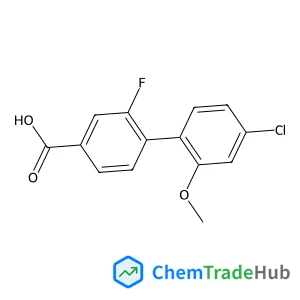
4-(4-Chloro-2-methoxyphenyl)-3-fluorobenzoic acid
CAS Number:
1261970-23-3
Molecular Formula:
C14H10ClFO3
Recommended Suppliers




Disclaimer
This page provides academic journal information for reference and research purposes only. We are not affiliated with any journal publishers and do not handle publication submissions. For publication-related inquiries, please contact the respective journal publishers directly.
If you notice any inaccuracies in the information displayed, please contact us at support@chemtradehub.com. We will promptly review and address your concerns.