












Thermoresponsive, stretchable, biodegradable and biocompatible poly(glycerol sebacate)-based polyurethane hydrogels
Literature Information
Publication Date
2015-09-25
DOI
10.1039/C5PY01136A
Impact Factor
5.582
Authors
Martin Frydrych, Sabiniano Román, Nicola H. Green, Sheila MacNeil, Biqiong Chen
View Original
Abstract
Thermoresponsive, stretchable, biodegradable and biocompatible polyester-based polyurethane (PEU) hydrogels, based on poly(glycerol sebacate) pre-polymer and poly(ethylene glycol)s of different molecular masses were synthesized by a facile solvent-based two-step method. The chemical and physical characteristics of the PEU hydrogels are tunable, enabling the design of various negatively thermosensitive, mechanically stable and biodegradable systems. The PEU hydrogels demonstrate reversible responses to a change in medium temperature from 5 °C to 37 °C, with the swelling ratio at equilibrium varying from 499% to 12%. The hydrogels have a tensile Young's modulus, ultimate tensile strength and elongation at break in the range of 0.02–0.20 MPa, 0.05–0.47 MPa and 426–623%, respectively, and show high stretchability and full shape recovery after compression. These are similar to the mechanical properties of adipose tissues. In vitro degradation tests show mass losses of 8.7–16.3% and 10.7–20.7% without and with the presence of lipase enzyme for 31 days, respectively. In vitro cell tests show clear evidence that some of the PEU hydrogels are suitable for culturing adipose-derived stem cells and dermal fibroblasts and hence for future soft tissue regeneration. The functionalities of the PEU hydrogels were also evaluated for potential applications in drug delivery, thermal actuation and ultralow power generation. The results demonstrate the versatility of these PEU hydrogels for a variety of biomedical and engineering applications.
Related Literature
Synthesis of hydrogels viaring-opening metathesispolymerization: factors affecting gelation
Ahmad E. Madkour, Joshua M. Grolman, Gregory N. Tew
2010-11-01
Paper
DOI: 10.1039/C0PY00151A
Catalytic chain transfer polymerization for molecular weight control in microemulsion polymerization
Niels M. B. Smeets, Rachel W. K. Lam, Raul P. Moraes, Timothy F. L. McKenna
2011-12-19
Paper
DOI: 10.1039/C2PY00469K
Synthesis of well-defined multigraft copolymers
David Uhrig
2010-09-17
Review Article
DOI: 10.1039/C0PY00185F
Phase separated structures in tethered dPS–PMMA copolymer films revealed using X-ray scattering with a novel contrast enhancement agent
Benjamin M. D. O'Driscoll, Gemma E. Newby, Ian W. Hamley
2010-11-10
Paper
DOI: 10.1039/C0PY00289E
2-[1-(2,4-Dibenzhydryl-6-methylphenylimino)ethyl]-6-[1-(arylimino)ethyl]pyridylcobalt(ii) dichlorides: Synthesis, characterization and ethylenepolymerization behavior
Weizhen Zhao, Wenhong Yang, Carl Redshaw, Tongling Liang, Yongwen Liu, Wen-Hua Sun
2012-01-25
Paper
DOI: 10.1039/C2PY00590E
Polyelectrolyte uptake by PEMs: Impact of salt concentration
Xingjie Zan, Bo Peng, David A. Hoagland, Zhaohui Su
2011-09-27
Paper
DOI: 10.1039/C1PY00280E
A study on the hydrogen bonding interaction of the electrospun ladder polyphenylsilsesquioxane/polyisophthalamide composite fibers by ATR FT-IR
Zhongjie Ren, Rongben Zhang, Feng Wang, Shouke Yan
2010-11-09
Paper
DOI: 10.1039/C0PY00274G
Propylenedioxythiophene (ProDOT)–phenylenecopolymers allow a yellow-to-transmissive electrochrome
Chad M. Amb, Justin A. Kerszulis, Emily J. Thompson, Aubrey L. Dyer, John R. Reynolds
2011-02-01
Communication
DOI: 10.1039/C0PY00405G
Combatting ionic aggregation using dielectric forces—combining modeling/simulation and experimental results to explain end-capping of primary amine functionalized polystyrene
Jamie M. Messman, Deanna L. Pickel, Monojoy Goswami, David W. Uhrig
2011-08-24
Paper
DOI: 10.1039/C1PY00226K
You might also like
Compound Q&A
What is 3-Fluoro-2-methylbenzylamine (CAS: 771573-36-5)?
3-Fluoro-2-methylbenzylamine is an organic compound with the CAS number 771573-3...
771573-36-53-Fluoro-2-methylben...
Compound Q&A
Is Tert-butyl 2-(oxetan-3-ylidene)acetate (CAS: 1207175-03-8) safe?
Tert-butyl 2-(oxetan-3-ylidene)acetate is considered safe for its intended uses ...
1207175-03-8Tert-butyl 2-(oxetan...
Compound Q&A
What precautions should be taken when handling 4-Acetyl-2-fluorobenzonitrile (CAS: 214760-18-6)?
Proper personal protective equipment (PPE) such as gloves, goggles, and a lab co...
214760-18-64-Acetyl-2-fluoroben...
Compound Q&A
How is 2-Ethyl-4-methyl-1,3-thiazole (CAS: 15679-12-6) typically synthesized?
2-Ethyl-4-methyl-1,3-thiazole is commonly synthesized via the reaction of thiour...
15679-12-62-Ethyl-4-methyl-1,3...
Compound Q&A
How should 5',5''-([2,2'-Bithiophene]-5,5'-diyl)bis(([1,1':3',1''-terphenyl]-4,4''-dicarboxylic acid)) (CAS: 1227780-71-3) be stored?
This compound should be stored in a cool, dry place away from direct sunlight an...
1227780-71-35',5''''-([2,2'-Bith...
Compound Q&A
What regulatory guidelines apply to L-Lysine Acetate Salt (CAS: 52315-92-1)?
L-Lysine Acetate Salt (CAS: 52315-92-1) is subject to various regulatory guideli...
52315-92-1L-LYSINE ACETATE SAL...
Compound Q&A
Is 6-Fluoro-3-hydroxy-2-pyrazinecarboxamide (CAS: 259793-96-9) safe?
6-Fluoro-3-hydroxy-2-pyrazinecarboxamide (CAS: 259793-96-9) is generally conside...
259793-96-96-Fluoro-3-hydroxy-2...
Compound Q&A
What are the physical and chemical properties of 1,1'-Sulfonylbis(1H-imidazole) (CAS: 7189-69-7)?
1,1'-Sulfonylbis(1H-imidazole) is a crystalline solid with a molecular weight of...
7189-69-71,1'-Sulfonylbis(1H-...
Compound Q&A
What industries use 4-methyl-7-nitro-1H-indole-3-carbonitrile (CAS: 289483-82-5)?
4-Methyl-7-nitro-1H-indole-3-carbonitrile (CAS: 289483-82-5) is primarily used i...
289483-82-54-methyl-7-nitro-1H-...
Compound Q&A
How should waste containing 5-Bromo-3-indolyl-beta-galactoside (CAS: 97753-82-7) be handled?
Waste containing 5-Bromo-3-indolyl-beta-galactoside (CAS: 97753-82-7) should be ...
97753-82-75-Bromo-3-indolyl-be...
Source Journal
Polymer Chemistry

CiteScore:
8.6
Self-citation Rate:
7.3%
Articles per Year:
457
Polymer Chemistry welcomes submissions in all areas of polymer science that have a strong focus on macromolecular chemistry. Manuscripts may cover a broad range of fields, yet no direct application focus is required.
Recommended Compounds

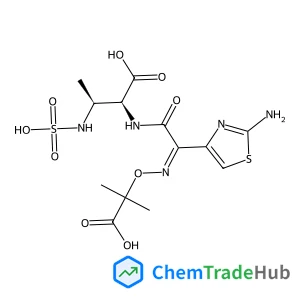
Aztreonam USP Related Compound A (Open-ring Aztreonam)
CAS Number:
87500-74-1
Molecular Formula:
C13H19N5O9S2
Recommended Suppliers






Disclaimer
This page provides academic journal information for reference and research purposes only. We are not affiliated with any journal publishers and do not handle publication submissions. For publication-related inquiries, please contact the respective journal publishers directly.
If you notice any inaccuracies in the information displayed, please contact us at support@chemtradehub.com. We will promptly review and address your concerns.