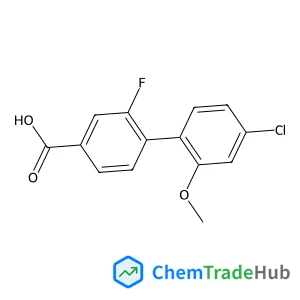
4-(4-Chloro-2-methoxyphenyl)-3-fluorobenzoic acid
CAS Number:
1261970-23-3
Molecular Formula:
C14H10ClFO3
Pijush Karak, Swapan Chakrabarti
To understand the effect of structural rigidity or flexibility on the intersystem crossing rate, herein we have adopted a time dependent correlation function based approach, an appropriate method for a harmonic oscillator under Condon approximation. Following this technique, we have developed generalized codes for calculating the rate of intersystem crossing (ISC) both at 0 K and at finite temperature. Since the rate of ISC is a measurable quantity, we have separated the real and imaginary parts of the complex correlation function carefully and eliminated the imaginary part by exploiting the odd nature of this function. Using this simplified method, we have calculated the ISC rate constant (kISC) of two molecules, namely, benzophenone and its fused analog, fluorenone. The calculations clearly elucidate that kISC of benzophenone is 103 times larger compared to that of fluorenone. Interestingly, our analyses reveal that the combined effect of spin–orbit coupling and the number of normal modes could increase the rate of ISC of benzophenone by three orders in comparison to that of fluorenone. Furthermore, the Duschinsky rotation matrix (J) and displacement vectors (D) could influence the rate of ISC by one order each, indicating that the overall rate of ISC of benzophenone could have been 105 times higher than that of fluorenone if the latter two factors, namely, J and D have practically no impact on the rate of ISC of fluorenone. However, it has been found that albeit J can't alter the rate of ISC of fluorenone, D indeed can change the rate by two orders, thereby keeping the overall ratio of the rate of ISC of benzophenone and fluorenone as 103. The present study elucidates that none of the above mentioned factors alone can explain the relative rate of ISC of the studied systems; rather a complex interplay between all these factors makes the rate of ISC of benzophenone 103 times higher than that of fluorenone.
Pratiksha P. Gawas, Buthanapalli Ramakrishna, Rajesh Pamanji, Joseph Selvin, Venkatramaiah Nutalapati
DOI: 10.1039/D3MA00559C
Chia-Wen Tsao, Ping-Chin Shen
DOI: 10.1039/D3MA00380A
Bipin S. Chikkatti, Nagaraj R. Banapurmath
DOI: 10.1039/D3MA00563A
Chang Liu, Lunxiang Yin, Yanli Guo, Bao Xie, Xu Wang, Yanqin Li
DOI: 10.1039/D3MA00925D
Krishna Sundar Das, Mainak Das, Sayan Saha, Amit Adhikary, Sukhen Bala, Partha Pratim Ray, Raju Mondal
DOI: 10.1039/D3MA00645J
Peide Zhu, Rongye Zhu, Juncheng Wang
DOI: 10.1039/D3MA00443K
Sabya Sachi Das, Balaga Venkata Krishna Rao, Mandeep Kumar Arora, Janne Ruokolainen, Mukesh Dhanka, Hemant Singh
DOI: 10.1039/D3MA00484H
Xiaolin Wang, Md Ahsan Habib, Jin Zhu, Jing Chen
DOI: 10.1039/D3MA00464C
Mimansa, Smriti Bansal, Pranjali Yadav, Asifkhan Shanavas
DOI: 10.1039/D3MA00576C
Philippe F. Smet, Rik Van Deun, David Van der Heggen
DOI: 10.1039/D3MA00772C
(5-Sulfamoyl-3-pyridinyl)boronic acid is primarily used in chemical synthesis, p...
Benzyl 2-methyl-2-(methylsulfonyl)-4-pentenoate is typically synthesized via est...
When handling 8-Fluoroquinolin-6-ol (CAS: 209353-22-0), it is important to use p...
1,3-Dibromo-5-(2-methyl-2-propanyl)benzene (CAS: 129316-09-2) is a crystalline c...
Ethyl 7-chloro-4-oxo-1-(1,3-thiazol-2-yl)-1,4-dihydro-1,8-naphthyridine-3-carbox...
When handling Delta-7-Avenasterol (CAS: 23290-26-8), it is important to wear app...
Proper handling involves the use of personal protective equipment such as gloves...
When handling 2-Methyl-2-proanyl 4-[(2-aminophenyl)amino]-1-piperidinecarboxylat...
N-Methyl-4-chlorobenzylamine hydrochloride (CAS: 65542-24-7) is a organic compou...
[2-(Dodecyloxy)ethoxy]acetic acid (CAS: 27306-90-7) is generally considered safe...

Physical Chemistry Chemical Physics (PCCP) is an international journal co-owned by 19 physical chemistry and physics societies from around the world. This journal publishes original, cutting-edge research in physical chemistry, chemical physics and biophysical chemistry. To be suitable for publication in PCCP, articles must include significant innovation and/or insight into physical chemistry; this is the most important criterion that reviewers and Editors will judge against when evaluating submissions. The journal has a broad scope and welcomes contributions spanning experiment, theory, computation and data science. Topical coverage includes spectroscopy, dynamics, kinetics, statistical mechanics, thermodynamics, electrochemistry, catalysis, surface science, quantum mechanics, quantum computing and machine learning. Interdisciplinary research areas such as polymers and soft matter, materials, nanoscience, energy, surfaces/interfaces, and biophysical chemistry are welcomed if they demonstrate significant innovation and/or insight into physical chemistry. Joined experimental/theoretical studies are particularly appreciated when complementary and based on up-to-date approaches.