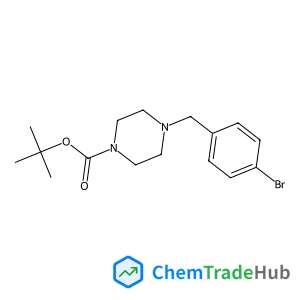
2-Methyl-2-propanyl 4-(4-bromobenzyl)-1-piperazinecarboxylate
CAS Number:
844891-10-7
Molecular Formula:
C16H23BrN2O2
The first page of this article is displayed as the abstract.
Helen Benjamin, Jonathan G. Richardson, Stephen A. Moggach, Sergejs Afanasjevs, Lisette Warren, Mark R. Warren, David R. Allan, Carole A. Morrison, Konstantin V. Kamenev, Neil Robertson
DOI: 10.1039/C9CP06749C
Ranzhuo Huang, Tianxing Wang, Xianqi Dai, Shuyi Wei, Yaqiang Ma
DOI: 10.1039/C9CP06249A
Rodrigo Ortiz de la Morena, Andika Asyuda, Hao Lu, Hannah Aitchison, Kelly Turner, Stephen M. Francis, Michael Zharnikov, Manfred Buck
DOI: 10.1039/C9CP06724H
Alexander Ostermann, Tobias M. Gasser, Thomas Loerting, Jörg Petrasch
DOI: 10.1039/C9CP04735B
Donghe Wei, Mengxue Ren, Jie Bi, George Maroulis
DOI: 10.1039/C9CP06330G
Lei Jin, Xiaoming Zhang, Tingli He, Weizhen Meng, Xuefang Dai, Guodong Liu
DOI: 10.1039/C9CP06033B
Zhixiang Liu, Mengyuan Xiang, Yao Zhang, Huaiyu Shao, Yunfeng Zhu, Xinli Guo, Liquan Li, Hui Wang, Wanqiang Liu
DOI: 10.1039/C9CP06090A
Jon M. Schwantes, Jacob L. Bair, Edgar C. Buck, Ram Devanathan, Sean H. Kessler, Timothy G. Lach, Jason M. Lonergan, Bruce K. McNamara, Camille J. Palmer, Richard A. Clark
DOI: 10.1039/C9CP05363H
Waste containing 2-Ethyl-4-Methyl-1H-Imidazole-5-Carbaldehyde (CAS: 88634-80-4) ...
Triethoxy(octyl)silane (CAS: 1385031-14-0) is widely used in the pharmaceuticals...
Several alternatives to 3-iodo-7-nitro-1H-indazole (CAS: 864724-64-1) exist in t...
Yes, there are alternatives to Benzene, bis[(trimethoxysilyl)ethyl] (CAS: 266317...
Isothiazole-3-carbonitrile (CAS: 1452-17-1) is generally considered safe when us...
(3-Chlorophenyl)methanol (CAS: 873-63-2) is considered low to moderately toxic. ...
(2S,3S)-2-Hydroxy-3-({[(2-methyl-2-propanyl)oxy]carbonyl}amino)-3-(2-naphthyl)pr...
Proper handling of methyl 2-(bromomethyl)-5-methoxybenzoate requires the use of ...
6,8-Dibromoimidazo[1,2-a]pyridine-2-carboxylic acid (CAS: 904805-36-3) is an aro...
3-Amino-5-bromo-2-pyridinecarbonitrile is considered safe when handled under pro...

Physical Chemistry Chemical Physics (PCCP) is an international journal co-owned by 19 physical chemistry and physics societies from around the world. This journal publishes original, cutting-edge research in physical chemistry, chemical physics and biophysical chemistry. To be suitable for publication in PCCP, articles must include significant innovation and/or insight into physical chemistry; this is the most important criterion that reviewers and Editors will judge against when evaluating submissions. The journal has a broad scope and welcomes contributions spanning experiment, theory, computation and data science. Topical coverage includes spectroscopy, dynamics, kinetics, statistical mechanics, thermodynamics, electrochemistry, catalysis, surface science, quantum mechanics, quantum computing and machine learning. Interdisciplinary research areas such as polymers and soft matter, materials, nanoscience, energy, surfaces/interfaces, and biophysical chemistry are welcomed if they demonstrate significant innovation and/or insight into physical chemistry. Joined experimental/theoretical studies are particularly appreciated when complementary and based on up-to-date approaches.