












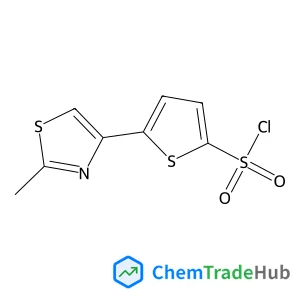
5-(2-Methyl-1,3-thiazol-4-yl)-2-thiophenesulfonyl chloride
CAS Number:
215434-25-6
Molecular Formula:
C8H6ClNO2S3
M. Krajewski, K. Brzozka, W. S. Lin, H. M. Lin, M. Tokarczyk, G. Kowalski, D. Wasik
This work describes an oxidation process of iron–iron oxide core–shell nanowires at temperatures between 100 °C and 800 °C. The studied nanomaterial was synthesized through a simple chemical reduction of iron trichloride in an external magnetic field under a constant flow of argon. The electron microscopy investigations allowed determining that the as-prepared nanowires were composed of self-assembled iron nanoparticles which were covered by a 3 nm thick oxide shell and separated from each other by a thin interface layer. Both these layers exhibited an amorphous or highly-disordered character which was traced by means of transmission electron microscopy and Mössbauer spectroscopy. The thermal oxidation was carried out under a constant flow of argon which contained the traces of oxygen. The first stage of process was related to slow transformations of amorphous Fe and amorphous iron oxides into crystalline phases and disappearance of interfaces between iron nanoparticles forming the studied nanomaterial (range: 25–300 °C). After that, the crystalline iron core and iron oxide shell became oxidized and signals for different compositions of iron oxide sheath were observed (range: 300–800 °C) using X-ray diffraction, Raman spectroscopy and Mössbauer spectroscopy. According to the thermal gravimetric analysis, the nanowires heated up to 800 °C under argon atmosphere gained 37% of mass with respect to their initial weight. The structure of the studied nanomaterial oxidized at 800 °C was mainly composed of α-Fe2O3 (∼93%). Moreover, iron nanowires treated above 600 °C lost their wire-like shape due to their shrinkage and collapse caused by the void coalescence.
Amin Reyhani, Masood S. Alivand, Kathryn A. Mumford, Greg Qiao
DOI: 10.1039/D0PY00220H
George E. Parkes, Helena J. Hutchins-Crawford, Claire Bourdin, Stuart Reynolds, Laura J. Leslie, Matthew J. Derry, Josephine L. Harries, Paul D. Topham
DOI: 10.1039/D0PY00244E
Le N. M. Dinh, Lakshmi N. Ramana, Vipul Agarwal, Per B. Zetterlund
DOI: 10.1039/D0PY00404A
Hengchen Zhang, Xiaojuan Liao, Ruyi Sun, Meiran Xie
DOI: 10.1039/D0PY00109K
Hiromitsu Sogawa, Takuya Katashima, Keiji Numata
DOI: 10.1039/D0PY00187B
Helen Yao, Kai Sheng, Jialing Sun, Shupeng Yan, Yingqin Hou, Hua Lu, Bradley D. Olsen
DOI: 10.1039/C9PY01680E
Haixun Ji, Linjing Liu, Sijia Feng, Yuqin Fu, Yu Yang, Changli Lü
DOI: 10.1039/D0PY00180E
Piyali Mandal, Diptendu Patra, Raja Shunmugam
DOI: 10.1039/D0PY00367K
Zhitao Li, Dong Wang, Daniele Ramella, Hong Gao, Hui Cao, Yuzhen Zhao, Zongcheng Miao, Zhou Yang, Wanli He
DOI: 10.1039/C9PY01771B
Waste containing 6-Chloro-5-(2'-hydroxy-3'-methoxy-4-biphenylyl)-3-(3-methoxyphe...
(3alpha,5alpha)-3-Hydroxypregnane-11,20-dione is primarily used in the pharmaceu...
The market for 4-Amino-6-chloro-2-pyridinecarboxylic acid (CAS: 546141-56-4) is ...
Alternatives to (2-Benzoylethyl)trimethylammonium chloride (CAS: 24472-88-6) in ...
N-[4-Nitro-3-(trifluoromethyl)phenyl]acetamide (CAS: 393-12-4) is generally safe...
Alternative reagents such as other phosphates or similar functional groups can b...
There are alternatives to N,N'-Bis(3-aminopropyl)-1,3-propanediamine (CAS: 4605-...
When handling Aluminium trihexadecanoate, it is important to use appropriate per...
(1,1-Dioxido-3-oxo-1,2-benzothiazol-2(3H)-yl)acetic acid is a chemical compound ...
Several alternatives to 5,5-dimethyloxolan-2-one (CAS: 3123-97-5) can be used in...

Physical Chemistry Chemical Physics (PCCP) is an international journal co-owned by 19 physical chemistry and physics societies from around the world. This journal publishes original, cutting-edge research in physical chemistry, chemical physics and biophysical chemistry. To be suitable for publication in PCCP, articles must include significant innovation and/or insight into physical chemistry; this is the most important criterion that reviewers and Editors will judge against when evaluating submissions. The journal has a broad scope and welcomes contributions spanning experiment, theory, computation and data science. Topical coverage includes spectroscopy, dynamics, kinetics, statistical mechanics, thermodynamics, electrochemistry, catalysis, surface science, quantum mechanics, quantum computing and machine learning. Interdisciplinary research areas such as polymers and soft matter, materials, nanoscience, energy, surfaces/interfaces, and biophysical chemistry are welcomed if they demonstrate significant innovation and/or insight into physical chemistry. Joined experimental/theoretical studies are particularly appreciated when complementary and based on up-to-date approaches.

![Benzyl 2-{[(tert-butoxy)carbonyl]amino}acetate structure](https://static.chemtradehub.com/structs/542/54244-69-8-6399.webp "Benzyl 2-{[(tert-butoxy)carbonyl]amino}acetate structure")



