












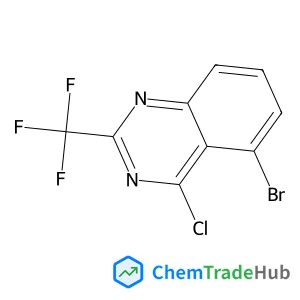
5-Bromo-4-chloro-2-(trifluoromethyl)quinazoline
CAS Number:
2089311-03-3
Molecular Formula:
C9H3BrClF3N2
We study the motion of a doped charge in a π-conjugated polymer chain in solution subject to Brownian fluctuations. Specifically, we take poly(para-phenylene) to be our model system where the Brownian fluctuations cause rotational motion of the phenylene rings. The instantaneous torsional fluctuations cause Anderson localization of the charge wavefunction, with the lower-energy spectrum being composed of local ground states and the higher-energy spectrum being composed of quasi-extended states. At low temperatures, additional charge localization occurs via torsional relaxation. The dynamical torsional fluctuations lead to two distinct modes of motion of the charge: adiabatic and non-adiabatic. Adiabatic motion is a ‘crawling’ motion of the charge along the polymer chain while the charge remains in its local ground state. Non-adiabatic motion is a rapid ‘hopping’ motion as the charge is excited into higher energy quasi-extended states and travels ballistically along the chain before relaxing into a local ground state. The adiabatic motion dominates at low temperatures, and exhibits a linear temperature dependence and thus a constant zero-field charge mobility. Non-adiabatic motion begins to dominate as the temperature is increased, as the charge is thermally excited into higher energy states. At high temperatures the diffusion constant becomes almost temperature independent, indicating a decrease in the charge mobility with increasing temperature, which we attribute to the charge localization length being a decreasing function of temperature at high temperatures.
Codrin Tugui, George T. Stiubianu, Maria Cazacu
DOI: 10.1039/D0PY00223B
Zhonghua Cheng, Lei Wang, Yan He, Xingjia Chen, Xiaojun Wu, Hangxun Xu, Yaozu Liao, Meifang Zhu
DOI: 10.1039/D0PY00249F
Manli Huang, Xuan Zeng, Cheng Zhong, Guohua Xie, Xiaosong Cao, Changan Yang
DOI: 10.1039/D0PY00469C
Hironobu Watanabe, Takuya Yamamoto, Arihiro Kanazawa, Sadahito Aoshima
DOI: 10.1039/D0PY00343C
Santimukul Santra, Ren Bean, Blaze Heckert, Zachary Shaw, Vedant Jain, Lok Shrestha, Raghunath Narayanam, Quentin Austin
DOI: 10.1039/D0PY00346H
Hengchen Zhang, Xiaojuan Liao, Ruyi Sun, Meiran Xie
DOI: 10.1039/D0PY00109K
Alex J. Anderson, Heidi R. Culver
DOI: 10.1039/D0PY00165A
Waste containing 6-Chloro-5-(2'-hydroxy-3'-methoxy-4-biphenylyl)-3-(3-methoxyphe...
(3alpha,5alpha)-3-Hydroxypregnane-11,20-dione is primarily used in the pharmaceu...
The market for 4-Amino-6-chloro-2-pyridinecarboxylic acid (CAS: 546141-56-4) is ...
Alternatives to (2-Benzoylethyl)trimethylammonium chloride (CAS: 24472-88-6) in ...
N-[4-Nitro-3-(trifluoromethyl)phenyl]acetamide (CAS: 393-12-4) is generally safe...
Alternative reagents such as other phosphates or similar functional groups can b...
There are alternatives to N,N'-Bis(3-aminopropyl)-1,3-propanediamine (CAS: 4605-...
When handling Aluminium trihexadecanoate, it is important to use appropriate per...
(1,1-Dioxido-3-oxo-1,2-benzothiazol-2(3H)-yl)acetic acid is a chemical compound ...
Several alternatives to 5,5-dimethyloxolan-2-one (CAS: 3123-97-5) can be used in...

Physical Chemistry Chemical Physics (PCCP) is an international journal co-owned by 19 physical chemistry and physics societies from around the world. This journal publishes original, cutting-edge research in physical chemistry, chemical physics and biophysical chemistry. To be suitable for publication in PCCP, articles must include significant innovation and/or insight into physical chemistry; this is the most important criterion that reviewers and Editors will judge against when evaluating submissions. The journal has a broad scope and welcomes contributions spanning experiment, theory, computation and data science. Topical coverage includes spectroscopy, dynamics, kinetics, statistical mechanics, thermodynamics, electrochemistry, catalysis, surface science, quantum mechanics, quantum computing and machine learning. Interdisciplinary research areas such as polymers and soft matter, materials, nanoscience, energy, surfaces/interfaces, and biophysical chemistry are welcomed if they demonstrate significant innovation and/or insight into physical chemistry. Joined experimental/theoretical studies are particularly appreciated when complementary and based on up-to-date approaches.
![Benzyl 2-{[(tert-butoxy)carbonyl]amino}acetate structure](https://static.chemtradehub.com/structs/542/54244-69-8-6399.webp "Benzyl 2-{[(tert-butoxy)carbonyl]amino}acetate structure")

![2-Methyl-2-propanyl [2-(2-oxa-6-azaspiro[3.3]hept-6-yl)ethyl]carbamate structure](https://static.chemtradehub.com/structs/141/1415562-38-7-c0a4.webp "2-Methyl-2-propanyl [2-(2-oxa-6-azaspiro[3.3]hept-6-yl)ethyl]carbamate structure")





