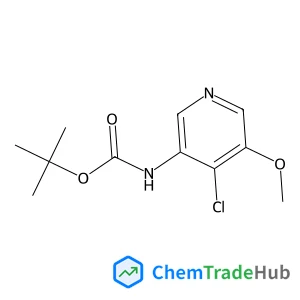
tert-Butyl 4-chloro-5-methoxypyridin-3-ylcarbamate
CAS Number:
1045858-17-0
Molecular Formula:
C11H15ClN2O3
Santimukul Santra, Ren Bean, Blaze Heckert, Zachary Shaw, Vedant Jain, Lok Shrestha, Raghunath Narayanam, Quentin Austin
In this study, a one-step Hüisgen 1,3-dipolar cycloaddition reaction, alkene–azide chemistry, was explored using a solvent and catalyst free method forming 1,2,3-triazoline ring-containing molecules. This facile method was utilized by synthesizing a mini library of small molecules, functional monomers, and polymers, which involved mixing a terminal alkene with a terminal azide at elevated temperature. Similar to traditional “click” chemistry, the proposed alkene–azide strategy uses solvent and heavy-metal catalyst free conditions and no further workup or purification steps are required. In our design, small molecule-based compounds, AB-type prepolymers and macromolecules are synthesized at 80–100 °C with more than 90% purity. Polymers made using this chemistry formed high molecular weight macromolecules (Mw = 59.1k, 34.9k, and 49.3k g mol−1). The synthesized new small molecules, functional monomers and polymers were characterized using various chromatographic and spectroscopic methods. The results indicated that the molecular linking, orthogonal green chemistry reaction proceeds well under gentle conditions, forming products with high yields and reserving atom economy. This chemistry provides a facile approach by offering modular synthetic routes, being highly efficient when using equivalent stoichiometric ratios, and by being solvent and catalyst free, which will be of particular interest to the pharmaceutical and industrial settings.

Acta Materialia

Russian Chemical Bulletin

New Journal of Chemistry

Chemistry Education Research and Practice

Current Opinion in Colloid & Interface Science

Journal of Peptide Science

Saudi Pharmaceutical Journal

Journal of Natural Medicines

Russian Journal of Applied Chemistry

Russian Journal of Coordination Chemistry
Sen Gao, Maoxia Yang, Shaomin Li, Ji Xia, Jun Mei, Hao Liu
DOI: 10.1039/C8SE00498F
Chengtian Zhou, Alfred Junio Samson, Kyle Hofstetter, Venkataraman Thangadurai
DOI: 10.1039/C8SE00234G
Feiyan Liang, Pia Lindberg, Peter Lindblad
DOI: 10.1039/C8SE00281A
Pengli Zhu, Leicong Zhang, Fengrui Zhou, Xianwen liang, Tingxi Li, Qing Wang, Rong Sun
DOI: 10.1039/C7SE00214A
RaviRanjan Kumar, Gunaseelan Dhanarajan, Moumita Bhaumik, Ramkrishna Sen
DOI: 10.1039/C7SE00010C
Chengxiang Xiang, Nathan S. Lewis
DOI: 10.1039/C7SE00062F
Ling-Ling Qu, Jun Wang, Tian-Yi Xu, Qiu-Yun Chen, Jie-Hui Chen, Chao-Jie Shi
DOI: 10.1039/C8SE00311D
Xuhui Zhang, Liangzheng Zhu, Haiying Zheng, Hongxia Wang, Tasawar Hayat, Xu Pan
DOI: 10.1039/C7SE00036G
Waste containing 6-Chloro-5-(2'-hydroxy-3'-methoxy-4-biphenylyl)-3-(3-methoxyphe...
(3alpha,5alpha)-3-Hydroxypregnane-11,20-dione is primarily used in the pharmaceu...
The market for 4-Amino-6-chloro-2-pyridinecarboxylic acid (CAS: 546141-56-4) is ...
Alternatives to (2-Benzoylethyl)trimethylammonium chloride (CAS: 24472-88-6) in ...
N-[4-Nitro-3-(trifluoromethyl)phenyl]acetamide (CAS: 393-12-4) is generally safe...
Alternative reagents such as other phosphates or similar functional groups can b...
There are alternatives to N,N'-Bis(3-aminopropyl)-1,3-propanediamine (CAS: 4605-...
When handling Aluminium trihexadecanoate, it is important to use appropriate per...
(1,1-Dioxido-3-oxo-1,2-benzothiazol-2(3H)-yl)acetic acid is a chemical compound ...
Several alternatives to 5,5-dimethyloxolan-2-one (CAS: 3123-97-5) can be used in...

Polymer Chemistry welcomes submissions in all areas of polymer science that have a strong focus on macromolecular chemistry. Manuscripts may cover a broad range of fields, yet no direct application focus is required.
![Benzo[b]naphtho[2,1-d]thiophene structure](https://static.chemtradehub.com/structs/239/239-35-0-ff90.webp "Benzo[b]naphtho[2,1-d]thiophene structure")