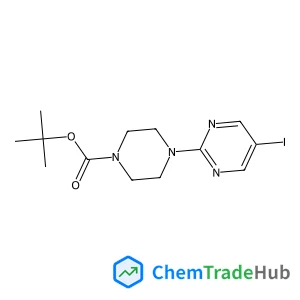
2-Methyl-2-propanyl 4-(5-iodo-2-pyrimidinyl)-1-piperazinecarboxylate
CAS Number:
1027616-32-5
Molecular Formula:
C13H19IN4O2
Sai J. Ganesan, Silvina Matysiak
Protein misfolding is an intrinsic property of polypeptides, and misfolded conformations have a propensity to aggregate. In the past decade, the development of various coarse-grained models for proteins has provided key insights into the driving forces in folding and aggregation. We recently developed a low resolution Water Explicit Polarizable PROtein coarse-grained Model (WEPPROM) by adding oppositely charged dummy particles inside protein backbone beads. With this model, we were able to achieve significant α/β secondary structure content, without any added bias. We now extend the model to study peptide aggregation at hydrophobic–hydrophilic interfaces and draw comparisons to aggregation in explicit water solvent. Elastin-like octapeptides (GV)4 are used as a model system for this study. A condensation-ordering mechanism of aggregation is observed in water. Our results suggest that backbone interpeptide dipolar interactions, not hydrophobicity, plays a more significant role in fibril-like peptide aggregation. We observe a cooperative effect in hydrogen bonding or dipolar interactions, with an increase in aggregate size in water and at interfaces. Based on this cooperative effect, we provide a potential explanation for the observed nucleus size in peptide aggregation pathways. The presence of a hydrophobic–hydrophilic interface increases both (a) order of aggregates formed, and (b) rate of the aggregation process. Without dipolar particles, peptide aggregation is not observed at the hydrophilic–hydrophobic interface. Thus, the presence of dipoles, not hydrophobicity, plays a key role in aggregation observed at hydrophobic interfaces.

Biocatalysis and Biotransformation

Bioorganic & Medicinal Chemistry

Bioorganic & Medicinal Chemistry Letters

Cellulose

Journal of Chemical Sciences

Journal of the Indian Institute of Science

Polycyclic Aromatic Compounds

Topics in Catalysis

Journal of Asian Natural Products Research

Critical Reviews in Solid State and Materials Sciences
Leilei Huang, Hui Nie, Yingzi Li, Lixing Song
DOI: 10.1039/D0MD00372G
Huihui Yang
DOI: 10.1039/D1MD00066G
Rachael Zigweid, Bart L. Staker
DOI: 10.1039/D0MD00303D
Kai-Lu Liu, Kongkai Zhu, Hua Zhang
DOI: 10.1039/D1MD00274K
Ingrid Allart-Simon, Aurélie Moniot, Nicolo Bisi, Miguel Ponce-Vargas, Sandra Audonnet, Marie Laronze-Cochard, Janos Sapi, Eric Hénon, Frédéric Velard, Stéphane Gérard
DOI: 10.1039/D0MD00423E
Winnie Deuther-Conrad, Daniel Diez-Iriepa, Isabel Iriepa, Francisco López-Muñoz, María Angeles Martínez-Grau, Michael Gütschow, José Marco-Contelles
DOI: 10.1039/D1MD00105A
Utsav Garg, Yasser Azim
DOI: 10.1039/D0MD00400F
Neetu Dayal
DOI: 10.1039/D1MD00211B
Charu Upadhyay, Poonam, Sumit Kumar, Brijesh Rathi
DOI: 10.1039/D1MD00244A
Jeffrey D. St. Denis, Richard J. Hall, Christopher W. Murray, Tom D. Heightman, David C. Rees
DOI: 10.1039/D0MD00375A
Waste containing 6-Chloro-5-(2'-hydroxy-3'-methoxy-4-biphenylyl)-3-(3-methoxyphe...
(3alpha,5alpha)-3-Hydroxypregnane-11,20-dione is primarily used in the pharmaceu...
The market for 4-Amino-6-chloro-2-pyridinecarboxylic acid (CAS: 546141-56-4) is ...
Alternatives to (2-Benzoylethyl)trimethylammonium chloride (CAS: 24472-88-6) in ...
N-[4-Nitro-3-(trifluoromethyl)phenyl]acetamide (CAS: 393-12-4) is generally safe...
Alternative reagents such as other phosphates or similar functional groups can b...
There are alternatives to N,N'-Bis(3-aminopropyl)-1,3-propanediamine (CAS: 4605-...
When handling Aluminium trihexadecanoate, it is important to use appropriate per...
(1,1-Dioxido-3-oxo-1,2-benzothiazol-2(3H)-yl)acetic acid is a chemical compound ...
Several alternatives to 5,5-dimethyloxolan-2-one (CAS: 3123-97-5) can be used in...

Physical Chemistry Chemical Physics (PCCP) is an international journal co-owned by 19 physical chemistry and physics societies from around the world. This journal publishes original, cutting-edge research in physical chemistry, chemical physics and biophysical chemistry. To be suitable for publication in PCCP, articles must include significant innovation and/or insight into physical chemistry; this is the most important criterion that reviewers and Editors will judge against when evaluating submissions. The journal has a broad scope and welcomes contributions spanning experiment, theory, computation and data science. Topical coverage includes spectroscopy, dynamics, kinetics, statistical mechanics, thermodynamics, electrochemistry, catalysis, surface science, quantum mechanics, quantum computing and machine learning. Interdisciplinary research areas such as polymers and soft matter, materials, nanoscience, energy, surfaces/interfaces, and biophysical chemistry are welcomed if they demonstrate significant innovation and/or insight into physical chemistry. Joined experimental/theoretical studies are particularly appreciated when complementary and based on up-to-date approaches.