












Morphology-controlled synthesis of monodispersed graphitic carbon coated core/shell structured Ni/NiO nanoparticles with enhanced magnetoresistance
Literature Information
Publication Date
2015-11-11
DOI
10.1039/C5CP05830A
Impact Factor
3.676
Authors
M. Patange, S. Biswas, A. K. Yadav, S. N. Jha, D. Bhattacharyya
View Original
Abstract
Graphitic carbon coated core/shell structured Ni/NiO nanoparticles were synthesized by a sol–gel type chemical precursor method and their structural, morphological and magnetic properties were evaluated. The synthesis method provides an improved and comparatively facile approach towards controlled growth of the composite structure of a metallic ferromagnetic (FM) core and an antiferromagnetic (AFM) metal oxide shell along with in situ growth of a supplementary surface functionalization layer of graphitic carbon. In addition, the process allows a precise control over the shape and size of this important class of core/shell type functional materials for a wide range of pertinent applications. The structural properties of the derived samples were studied with X-ray diffraction (XRD), X-ray absorption near edge structure (XANES), extended X-ray absorption fine structure (EXAFS), Raman spectroscopy, energy dispersive X-ray (EDX) analysis, and X-ray photoelectron spectroscopy (XPS). The microstructural features in the core/shell structured particles were evaluated using a scanning electron microscope (SEM) and a high resolution transmission electron microscope (HRTEM). Magnetic properties of the derived samples were studied using a vibrating sample magnetometer (VSM) in the 80–300 K temperature range. The surface functionalized Ni/NiO nanoparticles exhibit a distinctly enhanced magnetoresistance (MR), e.g., −10% at 290 K, than reported values in compacted Ni/NiO powders or composites.
Related Literature
Photo-induced copper mediated copolymerization of activated-ester methacrylate polymers and their use as reactive precursors to prepare multi-dentate ligands for the water transfer of inorganic nanoparticles
Binh T. Mai, Markus J. Barthel, Aidin Lak, Tommaso Avellini, Ana Maria Panaite, Emille M. Rodrigues, Luca Goldoni, Teresa Pellegrino
2020-03-19
Paper
DOI: 10.1039/D0PY00212G
Enhanced thermomechanical property of a self-healing polymer via self-assembly of a reversibly cross-linkable block copolymer
Hyang Moo Lee, Suguna Perumal, Gi Young Kim, Jin Chul Kim, Young-Ryul Kim, Minsoo P. Kim, Hyunhyup Ko, Yecheol Rho, In Woo Cheong
2020-04-14
Paper
DOI: 10.1039/D0PY00310G
A covalently crosslinked silk fibroin hydrogel using enzymatic oxidation and chemoenzymatically synthesized copolypeptide crosslinkers consisting of a GPG tripeptide motif and tyrosine: control of gelation and resilience
Hiromitsu Sogawa, Takuya Katashima, Keiji Numata
2020-04-08
Paper
DOI: 10.1039/D0PY00187B
Comprehensive theoretical and experimental study of near infrared absorbing copolymers based on dithienosilole
Katarzyna Brymora, Wissem Khelifi, Hussein Awada, Sylvie Blanc, Lionel Hirsch, Antoine Bousquet, Christine Lartigau-Dagron, Frédéric Castet
2020-04-30
Paper
DOI: 10.1039/D0PY00330A
Highly elastic, strong, and reprocessable cross-linked polyolefin elastomers enabled by boronic ester bonds
Fei Yang, Li Pan, Zhe Ma, Yahui Lou, Yuanyuan Li
2020-04-20
Paper
DOI: 10.1039/D0PY00235F
Synthesis of conjugated polymers via cyclopentannulation reaction: promising materials for iodine adsorption
Saleh Al-Mousawi
2020-04-03
Paper
DOI: 10.1039/D0PY00286K
Double-click synthesis of polysiloxane third-order nonlinear optical polymers with donor–acceptor chromophores
Zhitao Li, Dong Wang, Daniele Ramella, Hong Gao, Hui Cao, Yuzhen Zhao, Zongcheng Miao, Zhou Yang, Wanli He
2020-04-03
Paper
DOI: 10.1039/C9PY01771B
Correction: Flow-facilitated ring opening metathesis polymerization (ROMP) and post-polymerization modification reactions
Selesha I. Subnaik, Christopher E. Hobbs
2020-04-30
Correction
DOI: 10.1039/D0PY90065F
Stereoselective cationic polymerization of vinyl ethers by easily and finely tunable titanium complexes prepared from tartrate-derived diols: isospecific polymerization and recognition of chiral side chains
Hironobu Watanabe, Takuya Yamamoto, Arihiro Kanazawa, Sadahito Aoshima
2020-05-11
Communication
DOI: 10.1039/D0PY00343C
You might also like
Compound Q&A
How should waste containing 6-Chloro-5-(2'-hydroxy-3'-methoxy-4-biphenylyl)-3-(3-methoxyphenyl)-1H-pyrrolo[3,2-d]pyrimidine-2,4(3H,5H)-dione (CAS: 1346607-05-3) be handled?
Waste containing 6-Chloro-5-(2'-hydroxy-3'-methoxy-4-biphenylyl)-3-(3-methoxyphe...
1346607-05-36-Chloro-5-(2'-hydro...
Compound Q&A
What are the main uses of (3alpha,5alpha)-3-Hydroxypregnane-11,20-dione (CAS: 23930-19-0)?
(3alpha,5alpha)-3-Hydroxypregnane-11,20-dione is primarily used in the pharmaceu...
23930-19-0(3alpha,5alpha)-3-Hy...
Compound Q&A
What is the market or research trend for 4-Amino-6-chloro-2-pyridinecarboxylic acid (CAS: 546141-56-4)?
The market for 4-Amino-6-chloro-2-pyridinecarboxylic acid (CAS: 546141-56-4) is ...
546141-56-44-Amino-6-chloro-2-p...
Compound Q&A
Are there alternatives to (2-Benzoylethyl)trimethylammonium chloride (CAS: 24472-88-6) in synthesis?
Alternatives to (2-Benzoylethyl)trimethylammonium chloride (CAS: 24472-88-6) in ...
24472-88-6(2-Benzoylethyl)trim...
Compound Q&A
Is N-[4-Nitro-3-(trifluoromethyl)phenyl]acetamide (CAS: 393-12-4) safe?
N-[4-Nitro-3-(trifluoromethyl)phenyl]acetamide (CAS: 393-12-4) is generally safe...
393-12-4N-[4-Nitro-3-(triflu...
Compound Q&A
Are there alternatives to [(4R,5R,6S)-5-hydroxy-10-imino-3,7-dioxa-1,9-diazatricyclo[6.4.0.02,6]dodeca-8,11-dien-4-yl]methyl dihydrogen phosphate (CAS: 39679-56-6) in synthesis?
Alternative reagents such as other phosphates or similar functional groups can b...
39679-56-6[(4R,5R,6S)-5-hydrox...
Compound Q&A
Are there alternatives to N,N'-Bis(3-aminopropyl)-1,3-propanediamine (CAS: 4605-14-5) in synthesis?
There are alternatives to N,N'-Bis(3-aminopropyl)-1,3-propanediamine (CAS: 4605-...
4605-14-5N,N'-Bis(3-aminoprop...
Compound Q&A
What precautions should be taken when handling Aluminium trihexadecanoate (CAS: 555-35-1)?
When handling Aluminium trihexadecanoate, it is important to use appropriate per...
555-35-1Aluminium trihexadec...
Compound Q&A
What is (1,1-Dioxido-3-oxo-1,2-benzothiazol-2(3H)-yl)acetic acid (CAS: 52188-11-1)?
(1,1-Dioxido-3-oxo-1,2-benzothiazol-2(3H)-yl)acetic acid is a chemical compound ...
52188-11-1(1,1-Dioxido-3-oxo-1...
Compound Q&A
Are there alternatives to 5,5-dimethyloxolan-2-one (CAS: 3123-97-5) in synthesis?
Several alternatives to 5,5-dimethyloxolan-2-one (CAS: 3123-97-5) can be used in...
3123-97-55,5-dimethyloxolan-2...
Source Journal
Physical Chemistry Chemical Physics

CiteScore:
5.5
Self-citation Rate:
10.3%
Articles per Year:
3036
Physical Chemistry Chemical Physics (PCCP) is an international journal co-owned by 19 physical chemistry and physics societies from around the world. This journal publishes original, cutting-edge research in physical chemistry, chemical physics and biophysical chemistry. To be suitable for publication in PCCP, articles must include significant innovation and/or insight into physical chemistry; this is the most important criterion that reviewers and Editors will judge against when evaluating submissions. The journal has a broad scope and welcomes contributions spanning experiment, theory, computation and data science. Topical coverage includes spectroscopy, dynamics, kinetics, statistical mechanics, thermodynamics, electrochemistry, catalysis, surface science, quantum mechanics, quantum computing and machine learning. Interdisciplinary research areas such as polymers and soft matter, materials, nanoscience, energy, surfaces/interfaces, and biophysical chemistry are welcomed if they demonstrate significant innovation and/or insight into physical chemistry. Joined experimental/theoretical studies are particularly appreciated when complementary and based on up-to-date approaches.
Recommended Compounds
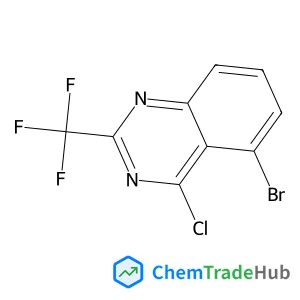
5-Bromo-4-chloro-2-(trifluoromethyl)quinazoline
CAS Number:
2089311-03-3
Molecular Formula:
C9H3BrClF3N2

![2-morpholino-2-[2-(trifluoromethyl)pyrimidin-5-yl]ethanamine structure](https://static.chemtradehub.com/structs/119/1192570-20-9-2810.webp "2-morpholino-2-[2-(trifluoromethyl)pyrimidin-5-yl]ethanamine structure")
2-morpholino-2-[2-(trifluoromethyl)pyrimidin-5-yl]ethanamine
CAS Number:
1192570-20-9
Molecular Formula:
C11H15F3N4O
Recommended Suppliers






Disclaimer
This page provides academic journal information for reference and research purposes only. We are not affiliated with any journal publishers and do not handle publication submissions. For publication-related inquiries, please contact the respective journal publishers directly.
If you notice any inaccuracies in the information displayed, please contact us at support@chemtradehub.com. We will promptly review and address your concerns.