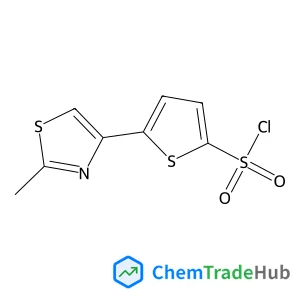
5-(2-Methyl-1,3-thiazol-4-yl)-2-thiophenesulfonyl chloride
CAS Number:
215434-25-6
Molecular Formula:
C8H6ClNO2S3
Matteo Balestrieri, Silviu Colis, Mathieu Gallart, Guy Schmerber, Paul Bazylewski, Gap Soo Chang, Marc Ziegler, Pierre Gilliot, Abdelilah Slaoui, Aziz Dinia
CeO2 is a promising material for applications in optoelectronics and photovoltaics due to its large band gap and values of the refractive index and lattice parameters, which are suitable for silicon-based devices. In this study, we show that trivalent Sm, Nd and Yb ions can be successfully inserted and optically activated in CeO2 films grown at a relatively low deposition temperature (400 °C), which is compatible with inorganic photovoltaics. CeO2 thin films can therefore be efficiently functionalized with photon-management properties by doping with trivalent rare earth (RE) ions. Structural and optical analyses provide details of the electronic level structure of the films and of their energy transfer mechanisms. In particular, we give evidence of the existence of an absorption band centered at 350 nm from which energy transfer to rare earth ions occurs. The transfer mechanisms can be completely explained only by considering the spontaneous migration of Ce3+ ions in CeO2 at a short distance from the RE3+ ions. The strong absorption cross section of the f–d transitions in Ce3+ ions efficiently intercepts the UV photons of the solar spectrum and therefore strongly increases the potential of these layers as downshifters and downconverters.

Critical Reviews in Solid State and Materials Sciences

Journal of the Indian Institute of Science

Atomization and Sprays

Heteroatom Chemistry

Polycyclic Aromatic Compounds

Journal of Asian Natural Products Research

Cellulose

Electroanalysis

Journal of Chemical Sciences

Bioorganic & Medicinal Chemistry Letters
Leilei Huang, Hui Nie, Yingzi Li, Lixing Song
DOI: 10.1039/D0MD00372G
DOI: 10.1039/D0MD00376J
Kaitlind C. Howard, Octavio A. Gonzalez, Sylvie Garneau-Tsodikova
DOI: 10.1039/D0MD00424C
Samir Yahiaoui, Katrin Voos, Jörg Haupenthal, Thomas A. Wichelhaus, Denia Frank, Lilia Weizel, Marco Rotter, Steffen Brunst, Jan S. Kramer, Ewgenij Proschak, Christian Ducho
DOI: 10.1039/D1MD00187F
Neetu Dayal
DOI: 10.1039/D1MD00211B
Samantha J. Bann, Ross D. Ballantine, Stephen A. Cochrane
DOI: 10.1039/D0MD00413H
Michael S. Bodnarchuk, Doyle J. Cassar, Jason G. Kettle, Graeme Robb, Richard A. Ward
DOI: 10.1039/D1MD00055A
Bhagyashri Rathod, Shivam Chak, Sagarkumar Patel, Amit Shard
DOI: 10.1039/D1MD00045D
Ali Nakhi, Henry L. Wong, Peter I. Dosa
DOI: 10.1039/D0MD00425A
Waste containing 6-Chloro-5-(2'-hydroxy-3'-methoxy-4-biphenylyl)-3-(3-methoxyphe...
(3alpha,5alpha)-3-Hydroxypregnane-11,20-dione is primarily used in the pharmaceu...
The market for 4-Amino-6-chloro-2-pyridinecarboxylic acid (CAS: 546141-56-4) is ...
Alternatives to (2-Benzoylethyl)trimethylammonium chloride (CAS: 24472-88-6) in ...
N-[4-Nitro-3-(trifluoromethyl)phenyl]acetamide (CAS: 393-12-4) is generally safe...
Alternative reagents such as other phosphates or similar functional groups can b...
There are alternatives to N,N'-Bis(3-aminopropyl)-1,3-propanediamine (CAS: 4605-...
When handling Aluminium trihexadecanoate, it is important to use appropriate per...
(1,1-Dioxido-3-oxo-1,2-benzothiazol-2(3H)-yl)acetic acid is a chemical compound ...
Several alternatives to 5,5-dimethyloxolan-2-one (CAS: 3123-97-5) can be used in...

Physical Chemistry Chemical Physics (PCCP) is an international journal co-owned by 19 physical chemistry and physics societies from around the world. This journal publishes original, cutting-edge research in physical chemistry, chemical physics and biophysical chemistry. To be suitable for publication in PCCP, articles must include significant innovation and/or insight into physical chemistry; this is the most important criterion that reviewers and Editors will judge against when evaluating submissions. The journal has a broad scope and welcomes contributions spanning experiment, theory, computation and data science. Topical coverage includes spectroscopy, dynamics, kinetics, statistical mechanics, thermodynamics, electrochemistry, catalysis, surface science, quantum mechanics, quantum computing and machine learning. Interdisciplinary research areas such as polymers and soft matter, materials, nanoscience, energy, surfaces/interfaces, and biophysical chemistry are welcomed if they demonstrate significant innovation and/or insight into physical chemistry. Joined experimental/theoretical studies are particularly appreciated when complementary and based on up-to-date approaches.
-1,2-cyclohexanediamine structure](https://static.chemtradehub.com/structs/928/928769-12-4-a4f0.webp "N,N'-Bis[3-(2-methoxyphenyl)-2-hydroxybenzyl](1R,2R)-1,2-cyclohexanediamine structure")