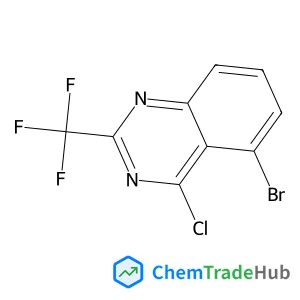
5-Bromo-4-chloro-2-(trifluoromethyl)quinazoline
CAS Number:
2089311-03-3
Molecular Formula:
C9H3BrClF3N2
Wenshuo Wang, Cornelia Damm, Johannes Walter, Thomas J. Nacken, Wolfgang Peukert
In this work we performed a detailed investigation of the photostability of bottom-up produced carbon nanodots (CDs) prepared from citric acid and urea by solvothermal synthesis. Analytical ultracentrifugation (AUC) reveals that the CDs have a hydrodynamic diameter of <1 nm and a very narrow size distribution. In the community it is widely assumed that CDs are photo-stable. In contrast, we found that CDs exposed to UV-irradiation exhibit noteworthy fluorescence degeneration compared to freshly prepared CDs or CDs stored in the dark, indicating that fluorescence bleaching is caused by a photochemical process. We found that fluorescence intensity decay due to exposure to UV-irradiation is accelerated in the presence of oxygen and identified the surface status of CDs as the decisive factor of fluorescence bleaching of CDs. Based on a discussion on the underlying mechanisms we show how to avoid photobleaching of CDs.

Critical Reviews in Solid State and Materials Sciences

Main Group Chemistry

Journal of the Indian Institute of Science

Bioorganic & Medicinal Chemistry

Chinese Journal of Chemistry

Heteroatom Chemistry

NDT & E International

Bioorganic & Medicinal Chemistry Letters

Herald of the Russian Academy of Sciences

Topics in Catalysis
Kleinberg X. Fernandez, Conrad Fischer, Jennie Vu, Samantha Gottschalk, John C. Vederas
DOI: 10.1039/D1MD00120E
Hyunsoo Kim, Yoon Soo Hwang, Mingi Kim
DOI: 10.1039/D1MD00068C
Jay Prakash Soni, Yogesh Yeole, Nagula Shankaraiah
DOI: 10.1039/D0MD00422G
Lauren L. Grant, Clarissa S. Sit
DOI: 10.1039/D1MD00074H
Padma Akkapeddi, Kai Wen Teng
DOI: 10.1039/D1MD00188D
Samir Yahiaoui, Katrin Voos, Jörg Haupenthal, Thomas A. Wichelhaus, Denia Frank, Lilia Weizel, Marco Rotter, Steffen Brunst, Jan S. Kramer, Ewgenij Proschak, Christian Ducho
DOI: 10.1039/D1MD00187F
Jeanette R. McConnell, H. Jane Dyson, Shelli R. McAlpine
DOI: 10.1039/D0MD00387E
H. Ratni, K. Baumann, P. Bellotti, X. A. Cook, L. G. Green, T. Luebbers, M. Reutlinger, A. F. Stepan, W. Vifian
DOI: 10.1039/D1MD00043H
Matthias R. Bauer, Paolo Di Fruscia, Simon C. C. Lucas, Iacovos N. Michaelides, Jennifer E. Nelson, R. Ian Storer, Benjamin C. Whitehurst
DOI: 10.1039/D0MD00370K
Waste containing 6-Chloro-5-(2'-hydroxy-3'-methoxy-4-biphenylyl)-3-(3-methoxyphe...
(3alpha,5alpha)-3-Hydroxypregnane-11,20-dione is primarily used in the pharmaceu...
The market for 4-Amino-6-chloro-2-pyridinecarboxylic acid (CAS: 546141-56-4) is ...
Alternatives to (2-Benzoylethyl)trimethylammonium chloride (CAS: 24472-88-6) in ...
N-[4-Nitro-3-(trifluoromethyl)phenyl]acetamide (CAS: 393-12-4) is generally safe...
Alternative reagents such as other phosphates or similar functional groups can b...
There are alternatives to N,N'-Bis(3-aminopropyl)-1,3-propanediamine (CAS: 4605-...
When handling Aluminium trihexadecanoate, it is important to use appropriate per...
(1,1-Dioxido-3-oxo-1,2-benzothiazol-2(3H)-yl)acetic acid is a chemical compound ...
Several alternatives to 5,5-dimethyloxolan-2-one (CAS: 3123-97-5) can be used in...

Physical Chemistry Chemical Physics (PCCP) is an international journal co-owned by 19 physical chemistry and physics societies from around the world. This journal publishes original, cutting-edge research in physical chemistry, chemical physics and biophysical chemistry. To be suitable for publication in PCCP, articles must include significant innovation and/or insight into physical chemistry; this is the most important criterion that reviewers and Editors will judge against when evaluating submissions. The journal has a broad scope and welcomes contributions spanning experiment, theory, computation and data science. Topical coverage includes spectroscopy, dynamics, kinetics, statistical mechanics, thermodynamics, electrochemistry, catalysis, surface science, quantum mechanics, quantum computing and machine learning. Interdisciplinary research areas such as polymers and soft matter, materials, nanoscience, energy, surfaces/interfaces, and biophysical chemistry are welcomed if they demonstrate significant innovation and/or insight into physical chemistry. Joined experimental/theoretical studies are particularly appreciated when complementary and based on up-to-date approaches.