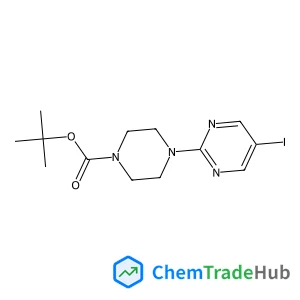
2-Methyl-2-propanyl 4-(5-iodo-2-pyrimidinyl)-1-piperazinecarboxylate
CAS Number:
1027616-32-5
Molecular Formula:
C13H19IN4O2
Yan Li, Xiang Li, Zigang Dong
Fatty acid binding protein 4 (FABP4), reversibly binding to fatty acids and other lipids with high affinities, is a potential target for treatment of cancers. The binding site of FABP4 is buried in an interior cavity and thereby ligand binding/unbinding is coupled with opening/closing of FABP4. It is a difficult task both experimentally and computationally to illuminate the entry or exit pathway, especially with the conformational gating. In this report we combine extensive computer simulations, clustering analysis, and the Markov state model to investigate the binding mechanism of FABP4 and troglitazone. Our simulations capture spontaneous binding and unbinding events as well as the conformational transition of FABP4 between the open and closed states. An allosteric binding site on the protein surface is recognized for the development of novel FABP4 inhibitors. The binding affinity is calculated and compared with the experimental value. The kinetic analysis suggests that ligand residence on the protein surface may delay the binding process. Overall, our results provide a comprehensive picture of ligand diffusion on the protein surface, ligand migration into the buried cavity, and the conformational change of FABP4 at an atomic level.
Chun Mei Li, Lei Zhan, Lin Ling Zheng, Yuan Fang Li
DOI: 10.1039/C6AN00489J
Yuanyuan Wang, Zhaopeng Yu, Zhen Zhang, Shusheng Zhang
DOI: 10.1039/C6AN00160B
Elena Tsolaki, Louis Didierlaurent, Samuel Staubli, Robert Zboray, Antonia Neels, Dörthe Dietrich, Pius Manser, Lotus May Desbiolles, Sebastian Leschka, Simon Wildermuth, Sandro Lehner, Pascale Chavatte-Palmer, Wolfram Jochum, Peter Wick, Tina Bürki-Turnherr, Tina Fischer, René Hornung, Sergio Bertazzo
DOI: 10.1039/C9AN01312A
Qi Kang, Dazhong Shen, Yunqing Wang
DOI: 10.1039/C9AN01694E
Nirmal Goswami, Huang-Hao Yang, Jianping Xie
DOI: 10.1039/C6AN00773B
Alain Wuethrich, Aswin Raj Rajkumar, Karthik Balaji Shanmugasundaram, Kamil K. Reza, Shuvashis Dey, Christopher B. Howard
DOI: 10.1039/C9AN01450K
Xia Cheng, Caili Xu, Qian Chen, Yi Wang, Yun Zhang, Guangyin Fan
DOI: 10.1039/C9AN01480B
Waste containing 6-Chloro-5-(2'-hydroxy-3'-methoxy-4-biphenylyl)-3-(3-methoxyphe...
(3alpha,5alpha)-3-Hydroxypregnane-11,20-dione is primarily used in the pharmaceu...
The market for 4-Amino-6-chloro-2-pyridinecarboxylic acid (CAS: 546141-56-4) is ...
Alternatives to (2-Benzoylethyl)trimethylammonium chloride (CAS: 24472-88-6) in ...
N-[4-Nitro-3-(trifluoromethyl)phenyl]acetamide (CAS: 393-12-4) is generally safe...
Alternative reagents such as other phosphates or similar functional groups can b...
There are alternatives to N,N'-Bis(3-aminopropyl)-1,3-propanediamine (CAS: 4605-...
When handling Aluminium trihexadecanoate, it is important to use appropriate per...
(1,1-Dioxido-3-oxo-1,2-benzothiazol-2(3H)-yl)acetic acid is a chemical compound ...
Several alternatives to 5,5-dimethyloxolan-2-one (CAS: 3123-97-5) can be used in...

Physical Chemistry Chemical Physics (PCCP) is an international journal co-owned by 19 physical chemistry and physics societies from around the world. This journal publishes original, cutting-edge research in physical chemistry, chemical physics and biophysical chemistry. To be suitable for publication in PCCP, articles must include significant innovation and/or insight into physical chemistry; this is the most important criterion that reviewers and Editors will judge against when evaluating submissions. The journal has a broad scope and welcomes contributions spanning experiment, theory, computation and data science. Topical coverage includes spectroscopy, dynamics, kinetics, statistical mechanics, thermodynamics, electrochemistry, catalysis, surface science, quantum mechanics, quantum computing and machine learning. Interdisciplinary research areas such as polymers and soft matter, materials, nanoscience, energy, surfaces/interfaces, and biophysical chemistry are welcomed if they demonstrate significant innovation and/or insight into physical chemistry. Joined experimental/theoretical studies are particularly appreciated when complementary and based on up-to-date approaches.