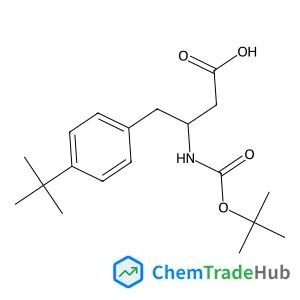
(S)-3-((tert-Butoxycarbonyl)amino)-4-(4-(tert-butyl)phenyl)butanoic acid
CAS Number:
403661-85-8
Molecular Formula:
C19H29NO4
Ondřej Jankovský, David Sedmidubský, Petr Šimek, Kateřina Klímová, Daniel Bouša, Chris Boothroyd, Zdeněk Sofer
The separation of rare metals from the ores and commercially available compounds is an important issue due to the need of their high purity in advanced materials and devices. Important examples of two highly important elements that co-exist in the ores are scandium and thorium. Scandium containing ores and consequently also commercially available scandium compounds often contain traces of thorium which is very difficult to separate. We used graphene oxide for the selective sorption of thorium ions from scandium and thorium mixtures originating from the mined ores as well as from commercially available scandium salts. Our results showed that graphene oxide has an extreme affinity towards thorium ions. After the sorption process the graphene oxide contained over 20 wt% of thorium while the amount of scandium sorbed on GO was very low. This phenomenon of high sorption selectivity of graphene oxide can be applied in industry for the purification of various chemicals containing scandium and for separation of thorium containing mixtures. Alternatively, this methodology can be used for preconcentration of thorium from low-grade ores and its further use in the new generation of nuclear reactors.
P. Clapés, A. Szekrenyi
DOI: 10.1039/C3GC42140F
Yoshinao Nakagawa, Momoko Ishikawa, Masazumi Tamura, Keiichi Tomishige
DOI: 10.1039/C3GC42322K
Sui Yung Chan, Tai-Shung Chung
DOI: 10.1039/C3GC41634H
José Luis Núñez-Rico, Héctor Fernández-Pérez
DOI: 10.1039/C3GC42132E
Zhongkui Zhao, Hongling Yang, Yu Li, Xinwen Guo
DOI: 10.1039/C3GC42049C
Laura Getrey, Thomas Krieg, Frank Hollmann, Jens Schrader, Dirk Holtmann
DOI: 10.1039/C3GC42269K
Xiu-Jie Yang, Bin Chen, Li-Qiang Zheng, Li-Zhu Wu
DOI: 10.1039/C3GC42042F
Airong Xu, Jianji Wang
DOI: 10.1039/C3GC41733F
Gregory Chatel, Jorge F. B. Pereira, Varun Debbeti, Hui Wang, Robin D. Rogers
DOI: 10.1039/C3GC41389F
When handling 4-Methyl-6-(trifluoromethyl)quinoline (CAS: 40716-16-3), safety go...
4-(3,5-Difluorophenyl)aniline is an aromatic organic compound with the CAS numbe...
5-{[4-(Trifluoromethyl)phenyl]sulfanyl}-1,2,3-thiadiazole-4-carboxylic acid can ...
The market for 4-Benzylaniline hydrochloride (CAS: 6317-57-3) is steadily growin...
[3-(Diethylsulfamoyl)phenyl]boronic acid is generally considered safe when handl...
3-Bromo-2,5-dimethoxyaniline is mainly used in the pharmaceutical and chemical i...
N-Methyl-1-(5-methyl-1H-indol-3-yl)methanamine (CAS: 915922-67-7) is subject to ...
This compound is primarily used in the pharmaceutical industry for the synthesis...
2-Methyl-2-propanyl [(1S,3R)-3-aminocyclohexyl]carbamate (CAS: 1298101-47-9) sho...
Ethyl 2-bromo-4,4,4-trifluorobutanoate (CAS: 367-33-9) is utilized in the pharma...

Physical Chemistry Chemical Physics (PCCP) is an international journal co-owned by 19 physical chemistry and physics societies from around the world. This journal publishes original, cutting-edge research in physical chemistry, chemical physics and biophysical chemistry. To be suitable for publication in PCCP, articles must include significant innovation and/or insight into physical chemistry; this is the most important criterion that reviewers and Editors will judge against when evaluating submissions. The journal has a broad scope and welcomes contributions spanning experiment, theory, computation and data science. Topical coverage includes spectroscopy, dynamics, kinetics, statistical mechanics, thermodynamics, electrochemistry, catalysis, surface science, quantum mechanics, quantum computing and machine learning. Interdisciplinary research areas such as polymers and soft matter, materials, nanoscience, energy, surfaces/interfaces, and biophysical chemistry are welcomed if they demonstrate significant innovation and/or insight into physical chemistry. Joined experimental/theoretical studies are particularly appreciated when complementary and based on up-to-date approaches.
![Imidazo[1,2-c]pyrimidine structure](https://static.chemtradehub.com/structs/274/274-78-2-8b4c.webp "Imidazo[1,2-c]pyrimidine structure")