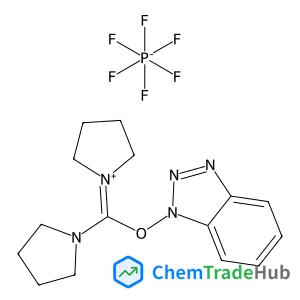
(1H-Benzotriazol-1-yloxy)(di-1-pyrrolidinyl)methylium hexafluorophosphate
CAS Number:
105379-24-6
Molecular Formula:
C15H21F6N5OP
N. J. A. Coughlan, B. D. Adamson, L. Gamon, K. Catani, E. J. Bieske
Retinal is one of Nature's most important and widespread chromophores, exhibiting remarkable versatility in its function and spectral response, depending on its protein environment. Reliable spectroscopic and photochemical data for the isolated retinal molecule are essential for calibrating theoretical approaches that seek to model retinal's behaviour in complex protein environments. However, due to low densities and possible co-existence of multiple isomers, retinal is a challenging target for gas-phase investigations. Here, the photoisomerization behaviour of the trans isomer of the retinal protonated Schiff base (RPSB) is investigated in the gas phase by irradiating mobility-selected RPSB ions with tunable light in a tandem ion mobility spectrometer. trans RPSB ions are converted to single cis isomers and also more compact isomers through irradiation with visible light. The S1 ← S0 photoisomerization action spectrum of trans RPSB, obtained by monitoring production of cis isomers as a function of wavelength, exhibits a single well-defined peak with a maximum at 618 ± 5 nm. Corresponding action spectra of cis RPSB isomers exhibit broader peaks, conclusively demonstrating an isomeric dependence for the RPSB spectrum in the gas phase.
Sunghyun Uhm
DOI: 10.1039/C3CP50885D
Andrew P. Ault, Defeng Zhao, Carlena J. Ebben, Michael J. Tauber, Franz M. Geiger, Vicki H. Grassian
DOI: 10.1039/C3CP43899F
Luis Gómez-Hortigüela, Furio Corà, C. Richard A. Catlow
DOI: 10.1039/C3CP51079D
Changqing Liu, Xiaobo Ji, Pingmin Zhang, Qiyuan Chen, Craig E. Banks
DOI: 10.1039/C3CP44171G
Lijia Liu, Tsun-Kong Sham, Weiqiang Han
DOI: 10.1039/C3CP50498K
Benedetta Mennucci
DOI: 10.1039/C3CP44417A
Guilherme Oliveira Siqueira, Tulio Matencio, Herculano Vieira da Silva, Yara Gonçalves de Souza, José Domingos Ardisson, Geraldo Magela de Lima, Arilza de Oliveira Porto
DOI: 10.1039/C3CP50549A
Venkata Bharat Ram Boppana, Feng Jiao, Dave Newby, Jr., Jude Laverock, Kevin E. Smith, Jean Claude Jumas, Greg Hutchings, Raul F. Lobo
DOI: 10.1039/C3CP44635B
M. Sadeghi
DOI: 10.1039/C3CP44563A
Amitaksha Saha, Chellappan Vijila, Rajan Jose, Zhang Jie, Seeram Ramakrishna
DOI: 10.1039/C3CP50994J
When handling 4-(2-Furylmethyl)thiomorpholine 1,1-dioxide (CAS: 79206-94-3), it ...
When handling 4-Chloro-N-[2-(4-morpholinyl)ethyl]benzamide (CAS: 71320-77-9), it...
Waste containing this compound (CAS: 62921-74-8) should be handled according to ...
Waste containing (S)-Methyl 2-amino-3-cyclohexylpropanoate should be collected i...
This compound can be synthesized using a multi-step process involving the conjug...
There are several alternatives to (2E)-3-(3,4-Dichlorophenyl)acrylic acid in syn...
Ethyl 6-(2-nitrophenyl)imidazo[2,1-b][1,3]thiazole-3-carboxylate (CAS: 925437-84...
Waste containing 2-(1,3-Thiazol-2-yl)ethanamine (CAS: 18453-07-1) should be coll...
Methyl 5-iodo-2-methylbenzoate can be synthesized through the iodination of meth...
5-Chloro[1,2,4]triazolo[1,5-a]pyridine is commonly synthesized via the condensat...

Physical Chemistry Chemical Physics (PCCP) is an international journal co-owned by 19 physical chemistry and physics societies from around the world. This journal publishes original, cutting-edge research in physical chemistry, chemical physics and biophysical chemistry. To be suitable for publication in PCCP, articles must include significant innovation and/or insight into physical chemistry; this is the most important criterion that reviewers and Editors will judge against when evaluating submissions. The journal has a broad scope and welcomes contributions spanning experiment, theory, computation and data science. Topical coverage includes spectroscopy, dynamics, kinetics, statistical mechanics, thermodynamics, electrochemistry, catalysis, surface science, quantum mechanics, quantum computing and machine learning. Interdisciplinary research areas such as polymers and soft matter, materials, nanoscience, energy, surfaces/interfaces, and biophysical chemistry are welcomed if they demonstrate significant innovation and/or insight into physical chemistry. Joined experimental/theoretical studies are particularly appreciated when complementary and based on up-to-date approaches.

![1-Naphthalenesulfonic acid, 2-[(2-hydroxy-1-naphthalenyl)azo]-, bariumsalt (2:1) structure](https://static.chemtradehub.com/structs/110/1103-38-4-0b33.webp "1-Naphthalenesulfonic acid, 2-[(2-hydroxy-1-naphthalenyl)azo]-, bariumsalt (2:1) structure")