












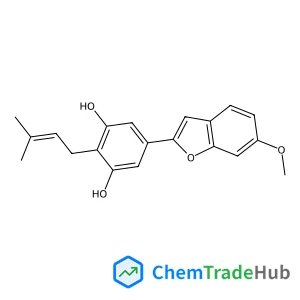
5-(6-Methoxy-1-benzofuran-2-yl)-2-(3-methyl-2-buten-1-yl)-1,3-benzenediol
CAS Number:
1017277-40-5
Molecular Formula:
C20H20O4
Denis Augusto Turchetti, Mariela Martins Nolasco, Daiane Szczerbowski, Luís Dias Carlos, Leni Campos Akcelrud
The photophysical properties of a new alternating copolymer containing fluorene, terpyridine, and complexed sites with trivalent europium (Eu3+) ions (LaPPS66Eu) were investigated, using the non-complexed backbone (LaPPS66) and a low molecular weight compound of similar chemical structure of the ligand/Eu3+ site (LaPPS66M) as a model compound. The analogous gadolinium complex (LaPPS66Gd) was also synthesized to determine the triplet state of the complex. 1H and 13C nuclear magnetic resonance (NMR) analysis, Fourier transform infrared (FT-IR) spectroscopy, inductively coupled plasma optical emission spectroscopy (ICP-OES), elemental analyses, differential scanning calorimetry (DSC), and thermogravimetric analysis (TGA) characterized the chemical structure and thermal properties of the synthesized materials. A level of Eu3+ insertion of 37% (molar basis) in the polymer backbone was achieved. The photoluminescence studies were performed in the solid state showing the occurrence of polymer-to-Eu3+ energy transfer brought about by the spectral overlap between the absorption spectra of the Eu3+ complex and the emission of the polymer backbone. A detailed theoretical photoluminescence study performed using time-dependent DFT (TD-DFT) calculations and the recently developed LUMPAC luminescence package is also presented. The high accuracy of the theoretical calculations was achieved on comparison with the experimental values. Aiming at a deeper level of understanding of the photoluminescence process, the ligand-to-Eu3+ intramolecular energy transfer and back-transfer rates were predicted. The complexed materials showed a dominant pathway involving the energy transfer between the triplet of the dbm (dibenzoylmethane) ligand and the 5D1 and 5D0 Eu3+ levels.
Rassmus Andersson, Guiomar Hernández, Jonas Mindemark
DOI: 10.1039/D2CP01904C
Rajamouli Boddula
DOI: 10.1039/D2CP01934E
Trey Oldham, Shurik Yatom
DOI: 10.1039/D2CP00203E
Valentina Zhelyazkova, Fernanda B. V. Martins, Frédéric Merkt
DOI: 10.1039/D1CP05861D
Aaron D. Nicholas, Leah C. Garman, Nicolina Albano, Christopher L. Cahill
DOI: 10.1039/D2CP01996E
David Wilian Oliveira de Sousa, Marco Antonio Chaer Nascimento
DOI: 10.1039/D2CP00841F
Yilin Liu, Jincai Su, Fei Duan, Xin Cui, Weichao Yan, Liwen Jin
DOI: 10.1039/D2CP01411D
Robert C. Dickson, Troy D. Manning, Edwin S. Raj, Jonathan C. S. Booth, Matthew J. Rosseinsky, Matthew S. Dyer
DOI: 10.1039/D2CP02180C
Thomas Weymuth, Markus Reiher
DOI: 10.1039/D2CP01725C
Beatriz Pérez-González, Álvaro Gómez-León, Gloria Platero
DOI: 10.1039/D2CP01806C
When handling 2-Methyl-2-propanyl 5-amino-2-thiophenecarboxylate (CAS: 1498311-5...
5-Bromo-1,2-dichloro-3-fluorobenzene (CAS: 1000572-93-9) is a crystalline solid ...
(2R)-2-Amino-2-(4-bromophenyl)ethanol (CAS: 354153-64-3) should be stored in a c...
Methyl 4-(aminomethyl)tetrahydro-2H-pyran-4-carboxylate hydrochloride (CAS: 3627...
1,4-Dimethyl-1H-pyrazole-5-sulfonyl chloride is primarily used as an intermediat...
Dinaphtho[1,2-b:2',1'-d]furan is generally safe when handled with appropriate pe...
The market for 7-Methyl-7,9-dihydro-1H-purine-2,6,8(3H)-trione (CAS: 612-37-3) i...
2-(4-Chlorophenyl)malonaldehyde (CAS: 205676-17-1) is a colorless or light yello...
2-Methylchrysene (CAS: 3351-32-4) is typically synthesized via the reaction of c...
N-(6-aminopyrimidin-4-yl)acetamide (CAS: 89533-23-3) is generally considered saf...

Physical Chemistry Chemical Physics (PCCP) is an international journal co-owned by 19 physical chemistry and physics societies from around the world. This journal publishes original, cutting-edge research in physical chemistry, chemical physics and biophysical chemistry. To be suitable for publication in PCCP, articles must include significant innovation and/or insight into physical chemistry; this is the most important criterion that reviewers and Editors will judge against when evaluating submissions. The journal has a broad scope and welcomes contributions spanning experiment, theory, computation and data science. Topical coverage includes spectroscopy, dynamics, kinetics, statistical mechanics, thermodynamics, electrochemistry, catalysis, surface science, quantum mechanics, quantum computing and machine learning. Interdisciplinary research areas such as polymers and soft matter, materials, nanoscience, energy, surfaces/interfaces, and biophysical chemistry are welcomed if they demonstrate significant innovation and/or insight into physical chemistry. Joined experimental/theoretical studies are particularly appreciated when complementary and based on up-to-date approaches.
![1-Oxa-8-azaspiro[4.5]decan-3-ol structure](https://static.chemtradehub.com/structs/757/757239-76-2-a0ec.webp "1-Oxa-8-azaspiro[4.5]decan-3-ol structure")
![2-Bromo-7-chloro-4H-pyrrolo[2,3-b]pyrazine structure](https://static.chemtradehub.com/structs/115/1150617-58-5-0b0a.webp "2-Bromo-7-chloro-4H-pyrrolo[2,3-b]pyrazine structure")





