













Temperature-dependent nanomorphology–performance relations in binary iridium complex blend films for organic light emitting diodes
Literature Information
Publication Date
2015-07-17
DOI
10.1039/C5CP03436A
Impact Factor
3.676
Authors
Young-Tae Kim, Young-Hoon Kim, Tae-Woo Lee
View Original
Abstract
Understanding the mechanism responsible for the temperature-dependent performances of emitting layers is essential for developing advanced phosphorescent organic light emitting diodes. We described the morphological evolution occurring in PVK:Ir(ppy)3 binary blend films, with respect to thermal annealing up to 300 °C, by coupling atomic force microscopy and transmission electron microscopy. In particular, in situ temperature-dependent experimental characterization was performed to directly determine the overall sequence of morphological evolution occurring in the films. The device thermally annealed at 200 °C exhibits a noticeable enhancement in the performances, compared to the devices in the as-processed state and to the devices annealed at 300 °C. Our approaches reveal that the Ir(ppy)3 molecules, with a needle-like structure in the as-processed state, were aggregated, and thus diffused into PVK without a morphological change at the temperature regime between 150 °C and 200 °C. Moreover, both network-like and droplet patterns existed in the devices annealed at 300 °C, which was beyond the glass temperature of PVK, leading to a profound increase in the surface roughness. The observed pattern formation is discussed in terms of viscoelastic phase separation. Based on our experimental findings, we propose that the performances of the devices are significantly controlled by the diffusion of dopant molecules and the morphological evolution of the host materials in binary blend systems.
Related Literature
N-Acetoxy-phthalimide (NAPI) as a new H-abstracting agent at high temperature: application to the melt functionalization of polyethylene
Denis Bélékian, Philippe Cassagnau, Jean-Jacques Flat, Sébastien Quinebeche, Laurent Autissier, Denis Bertin, Didier Siri, Didier Gigmes, Yohann Guillaneuf, Philippe Chaumont, Emmanuel Beyou
2013-03-15
Communication
DOI: 10.1039/C3PY00246B
Vinyl-monomer with lysine side chains for preparing copolymer surfaces with fibrinolytic activity
Zengchao Tang, Dan Li, Xiaoli Liu, Zhaoqiang Wu, Wei Liu, Hong Chen
2012-12-07
Paper
DOI: 10.1039/C2PY20944F
Pillar[5]arene–neutral guest recognition based supramolecular alternating copolymer containing [c2]daisy chain and bis-pillar[5]arene units
Xiaoyang Wang, Kang Han, Jian Li, Xueshun Jia
2013-05-01
Paper
DOI: 10.1039/C3PY00462G
Triphenylphosphine as phosphorus catalyst for reversible chain-transfer catalyzed polymerization (RTCP)
Liangjiu Bai, Lifen Zhang, Yuan Liu, Xiangqiang Pan, Zhenping Cheng, Xiulin Zhu
2013-03-04
Paper
DOI: 10.1039/C3PY00187C
SET-LRP synthesis of novel polyallene-based well-defined amphiphilic graft copolymers in acetone
Guolin Lu, Yongjun Li, Hao Guo, Weiyuan Du, Xiaoyu Huang
2013-03-05
Paper
DOI: 10.1039/C3PY00145H
Optimization, automation and validation of the large-scale radiosynthesis of Al18F tracers in a custom-made automatic platform for high yield
Zhiguo Liu, Lun Yu, Kai Cheng, Yabo Feng, Pengfei Qiu, Yongkang Gai, Ming Zhou
2020-06-04
Paper
DOI: 10.1039/D0RE00144A
Protecting-group-free synthesis of chain-end multifunctional polymers by combining ATRP with thiol–epoxy ‘click’ chemistry
Ikhlas Gadwal, Anzar Khan
2013-03-07
Communication
DOI: 10.1039/C3PY00136A
An effect on the side chain position of D–π–A-type conjugated polymers with sp2-hybridized orbitals for organic photovoltaics
Kwan Wook Song, Ho Jun Song, Tae Ho Lee, Soo Won Heo, Doo Kyung Moon
2013-03-12
Paper
DOI: 10.1039/C3PY00195D
One-pot controlled synthesis of double thermoresponsive N-vinylcaprolactam-based copolymers with tunable LCSTs
Anthony Kermagoret, Charles-André Fustin, Maxime Bourguignon, Christophe Detrembleur, Christine Jérôme, Antoine Debuigne
2013-02-18
Paper
DOI: 10.1039/C3PY00134B
You might also like
Compound Q&A
What is 1-(2,4,6-Trifluorophenyl)ethanol (CAS: 1250113-83-7)?
1-(2,4,6-Trifluorophenyl)ethanol is an organic compound with the CAS number 1250...
1250113-83-71-(2,4,6-Trifluoroph...
Compound Q&A
Is 1-(2,4-Dimethoxybenzyl)-4-(hydroxymethyl)-2-pyrrolidinone (CAS: 919111-34-5) safe?
1-(2,4-Dimethoxybenzyl)-4-(hydroxymethyl)-2-pyrrolidinone (CAS: 919111-34-5) is ...
919111-34-51-(2,4-Dimethoxybenz...
Compound Q&A
What are the physical and chemical properties of (7S,15R)-6β,15-Diacetoxy-7α,20-epoxy-7-hydroxykaura-2,16-dien-1-one (CAS: 51419-51-3)?
(7S,15R)-6β,15-Diacetoxy-7α,20-epoxy-7-hydroxykaura-2,16-dien-1-one is a crystal...
51419-51-3(7S,15R)-6β,15-Diace...
Compound Q&A
What regulatory guidelines apply to rac-ethyl (1r,4r)-4-hydroxycyclohexane-1-carboxylate, trans (CAS: 3618-04-0)?
The compound rac-ethyl (1r,4r)-4-hydroxycyclohexane-1-carboxylate, trans (CAS: 3...
3618-04-0rac-ethyl (1r,4r)-4-...
Compound Q&A
What is the market or research trend for 2-(2,4-Difluorophenoxy)-3-nitropyridine (CAS: 175135-62-3)?
The market for 2-(2,4-Difluorophenoxy)-3-nitropyridine (CAS: 175135-62-3) is cur...
175135-62-32-(2,4-Difluoropheno...
Compound Q&A
What are the main uses of 6-Diazo-5-oxo-L-norleucine (CAS: 157-03-9)?
The main uses of 6-Diazo-5-oxo-L-norleucine (CAS: 157-03-9) include research in ...
157-03-96-Diazo-5-oxo-L-norl...
Compound Q&A
What precautions should be taken when handling 2-Aminoethyl-mono-amide-DOTA-tris(tBu ester) (CAS: 173308-19-5)?
When handling 2-Aminoethyl-mono-amide-DOTA-tris(tBu ester) (CAS: 173308-19-5), i...
173308-19-52-Aminoethyl-mono-am...
Compound Q&A
How is 5-Methylimidazo[1,2-a]pyridine-3-carbaldehyde (CAS: 178488-37-4) typically synthesized?
5-Methylimidazo[1,2-a]pyridine-3-carbaldehyde (CAS: 178488-37-4) can be synthesi...
178488-37-45-Methylimidazo[1,2-...
Compound Q&A
Are there alternatives to 2,4,6-Trihydroxyisophthalaldehyde (CAS: 4396-13-8) in synthesis?
There are alternative reagents that can be used in the synthesis of 2,4,6-Trihyd...
4396-13-82,4,6-Trihydroxyisop...
Compound Q&A
What is (2Z)-3-(5-Fluoro-1H-indol-3-yl)-2-sulfanylacrylic acid (CAS: 179461-52-0)?
(2Z)-3-(5-Fluoro-1H-indol-3-yl)-2-sulfanylacrylic acid is a chemical compound wi...
179461-52-0(2Z)-3-(5-Fluoro-1H-...
Source Journal
Physical Chemistry Chemical Physics

CiteScore:
5.5
Self-citation Rate:
10.3%
Articles per Year:
3036
Physical Chemistry Chemical Physics (PCCP) is an international journal co-owned by 19 physical chemistry and physics societies from around the world. This journal publishes original, cutting-edge research in physical chemistry, chemical physics and biophysical chemistry. To be suitable for publication in PCCP, articles must include significant innovation and/or insight into physical chemistry; this is the most important criterion that reviewers and Editors will judge against when evaluating submissions. The journal has a broad scope and welcomes contributions spanning experiment, theory, computation and data science. Topical coverage includes spectroscopy, dynamics, kinetics, statistical mechanics, thermodynamics, electrochemistry, catalysis, surface science, quantum mechanics, quantum computing and machine learning. Interdisciplinary research areas such as polymers and soft matter, materials, nanoscience, energy, surfaces/interfaces, and biophysical chemistry are welcomed if they demonstrate significant innovation and/or insight into physical chemistry. Joined experimental/theoretical studies are particularly appreciated when complementary and based on up-to-date approaches.
Recommended Compounds
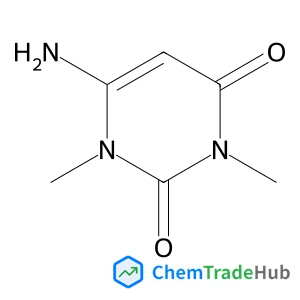
6-amino-1,3-dimethyl-1,2,3,4-tetrahydropyrimidine-2,4-dione
CAS Number:
6642-31-5
Molecular Formula:
C6H9N3O2
Recommended Suppliers




Disclaimer
This page provides academic journal information for reference and research purposes only. We are not affiliated with any journal publishers and do not handle publication submissions. For publication-related inquiries, please contact the respective journal publishers directly.
If you notice any inaccuracies in the information displayed, please contact us at support@chemtradehub.com. We will promptly review and address your concerns.