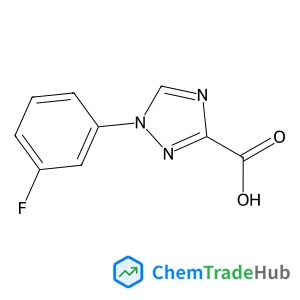
1-(3-Fluorophenyl)-1H-1,2,4-triazole-3-carboxylic acid
CAS Number:
1292369-51-7
Molecular Formula:
C9H6FN3O2
Extensive studies on thin films indicated a generic cubic current–voltage I–V dependence as a salient feature of charge transport by tunneling. A quick glance at I–V data for molecular junctions suggests a qualitatively similar behavior. This would render model-based studies almost irrelevant, since, whatever the model, its parameters can always be adjusted to fit symmetric (asymmetric) I–V curves characterized by two (three) expansion coefficients. Here, we systematically examine popular models based on tunneling barriers or tight-binding pictures and demonstrate that, for a quantitative description at biases of interest (V slightly higher than the transition voltage Vt), cubic expansions do not suffice. A detailed collection of analytical formulae as well as their conditions of applicability is presented to facilitate experimentalist colleagues to process and interpret their experimental data obtained by measuring currents in molecular junctions. We discuss in detail the limits of applicability of the various models and emphasize that uncritically adjusting the model parameters to experiment may be unjustified because the values deduced in this way may fall in ranges rendering a specific model invalid or incompatible to ab initio estimates. We exemplify with the benchmark case of oligophenylene-based junctions, for which the results of ab initio quantum chemical calculations are also reported. As a specific issue, we address the impact of the spatial potential profile and show that it is not notable up to biases V ≳ Vt, unlike at higher biases, where it may be responsible for negative differential resistance effects.
Patrick Taylor, Paul M. Lahti, Joseph B. Carroll, Vincent M. Rotello
DOI: 10.1039/B411389F
Lorenzo Malavasi, M. Cristina Mozzati, Cristina Tealdi, M. Rosa Pascarelli, Carlo B. Azzoni, Giorgio Flor
DOI: 10.1039/B403733B
Duncan J. Wardrop, Matthew S. Burge
DOI: 10.1039/B403081H
Stephanie A. Bejune, David R. McMillin
DOI: 10.1039/B402330G
Nihar R. Sarkar, Theresa Rosendahl, Aaron B. Krueger, Abir L. Banerjee, Keith Benton, Sanku Mallik, D. K. Srivastava
DOI: 10.1039/B416827E
Shu-Hong Zhang, Zhao-Xiong Xie, Zhi-Yuan Jiang, Xin Xu, Juan Xiang, Rong-Bin Huang, Lan-Sun Zheng
DOI: 10.1039/B315931K
Sandro Fracasso, Sebastiano Campagna, Scolastica Serroni, Rama Konduri, Frederick M. MacDonnell
DOI: 10.1039/B302962J
Michael Chi-Yung Tang, Kwok-Yin Wong, Tak Hang Chan
DOI: 10.1039/B416837B
Cristina Carcedo, Athanasia Dervisi, Ian A. Fallis, Liling Ooi, K. M. Abdul Malik
DOI: 10.1039/B401301H
Long Yi Jin, Jinyoung Bae, Jong-Hyun Ahn, Myongsoo Lee
DOI: 10.1039/B416089D
Waste containing N-Methoxy-N-methyl-1,3-thiazole-5-carboxamide (CAS: 898825-89-3...
N-(4-Biphenylyl)dibenzo[b,d]furan-4-amine should be stored in a tightly sealed c...
The market for 3-Acetamido-5-amino-2,4,6-triiodobenzoic acid (CAS: 1713-07-1) is...
Benzyl 2-O-acetyl-3,4,6-tri-O-benzyl-beta-D-galactopyranoside (CAS: 61820-03-9) ...
2-Ethylpiperazine dihydrochloride (CAS: 438050-52-3) is regulated under the Glob...
1,1'-[1,3-Phenylenebis(methylene)]bis(3-methyl-1H-pyrrole-2,5-dione) (CAS: 11946...
Several alternatives can be used in the synthesis of 5-Fluoro-2-(1-pyrrolidinyl)...
Proper personal protective equipment (PPE) must be worn when handling this compo...
When handling 6-Bromoimidazo[1,2-a]pyridin-8-amine, it is important to wear appr...
Alternatives to (2S,4R)-4-(4-Nitrobenzyl)pyrrolidine-2-carboxylic acid hydrochlo...

Physical Chemistry Chemical Physics (PCCP) is an international journal co-owned by 19 physical chemistry and physics societies from around the world. This journal publishes original, cutting-edge research in physical chemistry, chemical physics and biophysical chemistry. To be suitable for publication in PCCP, articles must include significant innovation and/or insight into physical chemistry; this is the most important criterion that reviewers and Editors will judge against when evaluating submissions. The journal has a broad scope and welcomes contributions spanning experiment, theory, computation and data science. Topical coverage includes spectroscopy, dynamics, kinetics, statistical mechanics, thermodynamics, electrochemistry, catalysis, surface science, quantum mechanics, quantum computing and machine learning. Interdisciplinary research areas such as polymers and soft matter, materials, nanoscience, energy, surfaces/interfaces, and biophysical chemistry are welcomed if they demonstrate significant innovation and/or insight into physical chemistry. Joined experimental/theoretical studies are particularly appreciated when complementary and based on up-to-date approaches.
![4-Chloro-2-{[(2-chlorophenoxy)acetyl]amino}benzoic acid structure](https://static.chemtradehub.com/structs/351/351424-20-9-9467.webp "4-Chloro-2-{[(2-chlorophenoxy)acetyl]amino}benzoic acid structure")
![2-Methylbenzo[h]quinoline structure](https://static.chemtradehub.com/structs/605/605-88-9-ac43.webp "2-Methylbenzo[h]quinoline structure")