












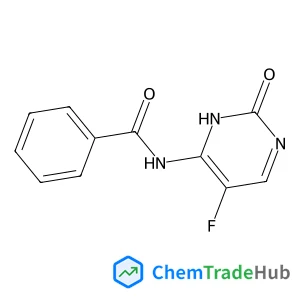
N-(5-Fluoro-2-oxo-2,3-dihydro-4-pyrimidinyl)benzamide
CAS Number:
10357-07-0
Molecular Formula:
C11H8FN3O2
An efficient carbon–polyaniline (PANI)-coated method was applied for perovskite-type oxide LaFeO3 to enhance its high-temperature electrochemical performance. Transmission electron microscopy (TEM) results reveal that LaFeO3 particles are evenly coated with carbon and PANI hybrid layers after carbon–PANI treatment. The carbon layers prevent the nanosized LaFeO3 particles from aggregation and allow the electrolyte to penetrate in every direction inside the particles. The PANI layers also enhance the electrocatalytic activity, facilitating hydrogen protons transferring from the electrolyte to the electrode interface. The cooperation of carbon and PANI hybrid layers results in a significant enhancement of the electrochemical performance at high temperatures. At an elevated temperature (60 °C), the maximum discharge capacity of the LaFeO3 electrodes remarkably increases from 231 mA h g−1 to 402 mA h g−1 and the high rate dischargeability at a discharge current density of 1500 mA g−1 (HRD1500) increases from 22.7% to 44.3%. Moreover, the hybrid layers mitigate the corrosion of LaFeO3 electrodes by reducing the loss of active materials in the alkaline electrolyte, leading to increase in the capacity retention rate from 67.1% to 77.6% after 100 cycles (S100).
Vikki Anand Varma, Simmie Jaglan, Mohd Yasir Khan, Sujin B. Babu
DOI: 10.1039/D3CP03681B
Jake A. Tan, Ka Un Lao
DOI: 10.1039/D3CP05437C
Jiali Nie, Ying Li, Dongyue Gao, Yi Fang, Jing Lin, Chengchun Tang, Zhonglu Guo
DOI: 10.1039/D3CP04718K
Umair Shamraiz, Abdul Majeed, Bareera Raza, Noor ul Ain, Amin Badshah
DOI: 10.1039/D3SE00942D
Robert Tirawat, Mengjin Yang, Severin N. Habisreutinger, Soňa Uličná, Ross A. Kerner, Kai Zhu, Laura T. Schelhas, Axel F. Palmstrom
DOI: 10.1039/D3SE01268A
Meixin Cheng
DOI: 10.1039/D3CP04975B
Licheng Liu, Deepak Pant
DOI: 10.1039/D3SE00876B
Yang Zhang, Wenxing Jiang, Zhenying Chen, Yingying Liu, Chengwei Deng, Xiaodong Zhuang, Junliang Zhang, Changchun Ke
DOI: 10.1039/D3SE01401K
Shengzhuo Chen, Juntian Niu, Xianrong Zheng, Haiyu Liu, Yan Jin, Jingyu Ran
DOI: 10.1039/D3CP05435G
Waste containing N-Methoxy-N-methyl-1,3-thiazole-5-carboxamide (CAS: 898825-89-3...
N-(4-Biphenylyl)dibenzo[b,d]furan-4-amine should be stored in a tightly sealed c...
The market for 3-Acetamido-5-amino-2,4,6-triiodobenzoic acid (CAS: 1713-07-1) is...
Benzyl 2-O-acetyl-3,4,6-tri-O-benzyl-beta-D-galactopyranoside (CAS: 61820-03-9) ...
2-Ethylpiperazine dihydrochloride (CAS: 438050-52-3) is regulated under the Glob...
1,1'-[1,3-Phenylenebis(methylene)]bis(3-methyl-1H-pyrrole-2,5-dione) (CAS: 11946...
Several alternatives can be used in the synthesis of 5-Fluoro-2-(1-pyrrolidinyl)...
Proper personal protective equipment (PPE) must be worn when handling this compo...
When handling 6-Bromoimidazo[1,2-a]pyridin-8-amine, it is important to wear appr...
Alternatives to (2S,4R)-4-(4-Nitrobenzyl)pyrrolidine-2-carboxylic acid hydrochlo...

Physical Chemistry Chemical Physics (PCCP) is an international journal co-owned by 19 physical chemistry and physics societies from around the world. This journal publishes original, cutting-edge research in physical chemistry, chemical physics and biophysical chemistry. To be suitable for publication in PCCP, articles must include significant innovation and/or insight into physical chemistry; this is the most important criterion that reviewers and Editors will judge against when evaluating submissions. The journal has a broad scope and welcomes contributions spanning experiment, theory, computation and data science. Topical coverage includes spectroscopy, dynamics, kinetics, statistical mechanics, thermodynamics, electrochemistry, catalysis, surface science, quantum mechanics, quantum computing and machine learning. Interdisciplinary research areas such as polymers and soft matter, materials, nanoscience, energy, surfaces/interfaces, and biophysical chemistry are welcomed if they demonstrate significant innovation and/or insight into physical chemistry. Joined experimental/theoretical studies are particularly appreciated when complementary and based on up-to-date approaches.

![4-[(2-{2-[2-(2-Aminoethoxy)ethoxy]ethoxy}ethyl)amino]-2-(2,6-dioxo-3-piperidinyl)-1H-isoindole-1,3(2H)-dione structure](https://static.chemtradehub.com/structs/209/2093416-31-8-3162.webp "4-[(2-{2-[2-(2-Aminoethoxy)ethoxy]ethoxy}ethyl)amino]-2-(2,6-dioxo-3-piperidinyl)-1H-isoindole-1,3(2H)-dione structure")

![tert-Butyl 6-chloro-4-oxospiro[chroman-2,4'-piperidine]-1'-carboxylate structure](https://static.chemtradehub.com/structs/101/1011482-37-3-88a5.webp "tert-Butyl 6-chloro-4-oxospiro[chroman-2,4'-piperidine]-1'-carboxylate structure")




