













Integrative electrochemical and biological catalysis for the mild and efficient utilization of renewable electricity and carbon resources
Literature Information
Publication Date
2023-12-06
DOI
10.1039/D3SE00876B
Impact Factor
6.367
Authors
Licheng Liu, Deepak Pant
View Original
Abstract
Chemical catalysis and biological catalysis both play important roles in producing various fuels, chemicals, and materials conventionally. In view of renewable resource (biomass and CO2) utilization, combining both chemical and biological catalysis would create revolutionary routes that are more sustainable and efficient for the processing of these resources. Considering that electricity is usually the main form of renewable energy, electrocatalysis also plays an important role. Therefore, integrative electrochemical and biological catalysis for the simultaneous utilization of renewable energy and resources is attracting significant attention. In this review, such integrative processes and methods are summarized and discussed in depth and two integration modes are distinguished based on the use of electroactive/non-electroactive microorganisms. Intermediate mediated consecutive synthesis from CO2 or biomass to specific chemicals is shown to play a pivotal role, such as H2 enhanced microbial electrosynthesis (MES) and CO or formate mediated longer carbon chain product synthesis. Accordingly, the synthesis efficiency was improved significantly following the collaborative design of abiotic and biological catalysts, as well as route innovation. For example, an acetate productivity of 1330 g m−2 day−1 in MES and a low cost of 45 g kW h−1 for producing butanol and hexanol could be achieved, which shows great potential for industrial application. Integrative electrochemical and biological catalysis can convert CO2 or biomass feedstocks to a wide product distribution from C1 to C6+, and even large molecules such as sugars, lipids, starch, etc. This article exhibits the importance of integrative electrochemical and biological catalysis for efficient utilization of renewable carbon resources, the ways to integrate two different processes and some reflections for future research.
Recommended Journals
Related Literature
Experimental suppression of multiple scattering: Effect on dynamic and static scattering data
Jörg-Michael Schröder, Simone Wiegand
2000-03-09
Paper
DOI: 10.1039/A909828C
Dynamic behaviour of triethylamine molecules adsorbed in aluminophosphate (AlPO4-5) and silicoaluminophosphate (SAPO-5) molecular sieves
Kazuma Gotoh, Shin'ichi Ishimaru, Ryuichi Ikeda
2000-01-05
Paper
DOI: 10.1039/A908962D
Membrane voltammetry: the metal/electrolyte interface
Brett Kralj, Robert A. W. Dryfe
2001-07-02
Paper
DOI: 10.1039/B103038H
129Xe NMR shielding and self-diffusion in the mixture of two thermotropic nematogens with opposite diamagnetic anisotropy
Jyrki Ruohonen, Jukka Jokisaari
2001-07-04
Paper
DOI: 10.1039/B102828F
Surfactant structure around DNA in aqueous solution
Paul Smith, R. M. Lynden-Bell, W. Smith
2000-03-09
Paper
DOI: 10.1039/A909519E
Electrodeposition of a thin germanium film on gold from a room temperature ionic liquid
2001-07-02
Paper
DOI: 10.1039/B102232F
Comment on “Concentration fluctuations and nonlinear nonequilibrium thermodynamics” by K. Ishida, Phys. Chem. Chem. Phys., 2000, 2, 4165
2001-07-10
Paper
DOI: 10.1039/B102326H
State specific dynamics of the H−+H2→H2+H− reaction: Energy resolved total reaction probabilities by the time-dependent wave packet method
Susanta Mahapatra
2000-01-07
Paper
DOI: 10.1039/A907521F
Low-temperature methanol decomposition to carbon monoxide and hydrogen catalysed over cationic palladium species in Pd/CeO2
Wen-Jie Shen, Yasuyuki Matsumura
2000-03-15
Paper
DOI: 10.1039/B000599L
Infrared laser spectroscopy and rovibrational analysis of the ν5 fundamental of cis-1-chloro-2-fluoroethylene
P. Stoppa, A. Pietropolli Charmet, S. Giorgianni, S. Ghersetti
2000-03-24
Paper
DOI: 10.1039/A910320L
You might also like
Compound Q&A
Are there alternatives to 1-(4-Chlorophenyl)-N-hydroxymethanimine (CAS: 3848-36-0) in synthesis?
When considering alternatives to 1-(4-Chlorophenyl)-N-hydroxymethanimine (CAS: 3...
3848-36-01-(4-Chlorophenyl)-N...
Compound Q&A
How should (1R,9S,10S,12S,14E,16S,19R,20R,21S,22R)-3,9,21-Trihydroxy-5,10,12,14,16,20,22-heptamethyl-23,24-dioxatetracyclo[17.3.1.1~6,9~.0~2,7~]tetracosa-2,5,7,14-tetraen-4-one (CAS: 183202-73-5) be stored?
This compound should be stored in a cool, dry place away from direct sunlight. I...
183202-73-5(1R,9S,10S,12S,14E,1...
Compound Q&A
How is 3-(4-Bromophenyl)-5-(2-fluorophenyl)-1,2,4-oxadiazole (CAS: 419553-16-5) typically synthesized?
3-(4-Bromophenyl)-5-(2-fluorophenyl)-1,2,4-oxadiazole is synthesized through a m...
419553-16-53-(4-Bromophenyl)-5-...
Compound Q&A
How is 5-Chloro-2-(4-chlorophenyl)-4-methyl-6-[3-(1-piperidinyl)propoxy]pyrimidine (CAS: 1639220-19-1) typically synthesized?
5-Chloro-2-(4-chlorophenyl)-4-methyl-6-[3-(1-piperidinyl)propoxy]pyrimidine (CAS...
1639220-19-15-Chloro-2-(4-chloro...
Compound Q&A
What industries use 2-Chloro-4-(difluoromethoxy)pyridine (CAS: 1206978-15-5)?
2-Chloro-4-(difluoromethoxy)pyridine is used in the pharmaceutical industry for ...
1206978-15-52-Chloro-4-(difluoro...
Compound Q&A
What regulatory guidelines apply to 3-Chloro-6-methylpyridazine (CAS: 1121-79-5)?
3-Chloro-6-methylpyridazine (CAS: 1121-79-5) is classified under the Globally Ha...
1121-79-53-Chloro-6-methylpyr...
Compound Q&A
Are there alternatives to Methyl 4,5-dimethyl-2-nitrobenzoate in synthesis?
Several alternatives can be used in the synthesis of Methyl 4,5-dimethyl-2-nitro...
90922-74-0Methyl 4,5-dimethyl-...
Compound Q&A
Are there alternatives to (2E,2'E)-3,3'-(1,4-Phenylene)bisacrylaldehyde in synthesis?
Alternatives to (2E,2'E)-3,3'-(1,4-Phenylene)bisacrylaldehyde include other acry...
63405-68-5(2E,2'E)-3,3'-(1,4-P...
Compound Q&A
What is 3-Amino-5-chloropyridin-2-ol hydrochloride (CAS: 1261906-29-9)?
3-Amino-5-chloropyridin-2-ol hydrochloride is an organic compound with the CAS n...
1261906-29-93-Amino-5-chloropyri...
Compound Q&A
What precautions should be taken when handling 6,7-Difluoro-2,3-dihydro-4H-chromen-4-one (CAS: 1092349-93-3)?
When handling 6,7-Difluoro-2,3-dihydro-4H-chromen-4-one, it is essential to wear...
1092349-93-36,7-Difluoro-2,3-dih...
Source Journal
Recommended Compounds

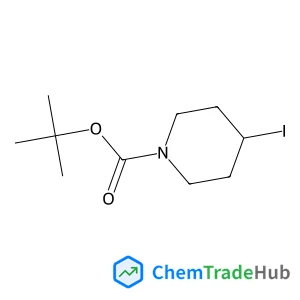
2-Methyl-2-propanyl 4-iodo-1-piperidinecarboxylate
CAS Number:
301673-14-3
Molecular Formula:
C10H18INO2

Recommended Suppliers




Disclaimer
This page provides academic journal information for reference and research purposes only. We are not affiliated with any journal publishers and do not handle publication submissions. For publication-related inquiries, please contact the respective journal publishers directly.
If you notice any inaccuracies in the information displayed, please contact us at support@chemtradehub.com. We will promptly review and address your concerns.