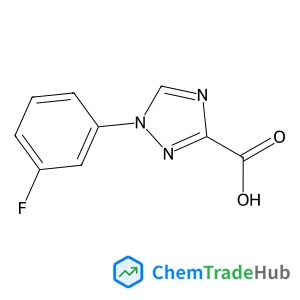
1-(3-Fluorophenyl)-1H-1,2,4-triazole-3-carboxylic acid
CAS Number:
1292369-51-7
Molecular Formula:
C9H6FN3O2
Z. Ruan, R. G. Zeng, Y. Ming, M. Zhang, B. Da, S. F. Mao, Z. J. Ding
In this paper, a novel quantum-trajectory Monte Carlo simulation method is developed to study electron beam interaction with a crystalline solid for application to electron microscopy and spectroscopy. The method combines the Bohmian quantum trajectory method, which treats electron elastic scattering and diffraction in a crystal, with a Monte Carlo sampling of electron inelastic scattering events along quantum trajectory paths. We study in this work the electron scattering and secondary electron generation process in crystals for a focused incident electron beam, leading to understanding of the imaging mechanism behind the atomic resolution secondary electron image that has been recently achieved in experiment with a scanning transmission electron microscope. According to this method, the Bohmian quantum trajectories have been calculated at first through a wave function obtained via a numerical solution of the time-dependent Schrödinger equation with a multislice method. The impact parameter-dependent inner-shell excitation cross section then enables the Monte Carlo sampling of ionization events produced by incident electron trajectories travelling along atom columns for excitation of high energy knock-on secondary electrons. Following cascade production, transportation and emission processes of true secondary electrons of very low energies are traced by a conventional Monte Carlo simulation method to present image signals. Comparison of the simulated image for a Si(110) crystal with the experimental image indicates that the dominant mechanism of atomic resolution of secondary electron image is the inner-shell ionization events generated by a high-energy electron beam.

Russian Journal of Coordination Chemistry

Russian Journal of Organic Chemistry

Russian Chemical Bulletin

Chemistry Education Research and Practice

Acta Materialia

Journal of Peptide Science

Current Opinion in Colloid & Interface Science

Chemical Communications

Drug Discovery Today

Russian Journal of Bioorganic Chemistry
Mark Louis P. Vidallon, Luke W. Giles, Simon Crawford, Alexis I. Bishop, Rico F. Tabor, Liliana de Campo, Boon Mian Teo
DOI: 10.1039/D1CP01146D
DOI: 10.1039/D1CP00245G
Conor D. Rankine, Thomas J. Penfold
DOI: 10.1039/D0CP06244H
Stuart J. Elliott, Olivier Cala, Quentin Stern, Dmitry Eshchenko, Roberto Melzi, James G. Kempf, Sami Jannin
DOI: 10.1039/D1CP00429H
Dengpan Dong, Samhitha Kancharla, Justin Hooper, Marina Tsianou, Dmitry Bedrov, Paschalis Alexandridis
DOI: 10.1039/D1CP00049G
Ming Chi, Jonathan M. White, Lars Goerigk
DOI: 10.1039/D1CP00541C
Belén Maté, Miguel Á. Satorre, Rafael Escribano
DOI: 10.1039/D1CP00291K
Junyi Wang, Youzi Li, Jiangting Zhao, Zhuo Xiong, Junying Zhang, Yongchun Zhao
DOI: 10.1039/D1CP00407G
Sayan Maity, Abhijeet S. Gangan, Ashwini Anshu, Rashid Rafeek V. Valappil, Varadharajan Srinivasan
DOI: 10.1039/D0CP04993J
Chandra Chowdhury, Pranab Gain, Ayan Datta
DOI: 10.1039/D1CP00094B
Waste containing N-Methoxy-N-methyl-1,3-thiazole-5-carboxamide (CAS: 898825-89-3...
N-(4-Biphenylyl)dibenzo[b,d]furan-4-amine should be stored in a tightly sealed c...
The market for 3-Acetamido-5-amino-2,4,6-triiodobenzoic acid (CAS: 1713-07-1) is...
Benzyl 2-O-acetyl-3,4,6-tri-O-benzyl-beta-D-galactopyranoside (CAS: 61820-03-9) ...
2-Ethylpiperazine dihydrochloride (CAS: 438050-52-3) is regulated under the Glob...
1,1'-[1,3-Phenylenebis(methylene)]bis(3-methyl-1H-pyrrole-2,5-dione) (CAS: 11946...
Several alternatives can be used in the synthesis of 5-Fluoro-2-(1-pyrrolidinyl)...
Proper personal protective equipment (PPE) must be worn when handling this compo...
When handling 6-Bromoimidazo[1,2-a]pyridin-8-amine, it is important to wear appr...
Alternatives to (2S,4R)-4-(4-Nitrobenzyl)pyrrolidine-2-carboxylic acid hydrochlo...

Physical Chemistry Chemical Physics (PCCP) is an international journal co-owned by 19 physical chemistry and physics societies from around the world. This journal publishes original, cutting-edge research in physical chemistry, chemical physics and biophysical chemistry. To be suitable for publication in PCCP, articles must include significant innovation and/or insight into physical chemistry; this is the most important criterion that reviewers and Editors will judge against when evaluating submissions. The journal has a broad scope and welcomes contributions spanning experiment, theory, computation and data science. Topical coverage includes spectroscopy, dynamics, kinetics, statistical mechanics, thermodynamics, electrochemistry, catalysis, surface science, quantum mechanics, quantum computing and machine learning. Interdisciplinary research areas such as polymers and soft matter, materials, nanoscience, energy, surfaces/interfaces, and biophysical chemistry are welcomed if they demonstrate significant innovation and/or insight into physical chemistry. Joined experimental/theoretical studies are particularly appreciated when complementary and based on up-to-date approaches.