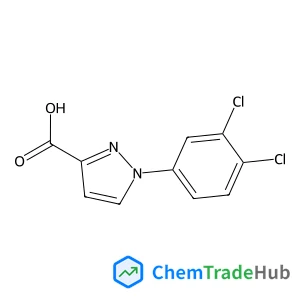
1-(3,4-Dichlorophenyl)-1H-pyrazole-3-carboxylic acid
CAS Number:
1152949-12-6
Molecular Formula:
C10H6Cl2N2O2
Stuart J. Elliott, Olivier Cala, Quentin Stern, Dmitry Eshchenko, Roberto Melzi, James G. Kempf, Sami Jannin
We have recently demonstrated the use of contactless radiofrequency pulse sequences under dissolution-dynamic nuclear polarization conditions as an attractive way of transferring polarization from sensitive 1H spins to insensitive 13C spins with low peak radiofrequency pulse powers and energies via a reservoir of dipolar order. However, many factors remain to be investigated and optimized to enable the full potential of this polarization transfer process. We demonstrate herein the optimization of several key factors by: (i) implementing more efficient shaped radiofrequency pulses; (ii) adapting 13C spin labelling; and (iii) avoiding methyl group relaxation sinks. Experimental demonstrations are presented for the case of [1-13C]sodium acetate and other relevant molecular candidates. By employing the range of approaches set out above, polarization transfer using the dipolar order mediated cross-polarization radiofrequency pulse sequence is improved by factors approaching ∼1.65 compared with previous results. Dipolar order mediated 1H→13C polarization transfer efficiencies reaching ∼76% were achieved using significantly reduced peak radiofrequency pulse powers relative to the performance of highly sophisticated state-of-the-art cross-polarization methods, indicating 13C nuclear spin polarization levels on the order of ∼32.1% after 10 minutes of 1H DNP. The approach does not require extensive pulse sequence optimization procedures and can easily accommodate high concentrations of 13C-labelled molecules.
Zhiqiang Wang, Gen Li
DOI: 10.1039/D3NJ05280J
Nasim Amiralian, Sandya S. A. Athukoralalage
DOI: 10.1039/D3TA04917E
Mohd Yeshab Ansari, Sumedha Swarnkar
DOI: 10.1039/D3NJ04619B
Shuming Zeng, Qian Shen, Lina Guo, Yinchang Zhao, Hao Huang, Yusong Tu
DOI: 10.1039/D3TA04338J
Sung-Jun Lee, Yoon-Gyung Sung, Santhia Kesavan, Chang-Lae Kim
DOI: 10.1039/D3NJ04802K
Benjamin Kirchweger, Julia Zwirchmayr, Ulrike Grienke, Judith M. Rollinger
DOI: 10.1039/D3NP00021D
Zhen Zhang, Linyan Zhao, Lin Cui, DongMei Li, Xing Tian, Zhiyong Liu, Shenglin Liu
DOI: 10.1039/D3NJ05042D
Jiayong Xiao, Hao Dong, Hui Zhang, Haolan Yang, Ming Qiu, Ying Yu
DOI: 10.1039/D3TA05834D
Balamurugan Selvaraj, Balaji Sambandam, Sungjin Kim, Vinod Mathew, Sehong Seo, Moonsu Song, Jaekook Kim
DOI: 10.1039/D3TA03912A
Katerina Bogomolov, Ekaterina Grishina
DOI: 10.1039/D3TA04612E
Waste containing N-Methoxy-N-methyl-1,3-thiazole-5-carboxamide (CAS: 898825-89-3...
N-(4-Biphenylyl)dibenzo[b,d]furan-4-amine should be stored in a tightly sealed c...
The market for 3-Acetamido-5-amino-2,4,6-triiodobenzoic acid (CAS: 1713-07-1) is...
Benzyl 2-O-acetyl-3,4,6-tri-O-benzyl-beta-D-galactopyranoside (CAS: 61820-03-9) ...
2-Ethylpiperazine dihydrochloride (CAS: 438050-52-3) is regulated under the Glob...
1,1'-[1,3-Phenylenebis(methylene)]bis(3-methyl-1H-pyrrole-2,5-dione) (CAS: 11946...
Several alternatives can be used in the synthesis of 5-Fluoro-2-(1-pyrrolidinyl)...
Proper personal protective equipment (PPE) must be worn when handling this compo...
When handling 6-Bromoimidazo[1,2-a]pyridin-8-amine, it is important to wear appr...
Alternatives to (2S,4R)-4-(4-Nitrobenzyl)pyrrolidine-2-carboxylic acid hydrochlo...

Physical Chemistry Chemical Physics (PCCP) is an international journal co-owned by 19 physical chemistry and physics societies from around the world. This journal publishes original, cutting-edge research in physical chemistry, chemical physics and biophysical chemistry. To be suitable for publication in PCCP, articles must include significant innovation and/or insight into physical chemistry; this is the most important criterion that reviewers and Editors will judge against when evaluating submissions. The journal has a broad scope and welcomes contributions spanning experiment, theory, computation and data science. Topical coverage includes spectroscopy, dynamics, kinetics, statistical mechanics, thermodynamics, electrochemistry, catalysis, surface science, quantum mechanics, quantum computing and machine learning. Interdisciplinary research areas such as polymers and soft matter, materials, nanoscience, energy, surfaces/interfaces, and biophysical chemistry are welcomed if they demonstrate significant innovation and/or insight into physical chemistry. Joined experimental/theoretical studies are particularly appreciated when complementary and based on up-to-date approaches.