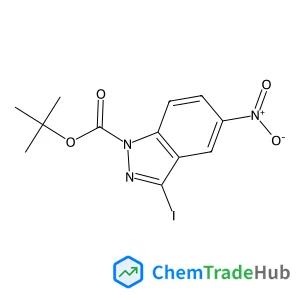
Tert-butyl 3-iodo-5-nitro-1H-indazole-1-carboxylate
CAS Number:
459133-69-8
Molecular Formula:
C12H12IN3O4
Pierre Y. Dapsens, Cecilia Mondelli, Bright T. Kusema, René Verel, Javier Pérez-Ramírez
The aqueous-phase heterogeneously catalysed isomerisation of bio-oil derived glyoxal is herein introduced as a novel route for the sustainable production of glycolic acid. While commercial ultra-stable Y zeolites displayed only moderate performance, their evaluation enabled us to highlight the crucial role of Lewis acidity in the reaction. Gallium incorporation into these zeolites boosted the glycolic acid yield, although the best catalytic results were obtained over tin-containing MFI-type zeolites, reaching 91% yield of the desired product at full conversion. These materials comprised hydrothermally-synthesised Sn-MFI as well as a novel catalyst obtained by the introduction of tin into silicalite-1 by means of a simpler and more scalable method, i.e. alkaline-assisted metallation. In-depth spectroscopic characterisation of these systems uncovered a substantial similarity of the tin centres obtained by the top-down and bottom-up synthetic approaches. NMR spectroscopic studies gave evidence that the reaction follows a 1,2-hydride shift mechanism solely catalysed by Lewis-acid sites. The Sn-MFI analogue could be reused in 5 cycles without the need for intermediate calcination, did not evidence any tin leaching, and demonstrated suitability for utilisation under continuous-flow operation. The tin-based zeolites exhibited remarkable performance also in alcoholic solvents, leading to the one-pot production of relevant alkyl glycolates.
Camila S. Monteiro, Daniele C. Ferreira, Gustavo A. M. Sáfar, Rafael N. Gontijo, Cristiano Fantini, Dayse C. S. Martins, Ynara M. Idemori, Maurício V. B. Pinheiro, Klaus Krambrock
DOI: 10.1039/C6CP03366K
Marnik Bercx, Nasrin Sarmadian, Rolando Saniz, Bart Partoens, Dirk Lamoen
DOI: 10.1039/C6CP03468C
Jan Chalabala, Petr Slavíček
DOI: 10.1039/C6CP02714H
Patrick K. Tamukong, Wadumesthrige D. N. Peiris, Svetlana Kilina
DOI: 10.1039/C6CP01665K
Quynh L. Nguyen, Vincent A. Spata, Spiridoula Matsika
DOI: 10.1039/C6CP01559J
Hongyu Zhang, Youhua Luo, Xiaojuan Feng, Lixia Zhao, Meng Zhang
DOI: 10.1039/C5CP02346G
Jeffrey J. Black, Thomas Murphy, Rob Atkin, Andrew Dolan, Leigh Aldous
DOI: 10.1039/C6CP02255C
Claudio Bulloni, Amador García-Fuente, Werner Urland, Claude Daul
DOI: 10.1039/C5CP02915E
Miao Miao, Gangling Wang, Shaomei Cao, Xin Feng, Jianhui Fang, Liyi Shi
DOI: 10.1039/C5CP04679C
Mouni Roy, Milan Kanti Naskar
DOI: 10.1039/C6CP02442D
When handling 4-Methyl-6-(trifluoromethyl)quinoline (CAS: 40716-16-3), safety go...
4-(3,5-Difluorophenyl)aniline is an aromatic organic compound with the CAS numbe...
5-{[4-(Trifluoromethyl)phenyl]sulfanyl}-1,2,3-thiadiazole-4-carboxylic acid can ...
The market for 4-Benzylaniline hydrochloride (CAS: 6317-57-3) is steadily growin...
[3-(Diethylsulfamoyl)phenyl]boronic acid is generally considered safe when handl...
3-Bromo-2,5-dimethoxyaniline is mainly used in the pharmaceutical and chemical i...
N-Methyl-1-(5-methyl-1H-indol-3-yl)methanamine (CAS: 915922-67-7) is subject to ...
This compound is primarily used in the pharmaceutical industry for the synthesis...
2-Methyl-2-propanyl [(1S,3R)-3-aminocyclohexyl]carbamate (CAS: 1298101-47-9) sho...
Ethyl 2-bromo-4,4,4-trifluorobutanoate (CAS: 367-33-9) is utilized in the pharma...

Green Chemistry provides a unique forum for the publication of innovative research on the development of alternative green and sustainable technologies. The scope of Green Chemistry is based on, but not limited to, the definition proposed by Anastas and Warner (Green Chemistry: Theory and Practice, P T Anastas and J C Warner, Oxford University Press, Oxford, 1998). Green chemistry is the utilisation of a set of principles that reduces or eliminates the use or generation of hazardous substances in the design, manufacture and application of chemical products. Green Chemistry is at the frontiers of this continuously-evolving interdisciplinary science and publishes research that attempts to reduce the environmental impact of the chemical enterprise by developing a technology base that is inherently non-toxic to living things and the environment. Submissions on all aspects of research relating to the endeavour are welcome. The journal publishes original and significant cutting-edge research that is likely to be of wide general appeal. To be published, work must present a significant advance in green chemistry. Papers must contain a comparison with existing methods and demonstrate advantages over those methods before publication can be considered. For more information please see this Editorial. Coverage includes the following, but is not limited to: Design (e.g. biomimicry, design for degradation/recycling/reduced toxicity…) Reagents & Feedstocks (e.g. renewables, CO2, solvents, auxiliary agents, waste utilization…) Synthesis (e.g. organic, inorganic, synthetic biology…) Catalysis (e.g. homogeneous, heterogeneous, enzyme, whole cell…) Process (e.g. process design, intensification, separations, recycling, efficiency…) Energy (e.g. renewable energy, fuels, photovoltaics, fuel cells, energy storage, energy carriers…) Applications (e.g. electronics, dyes, consumer products, coatings, pharmaceuticals, preservatives, building materials, chemicals for industry/agriculture/mining…) Impact (e.g. safety, metrics, LCA, sustainability, (eco)toxicology…) Green chemistry is, by definition, a continuously-evolving frontier. Therefore, the inclusion of a particular material or technology does not, of itself, guarantee that a paper is suitable for the journal. To be suitable, the novel advance should have the potential for reduced environmental impact relative to the state of the art. Green Chemistry does not normally deal with research associated with 'end-of-pipe' or remediation issues.
![[3-(2,6-Dichlorophenyl)-5-isopropyl-1,2-oxazol-4-yl]methanol structure](https://static.chemtradehub.com/structs/278/278597-30-1-5c79.webp "[3-(2,6-Dichlorophenyl)-5-isopropyl-1,2-oxazol-4-yl]methanol structure")
![6-Bromo-3-ethyl-3H-imidazo[4,5-b]pyridine structure](https://static.chemtradehub.com/structs/103/1033202-59-3-2a8f.webp "6-Bromo-3-ethyl-3H-imidazo[4,5-b]pyridine structure")