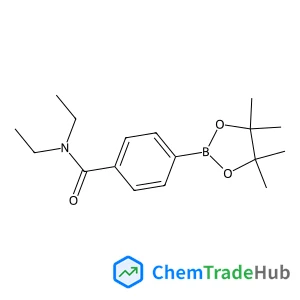
N,N-Diethyl-4-(4,4,5,5-tetramethyl-1,3,2-dioxaborolan-2-yl)benzamide
CAS Number:
325142-99-2
Molecular Formula:
C17H26BNO3
F. Kossoski, M. T. do N. Varella
The valence anion states of the potential radiosensitisers 5-bromouracil and 5-iodouracil were investigated through elastic scattering calculations. These compounds have rich spectra of negative ion states that trigger off different mechanisms for dissociative electron attachment. For each molecule, we obtained a bound π* anion, two π* shape resonances and a low lying σ* anion state, in addition to a dipole-bound state (the latter was obtained using bound-state techniques). The σ* anion, formed by electron attachment to an anti-bonding carbon-halogen orbital, was found to have resonant character in 5-bromouracil, and bound-state character in 5-iodouracil. The present calculations place the σCBr* resonance around 0.7 eV, considerably below the energy inferred from the electron transmission data (1.3 eV). The signature of this anion state, not evident in the measurements, would be obscured by the large background arising from the dipolar interaction, not by the strong signature of the π2*, as presumed. Our results support the π2* resonance as a precursor state to dissociative electron attachment around 1.5 eV in both 5-bromouracil and 5-iodouracil, while the interplay among π1*, σ* and dipole-bound states would be expected close to 0 eV. We also discuss the suppression of the hydrogen elimination channels in these species.
Tianbiao Wei, Shanqing Huang, Qingyuan Hu, Jue Wang, Zhongzhong Huo, Tongyang Zhu, Chi Wu, Hao Chen
DOI: 10.1039/D1PY01574E
Georgia Poulladofonou, Kevin Neumann
DOI: 10.1039/D2PY00851C
Nora Fribiczer, Sebastian Seiffert
DOI: 10.1039/D2PY00579D
Zhi Zhou, Ying Wang, Linlin Zhu, Dai Dang
DOI: 10.1039/D2PY00569G
Wei Xu, Yicong Wang, Feng-Gang Bian
DOI: 10.1039/D2PY00130F
Haoxiang Rong, Min Xu, Xiaolin Jiang, Xun Lu
DOI: 10.1039/D2PY00323F
Aristea Pavlou, Alexandros Petropoulos, Michael G. Siskos, Akram Hijazi, Frédéric Dumur
DOI: 10.1039/D2PY00753C
Nicholas G. Taylor, Marcus H. Reis, Travis P. Varner, Johann L. Rapp, Alexis Sarabia, Frank A. Leibfarth
DOI: 10.1039/D2PY00603K
This compound is mainly used as an intermediate in the synthesis of antipsychoti...
Waste containing 1-(D-Ribofuranosyl)-1,4-dihydro-3-pyridinecarboxamide (CAS: 191...
2-Methyl-2-propanyl 3-bromo-3-(hydroxymethyl)-1-azetidinecarboxylate (CAS: 20079...
N-(4-Chloro-2-pyridinyl)acetamide (CAS: 245056-66-0) is a chemical compound with...
5-Chloro-2-hydroxybenzoic acid, also known as 5-chlorosalicylic acid, is an arom...
When handling 1,1-Dichloro-1-fluoroethane (CAS: 1717-00-6), it is important to u...
Fmoc-(2S,3R)-3-phenylpyrrolidine-2-carboxylic acid is a white crystalline solid ...
4-Amino-5-bromo-2-pyridinecarboxylic acid is primarily used as a precursor in th...
Handling this compound should be done with personal protective equipment (PPE) i...
When handling 8-bromo-2,2-dimethyl-3,4-dihydro-2H-1,4-benzoxazin-3-one, use prop...

Physical Chemistry Chemical Physics (PCCP) is an international journal co-owned by 19 physical chemistry and physics societies from around the world. This journal publishes original, cutting-edge research in physical chemistry, chemical physics and biophysical chemistry. To be suitable for publication in PCCP, articles must include significant innovation and/or insight into physical chemistry; this is the most important criterion that reviewers and Editors will judge against when evaluating submissions. The journal has a broad scope and welcomes contributions spanning experiment, theory, computation and data science. Topical coverage includes spectroscopy, dynamics, kinetics, statistical mechanics, thermodynamics, electrochemistry, catalysis, surface science, quantum mechanics, quantum computing and machine learning. Interdisciplinary research areas such as polymers and soft matter, materials, nanoscience, energy, surfaces/interfaces, and biophysical chemistry are welcomed if they demonstrate significant innovation and/or insight into physical chemistry. Joined experimental/theoretical studies are particularly appreciated when complementary and based on up-to-date approaches.