


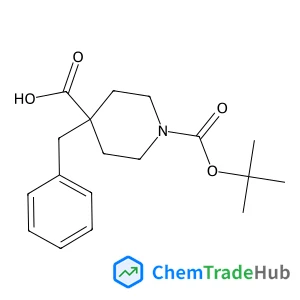
4-Benzyl-1-(tert-butoxycarbonyl)piperidine-4-carboxylic acid
CAS Number:
170838-87-6
Molecular Formula:
C18H25NO4
Marcos Mandado, Nicolás Ramos-Berdullas
The unusual aromatic stability of cyclic bicalicene has been suggested to come from a tetraionic structure, where positive and negative charges are located on the cyclopropene and cyclopentadiene rings, respectively. Energetic, magnetic, geometric and electron delocalization analysis performed on a series of bicalicene derivatives, incorporating different electron donating and withdrawing groups, and electrically perturbed bicalicene structures provide additional proof of the role played by this tetraionic structure in the aromatic stability of bicalicene. In this work the aromatic stabilization is chemically and electrically tuned, enhancing or disrupting the electron delocalization and aromatic stability of the cyclopropene and cyclopentadiene rings by increasing or decreasing their corresponding charges. It is shown how the electron delocalization within these rings is similar to that of cyclopropene cation and cyclopentadiene anion for a perfect polarization of one electron.

Critical Reviews in Solid State and Materials Sciences

Cellulose

Heteroatom Chemistry

Bioorganic & Medicinal Chemistry Letters

Main Group Chemistry

Journal of Chemical Sciences

Acta Metallurgica Sinica-English Letters

Biocatalysis and Biotransformation

Journal of the Indian Institute of Science

Atomization and Sprays
Xiacong Zhang, Biyi Xu, Wen Li
DOI: 10.1039/D2PY00118G
Ranajit Barman, Debes Ray, V. K. Aswal, Suhrit Ghosh
DOI: 10.1039/D2PY00625A
Spyridon Efstathiou, Congkai Ma, Despina Coursari, Georgios Patias, Lucas Al-Shok, David M. Haddleton
DOI: 10.1039/D2PY00167E
Zhou Lu, Weigang Fan
DOI: 10.1039/D2PY00282E
Alicja Balcerak, Janina Kabatc
DOI: 10.1039/D1PY01519B
Shaon Dey, Arpita Roy, Kalipada Manna, Sagar Pal
DOI: 10.1039/D2PY00626J
Nikunjkumar R. Visaveliya, Firdaus Khatoon, Jin Xu, Kelvin Leo, Lauren St. Peter, Christopher Chan, Tatiana Mikhailova, Visar Bexheti, Ashni Kapadia, Piyali Maity, William P. Carbery
DOI: 10.1039/D1PY01729B
Sicco de Vos, Vasilios Tsanaktsis, Bahar Yeniad
DOI: 10.1039/D2PY00189F
Jupeng Chen, Xiaolin Wu, Shaowen Zhang, Xiangqian Yan, Xiaolu Wu, Qingbin Cao, Huan Xu, Xiaofang Li
DOI: 10.1039/D2PY00490A
This compound is mainly used as an intermediate in the synthesis of antipsychoti...
Waste containing 1-(D-Ribofuranosyl)-1,4-dihydro-3-pyridinecarboxamide (CAS: 191...
2-Methyl-2-propanyl 3-bromo-3-(hydroxymethyl)-1-azetidinecarboxylate (CAS: 20079...
N-(4-Chloro-2-pyridinyl)acetamide (CAS: 245056-66-0) is a chemical compound with...
5-Chloro-2-hydroxybenzoic acid, also known as 5-chlorosalicylic acid, is an arom...
When handling 1,1-Dichloro-1-fluoroethane (CAS: 1717-00-6), it is important to u...
Fmoc-(2S,3R)-3-phenylpyrrolidine-2-carboxylic acid is a white crystalline solid ...
4-Amino-5-bromo-2-pyridinecarboxylic acid is primarily used as a precursor in th...
Handling this compound should be done with personal protective equipment (PPE) i...
When handling 8-bromo-2,2-dimethyl-3,4-dihydro-2H-1,4-benzoxazin-3-one, use prop...

Physical Chemistry Chemical Physics (PCCP) is an international journal co-owned by 19 physical chemistry and physics societies from around the world. This journal publishes original, cutting-edge research in physical chemistry, chemical physics and biophysical chemistry. To be suitable for publication in PCCP, articles must include significant innovation and/or insight into physical chemistry; this is the most important criterion that reviewers and Editors will judge against when evaluating submissions. The journal has a broad scope and welcomes contributions spanning experiment, theory, computation and data science. Topical coverage includes spectroscopy, dynamics, kinetics, statistical mechanics, thermodynamics, electrochemistry, catalysis, surface science, quantum mechanics, quantum computing and machine learning. Interdisciplinary research areas such as polymers and soft matter, materials, nanoscience, energy, surfaces/interfaces, and biophysical chemistry are welcomed if they demonstrate significant innovation and/or insight into physical chemistry. Joined experimental/theoretical studies are particularly appreciated when complementary and based on up-to-date approaches.
![tert-Butyl N-[(2-chloropyridin-4-yl)methyl]carbamate structure](https://static.chemtradehub.com/structs/916/916210-27-0-9f95.webp "tert-Butyl N-[(2-chloropyridin-4-yl)methyl]carbamate structure")






