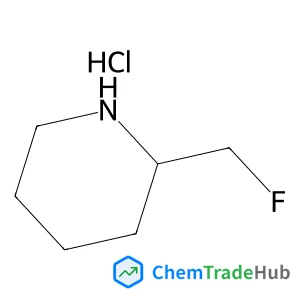
(2S)-2-(Fluoromethyl)piperidine hydrochloride (1:1)
CAS Number:
886216-73-5
Molecular Formula:
C6H13ClFN
Vu Thi Ngan, Ewald Janssens, Pieterjan Claes, André Fielicke, Minh Tho Nguyen, Peter Lievens
Mass spectrometry experiments show an exceptionally weak bonding between Si7Mn+ and rare gas atoms as compared to other exohedrally transition metal (TM) doped silicon clusters and other SinMn+ (n = 5–10) sizes. The Si7Mn+ cluster does not form Ar complexes and the observed fraction of Xe complexes is low. The interaction of two cluster series, SinMn+ (n = 6–10) and Si7TM+ (TM = Cr, Mn, Cu, and Zn), with Ar and Xe is investigated by density functional theory calculations. The cluster–rare gas binding is for all clusters, except Si7Mn+ and Si7Zn+, predominantly driven by short-range interaction between the TM dopant and the rare gas atoms. A high s-character electron density on the metal atoms in Si7Mn+ and Si7Zn+ shields the polarization toward the rare gas atoms and thereby hinders formation of short-range complexes. Overall, both Ar and Xe complexes are similar except that the larger polarizability of Xe leads to larger binding energies.
Alessandro Grottesi
DOI: 10.1039/D3CP05530B
Chiara Liliana Boldrini, Andrea Francesca Quivelli, Filippo Maria Perna, Paolo Biagini, Vito Capriati, Alessandro Abbotto, Norberto Manfredi
DOI: 10.1039/D3SE00949A
Nivedita Dutta, Joanna Sarzynska, Indrajit Deb, Ansuman Lahiri
DOI: 10.1039/D3CP02442C
Yue Lou
DOI: 10.1039/D3CP04958B
Bayram Deviren, Seyma Akkaya Deviren, Tevfik Fikret Yagmuroglu
DOI: 10.1039/D3CP04785G
Srinivas Pattipaka, Tae Wan Park, Young Min Bae, Yujin Na, Kyeongwoon Chung, Kwi-Il Park, Jungho Ryu, Woon Ik Park, Geon-Tae Hwang
DOI: 10.1039/D3SE01206A
Alasdair D. Keith, Elizabeth B. Sawyer, Desmond C. Y. Choy, Yuhang Xie, George S. Biggs, Oskar James Klein, Paul D. Brear, David J. Wales, Paul D. Barker
DOI: 10.1039/D3CP03897A
Waste containing N-Methoxy-N-methyl-1,3-thiazole-5-carboxamide (CAS: 898825-89-3...
N-(4-Biphenylyl)dibenzo[b,d]furan-4-amine should be stored in a tightly sealed c...
The market for 3-Acetamido-5-amino-2,4,6-triiodobenzoic acid (CAS: 1713-07-1) is...
Benzyl 2-O-acetyl-3,4,6-tri-O-benzyl-beta-D-galactopyranoside (CAS: 61820-03-9) ...
2-Ethylpiperazine dihydrochloride (CAS: 438050-52-3) is regulated under the Glob...
1,1'-[1,3-Phenylenebis(methylene)]bis(3-methyl-1H-pyrrole-2,5-dione) (CAS: 11946...
Several alternatives can be used in the synthesis of 5-Fluoro-2-(1-pyrrolidinyl)...
Proper personal protective equipment (PPE) must be worn when handling this compo...
When handling 6-Bromoimidazo[1,2-a]pyridin-8-amine, it is important to wear appr...
Alternatives to (2S,4R)-4-(4-Nitrobenzyl)pyrrolidine-2-carboxylic acid hydrochlo...

Physical Chemistry Chemical Physics (PCCP) is an international journal co-owned by 19 physical chemistry and physics societies from around the world. This journal publishes original, cutting-edge research in physical chemistry, chemical physics and biophysical chemistry. To be suitable for publication in PCCP, articles must include significant innovation and/or insight into physical chemistry; this is the most important criterion that reviewers and Editors will judge against when evaluating submissions. The journal has a broad scope and welcomes contributions spanning experiment, theory, computation and data science. Topical coverage includes spectroscopy, dynamics, kinetics, statistical mechanics, thermodynamics, electrochemistry, catalysis, surface science, quantum mechanics, quantum computing and machine learning. Interdisciplinary research areas such as polymers and soft matter, materials, nanoscience, energy, surfaces/interfaces, and biophysical chemistry are welcomed if they demonstrate significant innovation and/or insight into physical chemistry. Joined experimental/theoretical studies are particularly appreciated when complementary and based on up-to-date approaches.