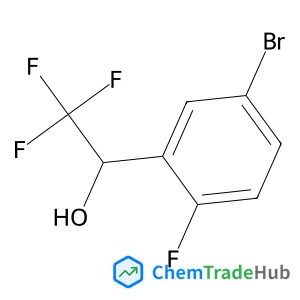
1-(5-Bromo-2-fluorophenyl)-2,2,2-trifluoroethanol
CAS Number:
1039827-16-1
Molecular Formula:
C8H5BrF4O
Francesco D'Amico, Gaia Camisasca, Filippo Bencivenga, Alessandro Gessini, Emiliano Principi, Riccardo Cucini, Claudio Masciovecchio
The formation of a hydration shell in acetamide aqueous solution has been investigated by means of UV Raman spectroscopy. The experimental results reveal the existence of two distinct regimes of water dynamics. At high acetamide concentration water molecules show a structural and dynamical behavior consistent with the so-called iceberg model. Upon increasing the amount of water we observe the formation of a hydration shell marked by fastening of hydrogen-bond dynamics. Such a behavior may help to shed light on the scientific debate on how water rearranges around the hydrophobic portions of solute molecules (iceberg vs. non-iceberg models).

Drug Discovery Today

Russian Journal of Applied Chemistry

Russian Journal of Organic Chemistry

Russian Journal of General Chemistry

New Journal of Chemistry

Russian Chemical Bulletin

Chemical Communications

Saudi Pharmaceutical Journal

Chemistry Education Research and Practice

Organic Process Research & Development
Joseph Eugene Andrews, Shayandev Sinha, Peter W. Chung, Siddhartha Das
DOI: 10.1039/C6CP01936F
Sergio Díaz-Rodríguez, Ranna Tolouei, Pascale Chevallier, Emmanuel Pauthe, Diego Mantovani
DOI: 10.1039/C6CP04527H
Oleg Kostko, Tyler P. Troy, Biswajit Bandyopadhyay, Musahid Ahmed
DOI: 10.1039/C6CP04916H
Stine T. Olsen, Kurt V. Mikkelsen
DOI: 10.1039/C6CP01078D
Li Chen, Qiandong Zhuang, Yeqing Chen, Changmin Shi, Dongchao Wang
DOI: 10.1039/C6CP04534K
Bohayra Mortazavi, Alireza Ostadhossein, Timon Rabczuk, Adri C. T. van Duin
DOI: 10.1039/C6CP03612K
Siwar Chibani, Mouheb Chebbi, Sébastien Lebègue, Laurent Cantrel, Michael Badawi
DOI: 10.1039/C6CP05015H
Yuri Martínez-Ratón, Miguel González-Pinto, Enrique Velasco
DOI: 10.1039/C6CP05022K
DOI: 10.1039/C6CP03938C
Tanmay Chatterjee, Mrinal Mandal, Prasun K. Mandal
DOI: 10.1039/C6CP04219H
2-(2-Chloroacetamido)-3-phenylpropanoic acid (CAS: 7765-11-9) is generally consi...
2-(Benzyloxy)-5-bromobenzoic acid can be handled safely if appropriate precautio...
(4-Methyl-1,2,5-oxadiazol-3-yl)methanamine hydrochloride is a chemical compound ...
2-(5-Hexylthiophen-2-yl)-4,4,5,5-tetramethyl-1,3,2-dioxaborolane (CAS: 917985-54...
While 4-(8-Methyl-9H-1,3-dioxolo[4,5-h][2,3]benzodiazepin-5-yl)benzenamine (CAS:...
The market for tert-butyl 3-hydroxy-4,5,7,8-tetrahydro-2H-pyrazolo[3,4-d]azepine...
Waste containing 3,5-Diamino-1H-pyrazole-4-carbonitrile (CAS: 6844-58-2) should ...
(6-Fluoro-3-pyridinyl)boronic acid can be synthesized through the reaction of 6-...
Dibenzyl carbonimidoylbiscarbamate (CAS: 10065-79-9) finds applications in vario...
The market for (beta,beta,2,3,4,5,6-~2~H_7_)Phenylalanine (CAS: 74228-83-4) is g...

Physical Chemistry Chemical Physics (PCCP) is an international journal co-owned by 19 physical chemistry and physics societies from around the world. This journal publishes original, cutting-edge research in physical chemistry, chemical physics and biophysical chemistry. To be suitable for publication in PCCP, articles must include significant innovation and/or insight into physical chemistry; this is the most important criterion that reviewers and Editors will judge against when evaluating submissions. The journal has a broad scope and welcomes contributions spanning experiment, theory, computation and data science. Topical coverage includes spectroscopy, dynamics, kinetics, statistical mechanics, thermodynamics, electrochemistry, catalysis, surface science, quantum mechanics, quantum computing and machine learning. Interdisciplinary research areas such as polymers and soft matter, materials, nanoscience, energy, surfaces/interfaces, and biophysical chemistry are welcomed if they demonstrate significant innovation and/or insight into physical chemistry. Joined experimental/theoretical studies are particularly appreciated when complementary and based on up-to-date approaches.