


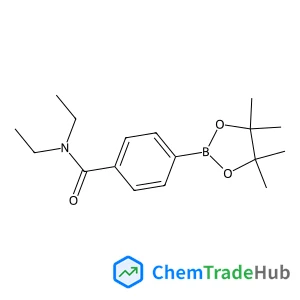
N,N-Diethyl-4-(4,4,5,5-tetramethyl-1,3,2-dioxaborolan-2-yl)benzamide
CAS Number:
325142-99-2
Molecular Formula:
C17H26BNO3
Giuseppe Lanza, Maria Assunta Chiacchio
DFT-M062X quantum chemical computations on the Ala3H+·nH2O (n up to 37) complexes have been performed to model for hydration effects on the molecular properties of protonated trialanine. Following simple rules to arrange water molecules around the peptide, geometry optimization allows us to find four minima corresponding to the unfolded extended (β) and polyproline II (PPII) conformations. The peptide is incorporated into the network of hydrogen bonds of interfacial water molecules with a hydration energy of about −85 kcal mol−1. The progressive hydration of the peptide shows a more efficient intermolecular hydrogen bonding in the PPII arrangement, and the following relative electronic energy stability β–β < β-PPII ≈ PPII-β < PPII–PPII has been found. The conformational entropy term proceeds in the reverse direction, thus these changes compensate in a way that leads to small changes in Gibbs free energy. These findings agree with experimental data which report an equilibrium between these conformers modulated by temperature.

Foundations of Chemistry

Photochemical & Photobiological Sciences

Nature Reviews Drug Discovery

Faraday Discussions

Journal of Medical Biochemistry

Mini-Reviews in Medicinal Chemistry

Angewandte Chemie International Edition

Advanced Engineering Materials

Coloration Technology

Current Pharmaceutical Biotechnology
Alvin Tanudjaja, Makoto Higuchi, Tomohiro Imai, Yoshimasa Matsumura, Ryoyu Hifumi, Shinsuke Inagi, Ikuyoshi Tomita
DOI: 10.1039/D2PY00452F
Csilla György, Timothy Smith, David J. Growney, Steven P. Armes
DOI: 10.1039/D2PY00559J
Tomoki Sakai, Nagisa Ito, Mitsuo Hara, Takahiro Seki, Mineto Uchiyama, Masami Kamigaito, Kotaro Satoh, Taiki Hoshino, Yukikazu Takeoka
DOI: 10.1039/D2PY00554A
Jie Li, Peng Liu
DOI: 10.1039/D1PY01670A
James D. Tinkler, Daniel W. Lester, Jonathan Martinelli, Lorenzo Tei, Stephen J. Butler, Helen Willcock
DOI: 10.1039/D2PY00337F
Irene Piergentili, Pepijn R. Bouwmans, Luuk Reinalda, Reece W. Lewis, Benjamin Klemm, Huanhuan Liu, Robin M. de Kruijff, Antonia G. Denkova, Rienk Eelkema
DOI: 10.1039/D2PY00207H
Shintaro Nakagawa, Naoko Yoshie
DOI: 10.1039/D1PY01547H
Spyridon Efstathiou, Congkai Ma, Despina Coursari, Georgios Patias, Lucas Al-Shok, David M. Haddleton
DOI: 10.1039/D2PY00167E
This compound is mainly used as an intermediate in the synthesis of antipsychoti...
Waste containing 1-(D-Ribofuranosyl)-1,4-dihydro-3-pyridinecarboxamide (CAS: 191...
2-Methyl-2-propanyl 3-bromo-3-(hydroxymethyl)-1-azetidinecarboxylate (CAS: 20079...
N-(4-Chloro-2-pyridinyl)acetamide (CAS: 245056-66-0) is a chemical compound with...
5-Chloro-2-hydroxybenzoic acid, also known as 5-chlorosalicylic acid, is an arom...
When handling 1,1-Dichloro-1-fluoroethane (CAS: 1717-00-6), it is important to u...
Fmoc-(2S,3R)-3-phenylpyrrolidine-2-carboxylic acid is a white crystalline solid ...
4-Amino-5-bromo-2-pyridinecarboxylic acid is primarily used as a precursor in th...
Handling this compound should be done with personal protective equipment (PPE) i...
When handling 8-bromo-2,2-dimethyl-3,4-dihydro-2H-1,4-benzoxazin-3-one, use prop...

Physical Chemistry Chemical Physics (PCCP) is an international journal co-owned by 19 physical chemistry and physics societies from around the world. This journal publishes original, cutting-edge research in physical chemistry, chemical physics and biophysical chemistry. To be suitable for publication in PCCP, articles must include significant innovation and/or insight into physical chemistry; this is the most important criterion that reviewers and Editors will judge against when evaluating submissions. The journal has a broad scope and welcomes contributions spanning experiment, theory, computation and data science. Topical coverage includes spectroscopy, dynamics, kinetics, statistical mechanics, thermodynamics, electrochemistry, catalysis, surface science, quantum mechanics, quantum computing and machine learning. Interdisciplinary research areas such as polymers and soft matter, materials, nanoscience, energy, surfaces/interfaces, and biophysical chemistry are welcomed if they demonstrate significant innovation and/or insight into physical chemistry. Joined experimental/theoretical studies are particularly appreciated when complementary and based on up-to-date approaches.
![5-Methyl-4,5,6,7-tetrahydropyrazolo[1,5-a]pyrazin-2-amine structure](https://static.chemtradehub.com/structs/122/1227210-33-4-8d64.webp "5-Methyl-4,5,6,7-tetrahydropyrazolo[1,5-a]pyrazin-2-amine structure")





