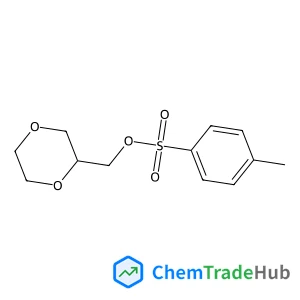
(S)-(1,4-Dioxan-2-yl)methyl 4-methylbenzenesulfonate
CAS Number:
917882-64-5
Molecular Formula:
C12H16O5S
Maria Sol Rau, Carsten Cremers
The ethanol oxidation reaction (EOR) was investigated by potentiodynamic techniques on Pt/C, Rh/C, Pt–Rh/C, Pt–SnO2/C and Pt–Rh–SnO2/C by differential electrochemical mass spectrometry (DEMS) in a flow cell system. Prior to the cyclic voltammetries, adsorption of H- and OH-species was carried out by chronoamperometry at Ead = 0.05 and 1 V vs. RHE, respectively, in order to examine their influence on the EOR on the different electrocatalysts. For the sake of comparison, another adsorption potential was chosen at Ead = 0.3 V vs. RHE, in the double layer region (i.e. in the absence of such adsorbates). For this study, 20 wt% electrocatalysts were synthesized using a modified polyol method and were physically characterized by inductively coupled plasma atomic emission spectrometry (ICP-AES), X-ray diffraction (XRD) and transmission electron microscopy (TEM). When comparing the first and second cycles of the cyclic voltammograms (CVs) on Pt/C and Pt–SnO2/C, the presence of Had on the electrocatalyst surface seems to hinder the initiation of the ethanol electrooxidation, whereas the reaction onset potential is shifted negatively with the presence of OH-adsorbates. In contrast to them, the EOR on Rh/C is enhanced when the electrocatalyst surface is covered with Had and is inhibited after adsorption at Ead = 0.3 and 1 V vs. RHE. Finally, on Pt–Rh/C and Pt–Rh–SnO2/C, neither the H- nor OH-adsorbates do impact the EOR initiation. The lowest EOR onset was recorded on Pt–SnO2/C and Pt–Rh–SnO2/C electrocatalysts. The CO2 currency efficiency (CCE) was also determined for each electrocatalyst and demonstrated higher values on Pt–Rh–SnO2/C.
R. R. Wu, M. T. Rodgers
DOI: 10.1039/C6CP03620A
Petr Dohnal, Ábel Kálosi, Radek Plašil, Štěpán Roučka, Artem Kovalenko, Serhiy Rednyk, Rainer Johnsen, Juraj Glosík
DOI: 10.1039/C6CP04152C
DOI: 10.1039/C6CP03938C
Bohayra Mortazavi, Alireza Ostadhossein, Timon Rabczuk, Adri C. T. van Duin
DOI: 10.1039/C6CP03612K
B. L. He, J. S. Shen, Z. X. Tian
DOI: 10.1039/C6CP03398A
Joseph Eugene Andrews, Shayandev Sinha, Peter W. Chung, Siddhartha Das
DOI: 10.1039/C6CP01936F
Paul C. Jennings, Steen Lysgaard, Heine A. Hansen, Tejs Vegge
DOI: 10.1039/C6CP04194A
P. Harrison, C. I. Smith, Y. Gründer, C. A. Lucas, S. D. Barrett, P. Weightman
DOI: 10.1039/C6CP03576K
Wei Cui, Yves Lansac, Hochun Lee, Seung-Tae Hong
DOI: 10.1039/C6CP01667G
Richmond Lee, Ganna Gryn'ova, K. U. Ingold, Michelle L. Coote
DOI: 10.1039/C6CP04670C
2-(2-Chloroacetamido)-3-phenylpropanoic acid (CAS: 7765-11-9) is generally consi...
2-(Benzyloxy)-5-bromobenzoic acid can be handled safely if appropriate precautio...
(4-Methyl-1,2,5-oxadiazol-3-yl)methanamine hydrochloride is a chemical compound ...
2-(5-Hexylthiophen-2-yl)-4,4,5,5-tetramethyl-1,3,2-dioxaborolane (CAS: 917985-54...
While 4-(8-Methyl-9H-1,3-dioxolo[4,5-h][2,3]benzodiazepin-5-yl)benzenamine (CAS:...
The market for tert-butyl 3-hydroxy-4,5,7,8-tetrahydro-2H-pyrazolo[3,4-d]azepine...
Waste containing 3,5-Diamino-1H-pyrazole-4-carbonitrile (CAS: 6844-58-2) should ...
(6-Fluoro-3-pyridinyl)boronic acid can be synthesized through the reaction of 6-...
Dibenzyl carbonimidoylbiscarbamate (CAS: 10065-79-9) finds applications in vario...
The market for (beta,beta,2,3,4,5,6-~2~H_7_)Phenylalanine (CAS: 74228-83-4) is g...

Physical Chemistry Chemical Physics (PCCP) is an international journal co-owned by 19 physical chemistry and physics societies from around the world. This journal publishes original, cutting-edge research in physical chemistry, chemical physics and biophysical chemistry. To be suitable for publication in PCCP, articles must include significant innovation and/or insight into physical chemistry; this is the most important criterion that reviewers and Editors will judge against when evaluating submissions. The journal has a broad scope and welcomes contributions spanning experiment, theory, computation and data science. Topical coverage includes spectroscopy, dynamics, kinetics, statistical mechanics, thermodynamics, electrochemistry, catalysis, surface science, quantum mechanics, quantum computing and machine learning. Interdisciplinary research areas such as polymers and soft matter, materials, nanoscience, energy, surfaces/interfaces, and biophysical chemistry are welcomed if they demonstrate significant innovation and/or insight into physical chemistry. Joined experimental/theoretical studies are particularly appreciated when complementary and based on up-to-date approaches.
![2-[(E)-(2-Methoxyphenyl)diazenyl]-3-oxo-N-(2-oxo-2,3-dihydro-1H-benzimidazol-5-yl)butanamide structure](https://static.chemtradehub.com/structs/821/82199-12-0-f1d0.webp "2-[(E)-(2-Methoxyphenyl)diazenyl]-3-oxo-N-(2-oxo-2,3-dihydro-1H-benzimidazol-5-yl)butanamide structure")
![(1S)-1,5-Anhydro-2-O-alpha-L-arabinopyranosyl-1-[5-hydroxy-7-({6-O-[3-(4-hydroxy-3-methoxyphenyl)propanoyl]-beta-D-glucopyranosyl}oxy)-2-(4-hydroxyphenyl)-4-oxo-4H-chromen-6-yl]-D-glucitol structure](https://static.chemtradehub.com/structs/225/2252345-81-4-bcff.webp "(1S)-1,5-Anhydro-2-O-alpha-L-arabinopyranosyl-1-[5-hydroxy-7-({6-O-[3-(4-hydroxy-3-methoxyphenyl)propanoyl]-beta-D-glucopyranosyl}oxy)-2-(4-hydroxyphenyl)-4-oxo-4H-chromen-6-yl]-D-glucitol structure")