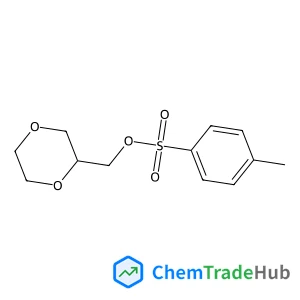
(S)-(1,4-Dioxan-2-yl)methyl 4-methylbenzenesulfonate
CAS Number:
917882-64-5
Molecular Formula:
C12H16O5S
J. Macías, A. A. Yaremchenko, D. P. Fagg, J. R. Frade
Structural and defect chemistry guidelines were used for Nb-substituted SrVO3−δ materials, designed to meet SOFC anode requirements, with emphasis on redox tolerance, thermochemical compatibility with other SOFC materials, electrical conductivity and adjustable changes in oxygen stoichiometry for their prospective impact on electrocatalytic performance. SrV1−xNbxO3−δ (x = 0–0.30) ceramics were prepared by solid-state synthesis and sintered at 1773 K in a reducing atmosphere. XRD and SEM/EDS showed that under these conditions a single-phase cubic perovskite structure appears up to x ≈ 0.25. Electrical conductivity is metallic-like and nearly p(O2)-independent. Although substitution by niobium decreases the conductivity, which still exceeds 100 S cm−1 for x ≤ 0.20 at temperatures below 1273 K, it also expands the stability domain of the cubic perovskite phase and suppresses partly high thermochemical expansion characteristic of parent SrVO3−δ. The upper p(O2) limit of phase stability was found to shift from ∼2 × 10⁻¹⁵ atm for the undoped material to ∼2 × 10⁻¹² atm for x = 0.30, whereas the average thermal expansion coefficient at 773–1223 K decreased from 22.7 × 10⁻⁶ to 13.3 × 10⁻⁶ K−1. SrV1−xNbxO3−δ perovskites undergo oxidative decomposition in air, which causes dimensional and microstructural changes. However, sluggish kinetics of oxidation under inert gas conditions results in nearly reversible behavior in relatively short-term redox cycles between reducing and inert atmospheres. Subtle structural changes and a close correlation with point defect chemistry clarify these sluggish changes and provide guidelines to retain the metastability.
Richmond Lee, Michelle L. Coote
DOI: 10.1039/C6CP05064F
Petr Dohnal, Ábel Kálosi, Radek Plašil, Štěpán Roučka, Artem Kovalenko, Serhiy Rednyk, Rainer Johnsen, Juraj Glosík
DOI: 10.1039/C6CP04152C
I. Agustín Aucar, Sergio S. Gomez, Claudia G. Giribet, Gustavo A. Aucar
DOI: 10.1039/C6CP03355E
Frances Separovic, Calum J. Drummond, Tamar L. Greaves
DOI: 10.1039/C6CP03332F
Claudio F. Narambuena, Fabricio O. Sanchez Varretti, Antonio J. Ramirez-Pastor
DOI: 10.1039/C6CP03924C
Tanmay Chatterjee, Mrinal Mandal, Prasun K. Mandal
DOI: 10.1039/C6CP04219H
R. R. Wu, M. T. Rodgers
DOI: 10.1039/C6CP03620A
David Shai Ellis, Hen Dotan, Avner Rothschild
DOI: 10.1039/C6CP04683E
Taku Goto, Tatsuki Owashi, Alex G. Rozhin, Shigeru Yamaguchi, Tsuyohito Ito
DOI: 10.1039/C6CP04556A
Mrinal Ghosh, Shaibal Banerjee, Md Abdul Shafeeuulla Khan, Nirmala Sikder, Arun Kanti Sikder
DOI: 10.1039/C6CP02185A
2-(2-Chloroacetamido)-3-phenylpropanoic acid (CAS: 7765-11-9) is generally consi...
2-(Benzyloxy)-5-bromobenzoic acid can be handled safely if appropriate precautio...
(4-Methyl-1,2,5-oxadiazol-3-yl)methanamine hydrochloride is a chemical compound ...
2-(5-Hexylthiophen-2-yl)-4,4,5,5-tetramethyl-1,3,2-dioxaborolane (CAS: 917985-54...
While 4-(8-Methyl-9H-1,3-dioxolo[4,5-h][2,3]benzodiazepin-5-yl)benzenamine (CAS:...
The market for tert-butyl 3-hydroxy-4,5,7,8-tetrahydro-2H-pyrazolo[3,4-d]azepine...
Waste containing 3,5-Diamino-1H-pyrazole-4-carbonitrile (CAS: 6844-58-2) should ...
(6-Fluoro-3-pyridinyl)boronic acid can be synthesized through the reaction of 6-...
Dibenzyl carbonimidoylbiscarbamate (CAS: 10065-79-9) finds applications in vario...
The market for (beta,beta,2,3,4,5,6-~2~H_7_)Phenylalanine (CAS: 74228-83-4) is g...

Physical Chemistry Chemical Physics (PCCP) is an international journal co-owned by 19 physical chemistry and physics societies from around the world. This journal publishes original, cutting-edge research in physical chemistry, chemical physics and biophysical chemistry. To be suitable for publication in PCCP, articles must include significant innovation and/or insight into physical chemistry; this is the most important criterion that reviewers and Editors will judge against when evaluating submissions. The journal has a broad scope and welcomes contributions spanning experiment, theory, computation and data science. Topical coverage includes spectroscopy, dynamics, kinetics, statistical mechanics, thermodynamics, electrochemistry, catalysis, surface science, quantum mechanics, quantum computing and machine learning. Interdisciplinary research areas such as polymers and soft matter, materials, nanoscience, energy, surfaces/interfaces, and biophysical chemistry are welcomed if they demonstrate significant innovation and/or insight into physical chemistry. Joined experimental/theoretical studies are particularly appreciated when complementary and based on up-to-date approaches.
![2-[(E)-(2-Methoxyphenyl)diazenyl]-3-oxo-N-(2-oxo-2,3-dihydro-1H-benzimidazol-5-yl)butanamide structure](https://static.chemtradehub.com/structs/821/82199-12-0-f1d0.webp "2-[(E)-(2-Methoxyphenyl)diazenyl]-3-oxo-N-(2-oxo-2,3-dihydro-1H-benzimidazol-5-yl)butanamide structure")