












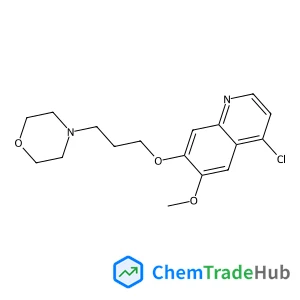
4-(3-((4-Chloro-6-methoxyquinolin-7-yl)oxy)propyl)morpholine
CAS Number:
205448-32-4
Molecular Formula:
C17H21ClN2O3
Hailong Che, Liao Peng, Qiquan Ye, Jun Guo, Ke Wang, Yen Wei, Jinying Yuan
CO2-responsive well-defined core–shell–corona structure magnetic Fe3O4@SiO2-poly(N,N-dimethylaminoethyl methacrylate) (PDMAEMA) nanocarriers have been developed as efficient drug delivery systems. The hybrid magnetic nanoparticles (MNPs) demonstrated a sandwich structure and highly super-paramagnetic biocompatibility properties as well as gas-responsive behavior. We found that the hydrodynamic radius (Rh) of the magnetic hybrid nanoparticles could be adjusted by alternate CO2/N2 treatment driving a switchable volume transition from contraction to expansion because of the CO2 responsiveness of PDMAEMA. The CO2-triggered protonation of the polymer shell gives rise to an obvious zeta potential change of the nanoparticles. Importantly, the CO2 induced reversible “on–off” transformation makes it possible to perform a dosage release of doxorubicin (DOX) in vitro in a time-controllable manner which is of great significance in controlled drug release. In the presence of CO2, the drug release rate is significantly accelerated, while low drug release could be achieved by removal of CO2 using N2. Moreover, the in vitro cytotoxicity test indicated that the CO2-responsive magnetic nanocarriers have good biocompatibility and could be safely used in living systems.
Roman Y. Pishchalnikov, Igor A. Yaroshevich, Tatiana A. Slastnikova, Aleksandr A. Ashikhmin, Alexey V. Stepanov, Ekaterina A. Slutskaya, Thomas Friedrich
DOI: 10.1039/C9CP04508B
P. Stange, A. Appelhagen, D. Michalik, D. Paschek
DOI: 10.1039/C9CP04983E
Trevor A. Profitt, Jason K. Pearson
DOI: 10.1039/C9CP03103K
Qihao Sun, Wenhui Yang, Yuanbo Cheng, Jiangpeng Dong, Mengqin Zhu, BinBin Zhang, Menghua Zhu, Wanqi Jie
DOI: 10.1039/D0CP04485G
Manish Singh, Rei Abe-Yoshizumi, Tatsuya Tsukuda
DOI: 10.1039/C9CP04991F
Donatella Loru, Annalisa Vigorito, Andreia F. M. Santos, Jackson Tang, M. Eugenia Sanz
DOI: 10.1039/C9CP05264J
Bastien Radola, Igor Bezverkhyy, Jean Marc Simon, José-Marcos Salazar, Mathieu Macaud, Jean Pierre Bellat
DOI: 10.1039/D0CP03871G
Wenyi Ding, Zhizhong Jiang, Jingping Xin, Min Zhang, Mingjie Zheng
DOI: 10.1039/C9CP05626B
Brielle L. Van Orman, Hoi-Ting Wu, Ryan R. Julian
DOI: 10.1039/D0CP04111D
C. Schwab, A. Höweling, A. Windmüller, J. Gonzalez-Julian, S. Möller, J. R. Binder, S. Uhlenbruck, O. Guillon
DOI: 10.1039/C9CP05128G
(5-Sulfamoyl-3-pyridinyl)boronic acid is primarily used in chemical synthesis, p...
Benzyl 2-methyl-2-(methylsulfonyl)-4-pentenoate is typically synthesized via est...
When handling 8-Fluoroquinolin-6-ol (CAS: 209353-22-0), it is important to use p...
1,3-Dibromo-5-(2-methyl-2-propanyl)benzene (CAS: 129316-09-2) is a crystalline c...
Ethyl 7-chloro-4-oxo-1-(1,3-thiazol-2-yl)-1,4-dihydro-1,8-naphthyridine-3-carbox...
When handling Delta-7-Avenasterol (CAS: 23290-26-8), it is important to wear app...
Proper handling involves the use of personal protective equipment such as gloves...
When handling 2-Methyl-2-proanyl 4-[(2-aminophenyl)amino]-1-piperidinecarboxylat...
N-Methyl-4-chlorobenzylamine hydrochloride (CAS: 65542-24-7) is a organic compou...
[2-(Dodecyloxy)ethoxy]acetic acid (CAS: 27306-90-7) is generally considered safe...

Polymer Chemistry welcomes submissions in all areas of polymer science that have a strong focus on macromolecular chemistry. Manuscripts may cover a broad range of fields, yet no direct application focus is required.
![[3-Fluoro-4-(1-pyrrolidinylcarbonyl)phenyl]boronic acid structure](https://static.chemtradehub.com/structs/874/874289-09-5-e3d4.webp "[3-Fluoro-4-(1-pyrrolidinylcarbonyl)phenyl]boronic acid structure")



