












The axial/equatorial conformational landscape and intramolecular dispersion: new insights from the rotational spectra of monoterpenoids
Literature Information
Publication Date
2019-11-14
DOI
10.1039/C9CP05264J
Impact Factor
3.676
Authors
Donatella Loru, Annalisa Vigorito, Andreia F. M. Santos, Jackson Tang, M. Eugenia Sanz
View Original
Abstract
Intramolecular non-covalent interactions determine the conformational preferences of many molecules, and their understanding is relevant for a proper description of molecular structure. Here, by using rotational spectroscopy in combination with quantum chemistry calculations, we show that intramolecular dispersion forces involving a three-carbon substituent influence the relative energies and conformational landscape of the three monoterpenoids carvone, limonene and perillaldehyde. New equatorial and axial conformers have been identified for all three molecules. Comparison of experimental data with ab initio and density functional calculations shows that axial conformers are stabilised by dispersion interactions between the cyclohexene ring and the isopropenyl group of the monoterpenoids, and that an accurate account of these interactions is challenging for theoretical methods. This work demonstrates the potential of rotational spectroscopy for investigating non-covalent interactions and provides critical benchmarks for theory. Our results will inform future investigations of axial/equatorial isomerism and impact understanding of intramolecular dispersion in larger species.
Recommended Journals
Related Literature
Photochemical switching of luminescence and singlet oxygen generation by chemical signal communication
Serena Silvi, Edwin C. Constable, Catherine E. Housecroft, Jonathon E. Beves, Emma L. Dunphy, Massimiliano Tomasulo, Françisco M. Raymo, Alberto Credi
2009-02-20
Communication
DOI: 10.1039/B900712A
Chemistry and structural determination of botcinolides, botcinins, and botcinic acids
Isamu Shiina, Hiroki Fukui
2008-12-03
Feature Article
DOI: 10.1039/B814375G
Verification of specific G-quadruplex structure by using a novel cyanine dye supramolecular assembly: I. Recognizing mixed G-quadruplex in human telomeres
Junfeng Xiang, Yalin Tang, Guangzhi Xu
2009-01-12
Communication
DOI: 10.1039/B820101C
Flagging up sunburn: a printable, multicomponent, UV-indicator that warns of the approach of erythema
Andrew Mills, Kate McDiarmid, Michael McFarlane, Pauline Grosshans
2009-02-10
Communication
DOI: 10.1039/B900569B
Evidence of strong hydrogen bonding by 8-aminoguanine
Aaron E. Engelhart, Thomas Hellman Morton, Nicholas V. Hud
2008-12-01
Communication
DOI: 10.1039/B818409G
One-pot noncovalent method to functionalize multi-walled carbon nanotubes using cyclomatrix-type polyphosphazenes
Jianwei Fu, Xiaobin Huang, Yawen Huang, Jiawei Zhang, Xiaozhen Tang
2008-12-22
Communication
DOI: 10.1039/B818071G
In situ antimony doping of solution-grown ZnOnanorods
Joe Briscoe, Diego E. Gallardo, Steve Dunn
2009-01-19
Communication
DOI: 10.1039/B820797F
Directed covalent assembly of rigid organic nanodisks using self-assembled temporary scaffolds‡
Samuel Tekobo, Eugene Pinkhassik
2009-01-06
Communication
DOI: 10.1039/B817598E
You might also like
Compound Q&A
What are the main uses of (5-Sulfamoyl-3-pyridinyl)boronic acid (CAS: 951233-61-7)?
(5-Sulfamoyl-3-pyridinyl)boronic acid is primarily used in chemical synthesis, p...
951233-61-7(5-Sulfamoyl-3-pyrid...
Compound Q&A
How is Benzyl 2-methyl-2-(methylsulfonyl)-4-pentenoate (CAS: 1942858-50-5) typically synthesized?
Benzyl 2-methyl-2-(methylsulfonyl)-4-pentenoate is typically synthesized via est...
1942858-50-5Benzyl 2-methyl-2-(m...
Compound Q&A
What precautions should be taken when handling 8-Fluoroquinolin-6-ol (CAS: 209353-22-0)?
When handling 8-Fluoroquinolin-6-ol (CAS: 209353-22-0), it is important to use p...
209353-22-08-Fluoroquinolin-6-o...
Compound Q&A
What are the physical and chemical properties of 1,3-Dibromo-5-(2-methyl-2-propanyl)benzene (CAS: 129316-09-2)?
1,3-Dibromo-5-(2-methyl-2-propanyl)benzene (CAS: 129316-09-2) is a crystalline c...
129316-09-21,3-Dibromo-5-(2-met...
Compound Q&A
What industries use Ethyl 7-chloro-4-oxo-1-(1,3-thiazol-2-yl)-1,4-dihydro-1,8-naphthyridine-3-carboxylate (CAS: 174726-87-5)?
Ethyl 7-chloro-4-oxo-1-(1,3-thiazol-2-yl)-1,4-dihydro-1,8-naphthyridine-3-carbox...
174726-87-5Ethyl 7-chloro-4-oxo...
Compound Q&A
What precautions should be taken when handling Delta-7-Avenasterol (CAS: 23290-26-8)?
When handling Delta-7-Avenasterol (CAS: 23290-26-8), it is important to wear app...
23290-26-8Delta-7-Avenasterol
Compound Q&A
What precautions should be taken when handling N-({(5R)-3-[3-Fluoro-4-(4-morpholinyl)phenyl]-2-oxo-1,3-oxazolidin-5-yl}methyl)acetamide (CAS: 872992-20-6)?
Proper handling involves the use of personal protective equipment such as gloves...
872992-20-6N-({(5R)-3-[3-Fluoro...
Compound Q&A
What precautions should be taken when handling 2-Methyl-2-proanyl 4-[(2-aminophenyl)amino]-1-piperidinecarboxylate (CAS: 79099-00-6)?
When handling 2-Methyl-2-proanyl 4-[(2-aminophenyl)amino]-1-piperidinecarboxylat...
79099-00-62-Methyl-2-propanyl ...
Compound Q&A
What is N-Methyl-4-chlorobenzylamine hydrochloride (CAS: 65542-24-7)?
N-Methyl-4-chlorobenzylamine hydrochloride (CAS: 65542-24-7) is a organic compou...
65542-24-7N-Methyl-4-chloroben...
Compound Q&A
Is [2-(Dodecyloxy)ethoxy]acetic acid (CAS: 27306-90-7) safe?
[2-(Dodecyloxy)ethoxy]acetic acid (CAS: 27306-90-7) is generally considered safe...
27306-90-7[2-(Dodecyloxy)ethox...
Source Journal
Physical Chemistry Chemical Physics

CiteScore:
5.5
Self-citation Rate:
10.3%
Articles per Year:
3036
Physical Chemistry Chemical Physics (PCCP) is an international journal co-owned by 19 physical chemistry and physics societies from around the world. This journal publishes original, cutting-edge research in physical chemistry, chemical physics and biophysical chemistry. To be suitable for publication in PCCP, articles must include significant innovation and/or insight into physical chemistry; this is the most important criterion that reviewers and Editors will judge against when evaluating submissions. The journal has a broad scope and welcomes contributions spanning experiment, theory, computation and data science. Topical coverage includes spectroscopy, dynamics, kinetics, statistical mechanics, thermodynamics, electrochemistry, catalysis, surface science, quantum mechanics, quantum computing and machine learning. Interdisciplinary research areas such as polymers and soft matter, materials, nanoscience, energy, surfaces/interfaces, and biophysical chemistry are welcomed if they demonstrate significant innovation and/or insight into physical chemistry. Joined experimental/theoretical studies are particularly appreciated when complementary and based on up-to-date approaches.
Recommended Compounds
![(4-Methyl-1H-benzo[d]imidazol-2-yl)methanamine structure](https://static.chemtradehub.com/structs/933/933756-31-1-7b0b.webp "(4-Methyl-1H-benzo[d]imidazol-2-yl)methanamine structure")
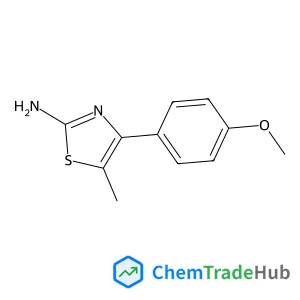
4-(4-Methoxyphenyl)-5-methyl-1,3-thiazol-2-amine
CAS Number:
105512-88-7
Molecular Formula:
C11H12N2OS
Recommended Suppliers





Disclaimer
This page provides academic journal information for reference and research purposes only. We are not affiliated with any journal publishers and do not handle publication submissions. For publication-related inquiries, please contact the respective journal publishers directly.
If you notice any inaccuracies in the information displayed, please contact us at support@chemtradehub.com. We will promptly review and address your concerns.