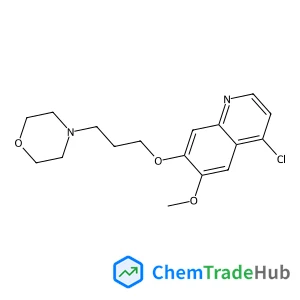
4-(3-((4-Chloro-6-methoxyquinolin-7-yl)oxy)propyl)morpholine
CAS Number:
205448-32-4
Molecular Formula:
C17H21ClN2O3
Qiongqin Mao, Kun Liu, Wen Li, Jiatao Yan, Afang Zhang
Using oligo(ethylene glycol)s (OEG)-modified β-cyclodextrin (CyD) as the building block, a new class of thermoresponsive polymers carrying CyD pendants with switchable inclusion ability are reported. Their synthesis, thermoresponsive behaviour and host–guest chemistry are described. Similar to other OEG-based polymers, these CyD polymers exhibit characteristic thermoresponsive properties. Their thermoresponsiveness and complexation behaviour are compared with their corresponding monomers to demonstrate the macromolecular effect. Notably, OEG moieties are found to cooperatively participate in the inclusion complexation with fluorescent dyes (guests). This cooperative interaction results in strong induced circular dichroism and significantly fluorescence enhancement from the guest dyes. These encapsulated guest dyes can be easily released at elevated temperature, associated with obvious fluorescence quenching, which makes these CyD polymers ideal candidates as scaffolds for thermoresponsive fluorescent sensors.
Henrique Bastos, Ricardo Bento, Nicolas Schaeffer, João A. P. Coutinho, Germán Pérez-Sánchez
DOI: 10.1039/D0CP04942E
DOI: 10.1039/C9CP04387J
O. Pacherova, N. Nepomniashchaia, V. Vetokhina, S. Cichon, T. Kocourek, A. Dejneka
DOI: 10.1039/D0CP03644G
Michael Fenech, Sean Lim, Jeffrey Cheung, Neeraj Sharma
DOI: 10.1039/C9CP05718H
Preetleen Kathuria, Stacey D. Wetmore, Purshotam Sharma
DOI: 10.1039/D0CP04921B
Tsan-Chuen Leung, Han Hu, An Ju Liu, Ming-Chieh Lin
DOI: 10.1039/C9CP04305E
Heyun Jiang, Shengsong Ge, Yu Zhang, Mei Liu, Jing Lin, Junxiang Wang, Zhanhu Guo
DOI: 10.1039/D0CP00431F
Gideon A. Lyngdoh, Rajesh Kumar, Sumanta Das
DOI: 10.1039/D0CP04646A
Niklas Gross, Stella Stopkowicz
DOI: 10.1039/D0CP04169F
Tuuva Kastinen, Demetrio Antonio da Silva Filho, Lassi Paunonen, Luiz Antonio Ribeiro Junior, Terttu I. Hukka
DOI: 10.1039/C9CP04837E
(5-Sulfamoyl-3-pyridinyl)boronic acid is primarily used in chemical synthesis, p...
Benzyl 2-methyl-2-(methylsulfonyl)-4-pentenoate is typically synthesized via est...
When handling 8-Fluoroquinolin-6-ol (CAS: 209353-22-0), it is important to use p...
1,3-Dibromo-5-(2-methyl-2-propanyl)benzene (CAS: 129316-09-2) is a crystalline c...
Ethyl 7-chloro-4-oxo-1-(1,3-thiazol-2-yl)-1,4-dihydro-1,8-naphthyridine-3-carbox...
When handling Delta-7-Avenasterol (CAS: 23290-26-8), it is important to wear app...
Proper handling involves the use of personal protective equipment such as gloves...
When handling 2-Methyl-2-proanyl 4-[(2-aminophenyl)amino]-1-piperidinecarboxylat...
N-Methyl-4-chlorobenzylamine hydrochloride (CAS: 65542-24-7) is a organic compou...
[2-(Dodecyloxy)ethoxy]acetic acid (CAS: 27306-90-7) is generally considered safe...

Polymer Chemistry welcomes submissions in all areas of polymer science that have a strong focus on macromolecular chemistry. Manuscripts may cover a broad range of fields, yet no direct application focus is required.
![2-Azaspiro[4.5]decane-3,8-dione structure](https://static.chemtradehub.com/structs/914/914780-96-4-e94b.webp "2-Azaspiro[4.5]decane-3,8-dione structure")