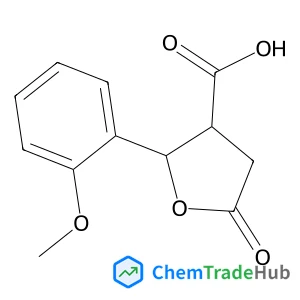
trans-2-(2-Methoxyphenyl)-5-oxotetrahydrofuran-3-carboxylic acid
CAS Number:
99226-02-5
Molecular Formula:
C12H12O5
C. R. Langford, D. W. Johnson, N. R. Cameron
Highly porous polymers (polyHIPEs) have been prepared by the photopolymerization of high internal phase emulsions (HIPEs) with varying ratios of thiol and acrylate monomers. The resulting polymers have a nominal porosity of 80%, and are seen to have a well-defined, interconnected pore morphology, with average pore diameters ranging from 30 to 60 μm. The polyHIPE polymers have been shown using a colourimetric (Ellman's) assay to contain residual thiols which are reactive towards a range of (meth)acrylates (hexafluoroisopropyl acrylate, fluorescein O-acrylate and poly(ethylene glycol) methyl ether methacrylate). Functionalization was explored using thermally- and UV-initiated radical-mediated “click” reactions and an amine-catalysed Michael addition reaction. The extent of functionalization was investigated qualitatively and quantitatively using a range of techniques (solid state NMR spectroscopy; FTIR spectroscopy; X-ray photoelectron spectroscopy (XPS); observation of fluorescence); high levels of conversion (up to 90–95%) were observed for the thermally-initiated radical reaction and the Michael reaction.
Alberto García-Vela, Iván Cabanillas-Vidosa, Juan C. Ferrero, Gustavo A. Pino
DOI: 10.1039/C2CP24061K
Yusuke Yamada, Kentaro Yano, Dachao Hong
DOI: 10.1039/C2CP00022A
David P. Penaloza, Jr., Koichiro Hori, Atsuomi Shundo
DOI: 10.1039/C2CP40284J
Nicolas Jouault, Yunjie Xiang, Emilie Moulin, Gad Fuks, Nicolas Giuseppone, Eric Buhler
DOI: 10.1039/C2CP23786E
Shiguo Zhang, Yan Zhang, Ying Wang, Shimin Liu, Youquan Deng
DOI: 10.1039/C2CP23675C
Andrey Yu. Rogachev, Alexander S. Filatov, Alexander V. Zabula, Marina A. Petrukhina
DOI: 10.1039/C2CP23442D
Dong-Hwa Seo, Hyungsub Kim, Kyu-Young Park
DOI: 10.1039/C2CP40082K
Patrick Rosa, Laure Vendier, Nicola Casati, Jean-François Létard, Azzedine Bousseksou, Philippe Guionneau, Gábor Molnár
DOI: 10.1039/C2CP23940J
David C. Clary
DOI: 10.1039/C2CP23689C
Madhurima Jana, Sanjoy Bandyopadhyay
DOI: 10.1039/C2CP24104H
3-Fluoro-2-methylbenzylamine is an organic compound with the CAS number 771573-3...
Tert-butyl 2-(oxetan-3-ylidene)acetate is considered safe for its intended uses ...
Proper personal protective equipment (PPE) such as gloves, goggles, and a lab co...
2-Ethyl-4-methyl-1,3-thiazole is commonly synthesized via the reaction of thiour...
This compound should be stored in a cool, dry place away from direct sunlight an...
L-Lysine Acetate Salt (CAS: 52315-92-1) is subject to various regulatory guideli...
6-Fluoro-3-hydroxy-2-pyrazinecarboxamide (CAS: 259793-96-9) is generally conside...
1,1'-Sulfonylbis(1H-imidazole) is a crystalline solid with a molecular weight of...
4-Methyl-7-nitro-1H-indole-3-carbonitrile (CAS: 289483-82-5) is primarily used i...
Waste containing 5-Bromo-3-indolyl-beta-galactoside (CAS: 97753-82-7) should be ...

Polymer Chemistry welcomes submissions in all areas of polymer science that have a strong focus on macromolecular chemistry. Manuscripts may cover a broad range of fields, yet no direct application focus is required.