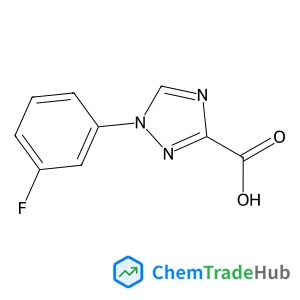
1-(3-Fluorophenyl)-1H-1,2,4-triazole-3-carboxylic acid
CAS Number:
1292369-51-7
Molecular Formula:
C9H6FN3O2
Shamon A. Walker, Devin T. Edwards, Ting Ann Siaw, Brandon D. Armstrong
In order to facilitate versatile applications with high field dynamic nuclear polarization (DNP), it is important to be able to optimize the DNP performance, i.e. reach high nuclear hyperpolarization within a short signal build up time. Given that the solid-state DNP process is strongly temperature-dependent, it is important to benchmark the temperature dependence of various DNP and electron paramagnetic resonance (EPR) parameters that can then be used to test and develop theories and models for high field DNP mechanisms. However, DNP and EPR experiments at high fields and cryogenic temperatures below 20 Kelvin usually require home built instrumentation, and therefore even basic experimental observations are lacking in the literature. DNP and EPR experiments at 7 T (197 GHz) and 8.5 T (240 GHz), respectively, were conducted at temperatures between 35 K and 3.7 K where the electron thermal polarization changes from 13.4% to 85.6%, respectively. The samples are frozen solutions of 15 mM OX063Me trityl radicals in various mixtures of [1-13C]pyruvic acid, glycerol, and Gd3+-chelates. For all sample mixtures, the trityl EPR lines are found to be inhomogeneously broadened and the dominant DNP mechanism is shown to be the cross effect (CE). A 20%, 11%, and 6.77% 13C polarization is achieved at 3.7 K with a [1-13C]pyruvic–glycerol–H2O sample, the addition of 2 mM of Gd3+-chelates, and pure [1-13C]pyruvic acid, respectively. When T1n is sufficiently long, our results seem to suggest T1e is a key variable in the DNP process, where longer T1e values correlate with larger DNP enhancements (εDNP). The experimental data reported here on the temperature dependence of T1n, T1e, Tm (electron phase memory time), the EPR linewidth, TDNP and εDNP at high fields will be helpful for testing the mechanism and theory of DNP processes.

Molecular Diversity

European Journal of Organic Chemistry

Nature Reviews Drug Discovery

Angewandte Chemie International Edition

Lab on a Chip

Physical Chemistry Chemical Physics

Green Chemistry

Photochemical & Photobiological Sciences

Journal of Enzyme inhibition and Medicinal Chemistry

Journal of Medical Biochemistry
Seon Joon Kim, Ohmin Kwon, Dae Woo Kim
DOI: 10.1039/C8CP02460J
Xiang-Yang Ren, Sha Xia, Nian-Ke Chen, Xue-Peng Wang, Dan Wang, Zhan-Guo Chen
DOI: 10.1039/C8CP03028F
Almudena Notario-Estévez, Piotr Kozłowski, Oliver Linnenberg, Xavier López, Kirill Yu. Monakhov
DOI: 10.1039/C8CP02669F
M. G. S. Costa, Y. F. Silva, P. R. Batista
DOI: 10.1039/C7CP07073J
Xing-Feng Tan, Bo Long, Da-Sen Ren, Zheng-Wen Long, Ellen Mitchell
DOI: 10.1039/C7CP07312G
Nirmali Prabha Das, Brigitta Müller, Ágota Tóth, Dezső Horváth, Gábor Schuszter
DOI: 10.1039/C8CP01798K
F. Meyer, M. Blum, Y. L. Jeyachandran, R. G. Wilks, W. Yang, M. Bär, F. Reinert, M. Zharnikov
DOI: 10.1039/C7CP07885D
Sheng-Lung Chou, Jen-Iu Lo, Yu-Chain Peng, Hsiao-Chi Lu, Bing-Ming Cheng
DOI: 10.1039/C8CP00078F
Shun-Jin Peng, Kai-Ming Wu, Kai-Lun Yao, Chee-Leung Mak, Chi-Hang Lam
DOI: 10.1039/C7CP08635K
Yemin Wang, Jie Cheng
DOI: 10.1039/C8CP02974A
Waste containing N-Methoxy-N-methyl-1,3-thiazole-5-carboxamide (CAS: 898825-89-3...
N-(4-Biphenylyl)dibenzo[b,d]furan-4-amine should be stored in a tightly sealed c...
The market for 3-Acetamido-5-amino-2,4,6-triiodobenzoic acid (CAS: 1713-07-1) is...
Benzyl 2-O-acetyl-3,4,6-tri-O-benzyl-beta-D-galactopyranoside (CAS: 61820-03-9) ...
2-Ethylpiperazine dihydrochloride (CAS: 438050-52-3) is regulated under the Glob...
1,1'-[1,3-Phenylenebis(methylene)]bis(3-methyl-1H-pyrrole-2,5-dione) (CAS: 11946...
Several alternatives can be used in the synthesis of 5-Fluoro-2-(1-pyrrolidinyl)...
Proper personal protective equipment (PPE) must be worn when handling this compo...
When handling 6-Bromoimidazo[1,2-a]pyridin-8-amine, it is important to wear appr...
Alternatives to (2S,4R)-4-(4-Nitrobenzyl)pyrrolidine-2-carboxylic acid hydrochlo...
Physical Chemistry Chemical Physics (PCCP) is an international journal co-owned by 19 physical chemistry and physics societies from around the world. This journal publishes original, cutting-edge research in physical chemistry, chemical physics and biophysical chemistry. To be suitable for publication in PCCP, articles must include significant innovation and/or insight into physical chemistry; this is the most important criterion that reviewers and Editors will judge against when evaluating submissions. The journal has a broad scope and welcomes contributions spanning experiment, theory, computation and data science. Topical coverage includes spectroscopy, dynamics, kinetics, statistical mechanics, thermodynamics, electrochemistry, catalysis, surface science, quantum mechanics, quantum computing and machine learning. Interdisciplinary research areas such as polymers and soft matter, materials, nanoscience, energy, surfaces/interfaces, and biophysical chemistry are welcomed if they demonstrate significant innovation and/or insight into physical chemistry. Joined experimental/theoretical studies are particularly appreciated when complementary and based on up-to-date approaches.