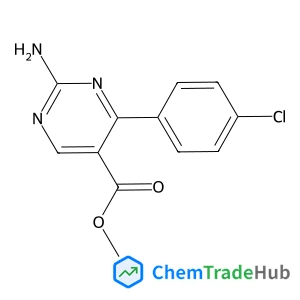
Methyl 2-amino-4-(4-chlorophenyl)-5-pyrimidinecarboxylate
CAS Number:
1133115-56-6
Molecular Formula:
C12H10ClN3O2
Amir Taheri, Changhui Liu, Bingbing Lai, Cheng Cheng, Xiaojuan Pan
A direct dehydrative coupling protocol for the synthesis of 3-vinylindoles using easily available indoles and simple ketones as substrates was developed with the aid of a sulfonyl-containing Brønsted acid ionic liquid. The salient features of this protocol are high synthetic efficiency, a metal- and solvent-free system, a recyclable catalyst, mild conditions and easy product isolation. With the ionic liquid catalyst, a hitherto unreported straightforward method for the construction of the indolo[3,2-b]carbazole skeleton was also developed using 2-hydroxymethylindole and acetophenone as starting materials.
Jean-Nicolas Dumez, Lyndon Emsley
DOI: 10.1039/C1CP00004G
Qiuju Zhang, Bo Li, Qinghong Yuan, Baihai Li, Zhifeng Liu, Liang Chen
DOI: 10.1039/C0CP01506G
Juan Soto, Francisco J. Avila, Juan C. Otero, Juan F. Arenas
DOI: 10.1039/C0CP01917H
P. Yang, Z. G. Wang, X. T. Zu, H. Y. Xiao, X. Sun, M. A. Khaleel, F. Gao
DOI: 10.1039/C0CP02001J
B. Grüner, M. Schlesinger, Ph. Heister, W. T. Strunz, F. Stienkemeier, M. Mudrich
DOI: 10.1039/C0CP02355H
Ryoji Kusaka, Satoshi Kokubu, Yoshiya Inokuchi, Takeharu Haino, Takayuki Ebata
DOI: 10.1039/C0CP02523B
M. Weser, E. N. Voloshina, K. Horn, Yu. S. Dedkov
DOI: 10.1039/C1CP00014D
Christine Lapouge, Jean-Paul Cornard
DOI: 10.1039/C0CP00714E
Yasutaka Kitahama, Yuhei Tanaka, Tamitake Itoh, Yukihiro Ozaki
DOI: 10.1039/C0CP02802A
B. Ostojić, P. Schwerdtfeger, B. Assadollahzadeh, Per Jensen
DOI: 10.1039/C0CP02996C
2-Methylbenzene-1,4-diamine dihydrochloride (CAS: 615-45-2) should be stored in ...
(1S,4S)-2,5-Diazabicyclo[2.2.1]heptane dihydrobromide is generally considered sa...
(6-Chloropyridazin-3-YL)methanamine finds applications in the pharmaceutical ind...
2-Fluoro-3-methylphenol is primarily used in the synthesis of pharmaceuticals, p...
When handling 3-Methoxy-4-nitrobenzonitrile, it is important to wear appropriate...
When handling 1,3-Oxazolo[4,5-b]pyridine-2(3H)-thione (CAS: 211949-57-4), it is ...
4-Ethynylbenzamide (CAS: 90347-86-7) falls under various regulatory guidelines i...
3-(2-Ethylphenyl)-2-thioxo-4-imidazolidinone is primarily used as an intermediat...
(2-Fluoro-6-methoxyphenyl)acetic acid, also known as 4-fluoro-3-methoxybenzoic a...
Market trends for 2-[4-(Hydroxymethyl)phenoxy]ethanol (CAS: 102196-18-9) indicat...

Green Chemistry provides a unique forum for the publication of innovative research on the development of alternative green and sustainable technologies. The scope of Green Chemistry is based on, but not limited to, the definition proposed by Anastas and Warner (Green Chemistry: Theory and Practice, P T Anastas and J C Warner, Oxford University Press, Oxford, 1998). Green chemistry is the utilisation of a set of principles that reduces or eliminates the use or generation of hazardous substances in the design, manufacture and application of chemical products. Green Chemistry is at the frontiers of this continuously-evolving interdisciplinary science and publishes research that attempts to reduce the environmental impact of the chemical enterprise by developing a technology base that is inherently non-toxic to living things and the environment. Submissions on all aspects of research relating to the endeavour are welcome. The journal publishes original and significant cutting-edge research that is likely to be of wide general appeal. To be published, work must present a significant advance in green chemistry. Papers must contain a comparison with existing methods and demonstrate advantages over those methods before publication can be considered. For more information please see this Editorial. Coverage includes the following, but is not limited to: Design (e.g. biomimicry, design for degradation/recycling/reduced toxicity…) Reagents & Feedstocks (e.g. renewables, CO2, solvents, auxiliary agents, waste utilization…) Synthesis (e.g. organic, inorganic, synthetic biology…) Catalysis (e.g. homogeneous, heterogeneous, enzyme, whole cell…) Process (e.g. process design, intensification, separations, recycling, efficiency…) Energy (e.g. renewable energy, fuels, photovoltaics, fuel cells, energy storage, energy carriers…) Applications (e.g. electronics, dyes, consumer products, coatings, pharmaceuticals, preservatives, building materials, chemicals for industry/agriculture/mining…) Impact (e.g. safety, metrics, LCA, sustainability, (eco)toxicology…) Green chemistry is, by definition, a continuously-evolving frontier. Therefore, the inclusion of a particular material or technology does not, of itself, guarantee that a paper is suitable for the journal. To be suitable, the novel advance should have the potential for reduced environmental impact relative to the state of the art. Green Chemistry does not normally deal with research associated with 'end-of-pipe' or remediation issues.
![5-Bromo-3-isopropyl-1H-pyrrolo[2,3-b]pyridine structure](https://static.chemtradehub.com/structs/125/1256819-54-1-8620.webp "5-Bromo-3-isopropyl-1H-pyrrolo[2,3-b]pyridine structure")