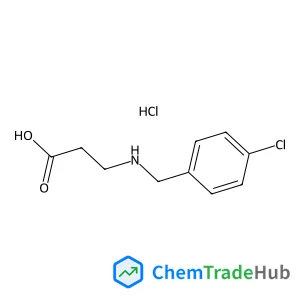
N-(4-Chlorobenzyl)-beta-alanine hydrochloride (1:1)
CAS Number:
1172479-10-5
Molecular Formula:
C10H13Cl2NO2
Adam M. Scheer, Oliver Welz, Subith S. Vasu, David L. Osborn, Craig A. Taatjes
The low-temperature oxidation of three cyclic ketones, cyclopentanone (CPO; C5H8O), cyclohexanone (CHO; C6H10O), and 2-methyl-cyclopentanone (2-Me-CPO; CH3–C5H7O), is studied between 550 and 700 K and at 4 or 8 Torr total pressure. Initial fuel radicals R are formed via fast H-abstraction from the ketones by laser-photolytically generated chlorine atoms. Intermediates and products from the subsequent reactions of these radicals in the presence of excess O2 are probed with time and isomeric resolution using multiplexed photoionization mass spectrometry with tunable synchrotron ionizing radiation. For CPO and CHO the dominant product channel in the R + O2 reactions is chain-terminating HO2-elimination yielding the conjugated cyclic coproducts 2-cyclopentenone and 2-cyclohexenone, respectively. Results on oxidation of 2-Me-CPO also show a dominant contribution from HO2-elimination. The photoionization spectrum of the co-product suggests formation of 2-methyl-2-cyclopentenone and/or 2-cyclohexenone, resulting from a rapid Dowd–Beckwith rearrangement, preceding addition to O2, of the initial (2-oxocyclopentyl)methyl radical to 3-oxocyclohexyl. Cyclic ethers, markers for hydroperoxyalkyl radicals (QOOH), key intermediates in chain-propagating and chain-branching low-temperature combustion pathways, are only minor products. The interpretation of the experimental results is supported by stationary point calculations on the potential energy surfaces of the associated R + O2 reactions at the CBS-QB3 level. The calculations indicate that HO2-elimination channels are energetically favored and product formation via QOOH is disfavored. The prominence of chain-terminating pathways linked with HO2 formation in low-temperature oxidation of cyclic ketones suggests little low-temperature reactivity of these species as fuels in internal combustion engines.
Jeane Bordini, Peter C. Ford, Elia Tfouni
DOI: 10.1039/B507407J
Mei-Ling Hong, Shun-Jun Ji, Yong-Chua Teo
DOI: 10.1039/B507768K
Jing Yang, Daniel Lévy, Wei Deng, Patrick Keller, Min-Hui Li
DOI: 10.1039/B508034G
Hui Hong, Tim Stinear, Paul Skelton, Jonathan B. Spencer, Peter F. Leadlay
DOI: 10.1039/B506835E
Tao Yang, Guobao Li, Liping You, Jing Ju, Fuhui Liao, Jianhua Lin
DOI: 10.1039/B506901G
Nicolai Dieltiens, Diederica D. Claeys, Bart Allaert, Francis Verpoort, Christian V. Stevens
DOI: 10.1039/B508663A
Waste containing N-Methoxy-N-methyl-1,3-thiazole-5-carboxamide (CAS: 898825-89-3...
N-(4-Biphenylyl)dibenzo[b,d]furan-4-amine should be stored in a tightly sealed c...
The market for 3-Acetamido-5-amino-2,4,6-triiodobenzoic acid (CAS: 1713-07-1) is...
Benzyl 2-O-acetyl-3,4,6-tri-O-benzyl-beta-D-galactopyranoside (CAS: 61820-03-9) ...
2-Ethylpiperazine dihydrochloride (CAS: 438050-52-3) is regulated under the Glob...
1,1'-[1,3-Phenylenebis(methylene)]bis(3-methyl-1H-pyrrole-2,5-dione) (CAS: 11946...
Several alternatives can be used in the synthesis of 5-Fluoro-2-(1-pyrrolidinyl)...
Proper personal protective equipment (PPE) must be worn when handling this compo...
When handling 6-Bromoimidazo[1,2-a]pyridin-8-amine, it is important to wear appr...
Alternatives to (2S,4R)-4-(4-Nitrobenzyl)pyrrolidine-2-carboxylic acid hydrochlo...

Physical Chemistry Chemical Physics (PCCP) is an international journal co-owned by 19 physical chemistry and physics societies from around the world. This journal publishes original, cutting-edge research in physical chemistry, chemical physics and biophysical chemistry. To be suitable for publication in PCCP, articles must include significant innovation and/or insight into physical chemistry; this is the most important criterion that reviewers and Editors will judge against when evaluating submissions. The journal has a broad scope and welcomes contributions spanning experiment, theory, computation and data science. Topical coverage includes spectroscopy, dynamics, kinetics, statistical mechanics, thermodynamics, electrochemistry, catalysis, surface science, quantum mechanics, quantum computing and machine learning. Interdisciplinary research areas such as polymers and soft matter, materials, nanoscience, energy, surfaces/interfaces, and biophysical chemistry are welcomed if they demonstrate significant innovation and/or insight into physical chemistry. Joined experimental/theoretical studies are particularly appreciated when complementary and based on up-to-date approaches.
![2-Methylbenzo[h]quinoline structure](https://static.chemtradehub.com/structs/605/605-88-9-ac43.webp "2-Methylbenzo[h]quinoline structure")