


Temperature driven p–n–p type conduction switching materials: current trends and future directions
Literature Information
Publication Date
2015-03-19
DOI
10.1039/C4CP06088A
Impact Factor
3.676
Authors
Satya N. Guin, Kanishka Biswas
View Original
Abstract
Modern technological inventions have been going through a “renaissance” period. Development of new materials and understanding of fundamental structure–property correlations are the important steps to move further for advanced technologies. In modern technologies, inorganic semiconductors are the leading materials which are extensively used for different applications. In the current perspective, we present discussion on an important class of materials that show fascinating p–n–p type conduction switching, which can have potential applications in diodes or transistor devices that operate reversibly upon temperature or voltage change. We highlight the key concepts, present the current fundamental understanding and show the latest developments in the field of p–n–p type conduction switching. Finally, we point out the major challenges and opportunities in this field.
Recommended Journals

Journal of Peptide Science

New Journal of Chemistry

Saudi Pharmaceutical Journal

Russian Journal of Organic Chemistry

Chemistry Education Research and Practice

Russian Journal of Bioorganic Chemistry

Journal of Saudi Chemical Society

Russian Chemical Bulletin

Current Opinion in Colloid & Interface Science

Russian Journal of Coordination Chemistry
Related Literature
Lithium intercalation and diffusion in TiO2 nanotubes: a first-principles investigation
Ke Liang, Xue Chen, Zhenyu Guo, Tingjun Hou, Xiaohong Zhang, Youyong Li
2016-08-05
Paper
DOI: 10.1039/C6CP03830A
Micelle formation of a non-ionic surfactant in non-aqueous molecular solvents and protic ionic liquids (PILs)
Frances Separovic, Calum J. Drummond, Tamar L. Greaves
2016-08-08
Paper
DOI: 10.1039/C6CP03332F
Tuning the thermal conductivity of methylammonium lead halide by the molecular substructure
Claudia Caddeo, Claudio Melis, Maria Ilenia Saba, Alessio Filippetti, Luciano Colombo, Alessandro Mattoni
2016-07-29
Paper
DOI: 10.1039/C6CP04246E
Nanostructured CuS networks composed of interconnected nanoparticles for asymmetric supercapacitors
Wenbin Fu, Weihua Han, Heming Zha, Junfeng Mei, Yunxia Li, Zemin Zhang, Erqing Xie
2016-08-08
Paper
DOI: 10.1039/C6CP02228F
Solvent H-bond accepting ability induced conformational change and its influence towards fluorescence enhancement and dual fluorescence of hydroxy meta-GFP chromophore analogue
Tanmay Chatterjee, Mrinal Mandal, Prasun K. Mandal
2016-08-05
Paper
DOI: 10.1039/C6CP04219H
Realizing controllable graphene nucleation by regulating the competition of hydrogen and oxygen during chemical vapor deposition heating
Zhi Jin, Xinyu Liu
2016-07-28
Paper
DOI: 10.1039/C6CP03102A
Influence of solvent polarity on the structure of drop-cast electroactive tetra(aniline)-surfactant thin films
Thomas G. Dane, Julia E. Bartenstein, Beatrice Sironi, Benjamin M. Mills, O. Alexander Bell, J. Emyr Macdonald, Thomas Arnold, Charl F. J. Faul, Wuge H. Briscoe
2016-08-12
Paper
DOI: 10.1039/C6CP05221E
Effects of water molecules on the chemical stability of MAGeI3 perovskite explored from a theoretical viewpoint
Ping-Ping Sun, Wei-Jie Chi, Ze-Sheng Li
2016-08-01
Paper
DOI: 10.1039/C6CP04344E
A strategy to achieve enhanced electromagnetic interference shielding at low concentration with a new generation of conductive carbon black in a chlorinated polyethylene elastomeric matrix
Subhadip Mondal, Sayan Ganguly, Mostafizur Rahaman, Ali Aldalbahi, Tapan K. Chaki, Dipak Khastgir, Narayan Ch. Das
2016-08-19
Paper
DOI: 10.1039/C6CP04274K
Utilization of the Donnan potential induced by reverse salt flux in pressure retarded osmosis systems
Chul Ho Park, Sung Jo Kwak, Joo-Youn Nam, Moon Seok Jang, Jung-Hyun Lee
2016-08-15
Communication
DOI: 10.1039/C6CP03939A
You might also like
Compound Q&A
Is 2-(2-chloroacetamido)-3-phenylpropanoic acid (CAS: 7765-11-9) safe?
2-(2-Chloroacetamido)-3-phenylpropanoic acid (CAS: 7765-11-9) is generally consi...
7765-11-92-(2-chloroacetamido...
Compound Q&A
Is 2-(Benzyloxy)-5-bromobenzoic acid (CAS: 62176-31-2) safe?
2-(Benzyloxy)-5-bromobenzoic acid can be handled safely if appropriate precautio...
62176-31-22-(Benzyloxy)-5-brom...
Compound Q&A
What is (4-Methyl-1,2,5-oxadiazol-3-yl)methanamine hydrochloride (CAS: 1159825-48-5)?
(4-Methyl-1,2,5-oxadiazol-3-yl)methanamine hydrochloride is a chemical compound ...
1159825-48-5(4-Methyl-1,2,5-oxad...
Compound Q&A
What is 2-(5-Hexylthiophen-2-yl)-4,4,5,5-tetramethyl-1,3,2-dioxaborolane (CAS: 917985-54-7)?
2-(5-Hexylthiophen-2-yl)-4,4,5,5-tetramethyl-1,3,2-dioxaborolane (CAS: 917985-54...
917985-54-72-(5-Hexylthiophen-2...
Compound Q&A
Are there alternatives to 4-(8-Methyl-9H-1,3-dioxolo[4,5-h][2,3]benzodiazepin-5-yl)benzenamine (CAS: 102771-26-6) in synthesis?
While 4-(8-Methyl-9H-1,3-dioxolo[4,5-h][2,3]benzodiazepin-5-yl)benzenamine (CAS:...
102771-26-64-(8-Methyl-9H-1,3-d...
Compound Q&A
What is the market or research trend for tert-butyl 3-hydroxy-4,5,7,8-tetrahydro-2H-pyrazolo[3,4-d]azepine-6-carboxylate (CAS: 851376-80-2)?
The market for tert-butyl 3-hydroxy-4,5,7,8-tetrahydro-2H-pyrazolo[3,4-d]azepine...
851376-80-2tert-butyl 3-hydroxy...
Compound Q&A
How should waste containing 3,5-Diamino-1H-pyrazole-4-carbonitrile (CAS: 6844-58-2) be handled?
Waste containing 3,5-Diamino-1H-pyrazole-4-carbonitrile (CAS: 6844-58-2) should ...
6844-58-23,5-Diamino-1H-pyraz...
Compound Q&A
How is (6-Fluoro-3-pyridinyl)boronic acid (CAS: 351019-18-6) typically synthesized?
(6-Fluoro-3-pyridinyl)boronic acid can be synthesized through the reaction of 6-...
351019-18-6(6-Fluoro-3-pyridiny...
Compound Q&A
What industries use Dibenzyl carbonimidoylbiscarbamate (CAS: 10065-79-9)?
Dibenzyl carbonimidoylbiscarbamate (CAS: 10065-79-9) finds applications in vario...
10065-79-9Dibenzyl carbonimido...
Compound Q&A
What is the market or research trend for (beta,beta,2,3,4,5,6-~2~H_7_)Phenylalanine (CAS: 74228-83-4)?
The market for (beta,beta,2,3,4,5,6-~2~H_7_)Phenylalanine (CAS: 74228-83-4) is g...
74228-83-4(beta,beta,2,3,4,5,6...
Source Journal
Physical Chemistry Chemical Physics

CiteScore:
5.5
Self-citation Rate:
10.3%
Articles per Year:
3036
Physical Chemistry Chemical Physics (PCCP) is an international journal co-owned by 19 physical chemistry and physics societies from around the world. This journal publishes original, cutting-edge research in physical chemistry, chemical physics and biophysical chemistry. To be suitable for publication in PCCP, articles must include significant innovation and/or insight into physical chemistry; this is the most important criterion that reviewers and Editors will judge against when evaluating submissions. The journal has a broad scope and welcomes contributions spanning experiment, theory, computation and data science. Topical coverage includes spectroscopy, dynamics, kinetics, statistical mechanics, thermodynamics, electrochemistry, catalysis, surface science, quantum mechanics, quantum computing and machine learning. Interdisciplinary research areas such as polymers and soft matter, materials, nanoscience, energy, surfaces/interfaces, and biophysical chemistry are welcomed if they demonstrate significant innovation and/or insight into physical chemistry. Joined experimental/theoretical studies are particularly appreciated when complementary and based on up-to-date approaches.
Recommended Compounds
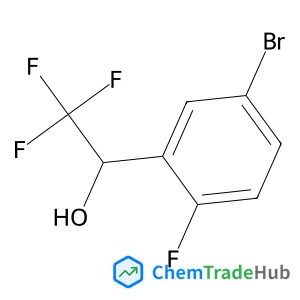
1-(5-Bromo-2-fluorophenyl)-2,2,2-trifluoroethanol
CAS Number:
1039827-16-1
Molecular Formula:
C8H5BrF4O
Recommended Suppliers





Disclaimer
This page provides academic journal information for reference and research purposes only. We are not affiliated with any journal publishers and do not handle publication submissions. For publication-related inquiries, please contact the respective journal publishers directly.
If you notice any inaccuracies in the information displayed, please contact us at support@chemtradehub.com. We will promptly review and address your concerns.