


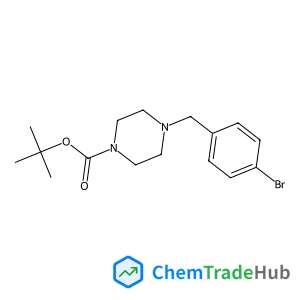
2-Methyl-2-propanyl 4-(4-bromobenzyl)-1-piperazinecarboxylate
CAS Number:
844891-10-7
Molecular Formula:
C16H23BrN2O2
Pamir Nag, Dhananjay Nandi
Complete dissociation dynamics in electron attachment to carbon monoxide (CO) have been studied using the newly developed velocity slice imaging (VSI) technique. Both kinetic energy and angular distributions of O− ions formed by dissociative electron attachment (DEA) to CO molecules have been measured for 9, 9.5, 10, 10.5, 11, and 11.5 eV incident electron energies around the resonance. Detailed observations conclusively show that two separate DEA reactions lead to the formation of O− ions in the ground 2P state along with the neutral C atoms in the ground 3P state and the first excited 1D state, respectively. Within the axial recoil approximation and involving four partial waves, our angular distribution results clearly indicate that the two reactions leading to O− formation proceed through the specific resonant state(s). For the first process, more than one intermediate state is involved. On the other hand, for the second process, only one state is involved. The observed forward–backward asymmetry is explained in terms of the interference between the different partial waves that are involved in the processes.

Foundations of Chemistry

Angewandte Chemie International Edition

Journal of Medical Biochemistry

Environmental Toxicology and Pharmacology

Advanced Engineering Materials

Journal of Enzyme inhibition and Medicinal Chemistry

CrystEngComm

Contact Lens & Anterior Eye

Physical Chemistry Chemical Physics

Molecules
Robert J. Deeth, David L. Foulis
DOI: 10.1039/B203815C
Andreas Hertwig, Horst Hippler, Andreas-N. Unterreiner
DOI: 10.1039/B204530N
Patrick Gélin, Laurent Périer-Camby, Hélène Praliaud, Gérard Thomas
DOI: 10.1039/B206336K
Bernd Giese, Don McNaughton
DOI: 10.1039/B203829C
James R. Petherbridge, Paul W. May, Edward J. Crichton, Keith N. Rosser, Michael N. R. Ashfold
DOI: 10.1039/B206034P
J. Dobkowski, W. Rettig, J. Waluk
DOI: 10.1039/B204749G
Yu-Mei Xing, Xiu-Fang Xu, Lan Chen, Zun-Sheng Cai, Xue-Zhuang Zhao, Jin-Pei Cheng
DOI: 10.1039/B202613A
Björn Klotz, Rainer Volkamer, Michael D. Hurley, Mads P. Sulbaek Andersen, Ole John Nielsen, Ian Barnes, Takashi Imamura, Klaus Wirtz, Karl-Heinz Becker, Ulrich Platt, Timothy J. Wallington, Nobuaki Washida
DOI: 10.1039/B204398J
Xin Zhou, Ai-Min Ren, Ji-Kang Feng, Xiao-Juan Liu, Junxiang Zhang, Juzheng Liu
DOI: 10.1039/B203808K
Waste containing 2-Ethyl-4-Methyl-1H-Imidazole-5-Carbaldehyde (CAS: 88634-80-4) ...
Triethoxy(octyl)silane (CAS: 1385031-14-0) is widely used in the pharmaceuticals...
Several alternatives to 3-iodo-7-nitro-1H-indazole (CAS: 864724-64-1) exist in t...
Yes, there are alternatives to Benzene, bis[(trimethoxysilyl)ethyl] (CAS: 266317...
Isothiazole-3-carbonitrile (CAS: 1452-17-1) is generally considered safe when us...
(3-Chlorophenyl)methanol (CAS: 873-63-2) is considered low to moderately toxic. ...
(2S,3S)-2-Hydroxy-3-({[(2-methyl-2-propanyl)oxy]carbonyl}amino)-3-(2-naphthyl)pr...
Proper handling of methyl 2-(bromomethyl)-5-methoxybenzoate requires the use of ...
6,8-Dibromoimidazo[1,2-a]pyridine-2-carboxylic acid (CAS: 904805-36-3) is an aro...
3-Amino-5-bromo-2-pyridinecarbonitrile is considered safe when handled under pro...
Physical Chemistry Chemical Physics (PCCP) is an international journal co-owned by 19 physical chemistry and physics societies from around the world. This journal publishes original, cutting-edge research in physical chemistry, chemical physics and biophysical chemistry. To be suitable for publication in PCCP, articles must include significant innovation and/or insight into physical chemistry; this is the most important criterion that reviewers and Editors will judge against when evaluating submissions. The journal has a broad scope and welcomes contributions spanning experiment, theory, computation and data science. Topical coverage includes spectroscopy, dynamics, kinetics, statistical mechanics, thermodynamics, electrochemistry, catalysis, surface science, quantum mechanics, quantum computing and machine learning. Interdisciplinary research areas such as polymers and soft matter, materials, nanoscience, energy, surfaces/interfaces, and biophysical chemistry are welcomed if they demonstrate significant innovation and/or insight into physical chemistry. Joined experimental/theoretical studies are particularly appreciated when complementary and based on up-to-date approaches.
![2,2'-[(Abieta-8,11,13-trien-18-ylimino)bis(2,1-ethanediyloxy)]diethanol structure](https://static.chemtradehub.com/structs/513/51344-62-8-8518.webp "2,2'-[(Abieta-8,11,13-trien-18-ylimino)bis(2,1-ethanediyloxy)]diethanol structure")





