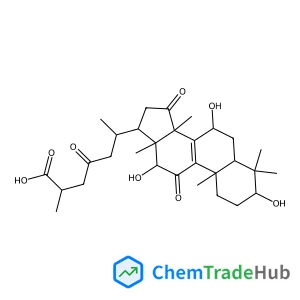
(3beta,7beta,12beta)-3,7,12-Trihydroxy-11,15,23-trioxolanost-8-en-26-oic acid
CAS Number:
98665-22-6
Molecular Formula:
C30H44O8
Ting-Ting Zhou, Jian-Feng Lou, Hua-Jie Song
The anisotropic shock sensitivity in a single crystal δ-cyclotetramethylene tetranitramine (δ-HMX) was investigated using the compress-shear reactive dynamics (CS-RD) computational protocol. Significant anisotropies in the thermo-mechanical and chemical responses were found by measuring the shear stress, energy, temperature, and chemical reactions during the dynamical process for the shock directions perpendicular to the (100), (010), (001), (110), (101), (011), and (111) planes. We predict that δ-HMX is sensitive for the shocks perpendicular to the (111), (011), (110), and (101) planes, which is intermediate to the (100) and (010) plane and is insensitive to the (001) plane. The internal energy accumulated within the duration of the surmounting shear stress barrier is a useful criterion to distinguish the sensitive directions from the less sensitive ones. The molecular origin of the anisotropic sensitivity is suggested to be the intermolecular steric arrangements across a slip plane induced by shock compression. The shear deformation induced by the shock along the sensitive direction encounters strong intermolecular contacts and has small intermolecular free space for geometry relaxation when the molecules collide, leading to high shear stress barriers and energy accumulation, which benefits the temperature increase and initial chemical bond breaking that trigger further reactions.
Mathieu A. Ayer, Cheyenne H. Liu, Christoph Weder
DOI: 10.1039/D1PY00420D
Georg M. Scheutz, Justine Elgoyhen, Kyle C. Bentz, Hao Sun, Junpeng Zhao, Daniel A. Savin, Brent S. Sumerlin
DOI: 10.1039/D1PY00780G
Ayano Ishida, Shunichi Fujii, Akifumi Sumida, Tasuku Kamitani, Saori Minami, Kenji Urayama, Hiroaki Imoto
DOI: 10.1039/D1PY00346A
Vincent Bouad, Marc Guerre, Sami Zeliouche, Bruno Améduri, Cédric Totée, Gilles Silly, Rinaldo Poli, Vincent Ladmiral
DOI: 10.1039/D0PY01753A
Marc Guerre, Cédric Totée, Gilles Silly, Olinda Gimello, Bruno Améduri, Jean-François Tahon, Rinaldo Poli, Sophie Barrau, Vincent Ladmiral
DOI: 10.1039/D0PY01754J
DOI: 10.1039/D1PY00313E
Brian J. Ree, Yusuke Satoh, Takuya Isono, Toshifumi Satoh
DOI: 10.1039/D1PY00421B
Xabier Lopez de Pariza, Nicolas Zivic, Fernando Ruipérez, Timothy E. Long, Haritz Sardon
DOI: 10.1039/D1PY00734C
Yunkai Dai, Zhitao Hu, Xiaoying Wang, Xingliang Liu, Yuanchao Li, Yi Shi, Yongming Chen
DOI: 10.1039/D1PY00106J
When handling 4-(2-Furylmethyl)thiomorpholine 1,1-dioxide (CAS: 79206-94-3), it ...
When handling 4-Chloro-N-[2-(4-morpholinyl)ethyl]benzamide (CAS: 71320-77-9), it...
Waste containing this compound (CAS: 62921-74-8) should be handled according to ...
Waste containing (S)-Methyl 2-amino-3-cyclohexylpropanoate should be collected i...
This compound can be synthesized using a multi-step process involving the conjug...
There are several alternatives to (2E)-3-(3,4-Dichlorophenyl)acrylic acid in syn...
Ethyl 6-(2-nitrophenyl)imidazo[2,1-b][1,3]thiazole-3-carboxylate (CAS: 925437-84...
Waste containing 2-(1,3-Thiazol-2-yl)ethanamine (CAS: 18453-07-1) should be coll...
Methyl 5-iodo-2-methylbenzoate can be synthesized through the iodination of meth...
5-Chloro[1,2,4]triazolo[1,5-a]pyridine is commonly synthesized via the condensat...

Physical Chemistry Chemical Physics (PCCP) is an international journal co-owned by 19 physical chemistry and physics societies from around the world. This journal publishes original, cutting-edge research in physical chemistry, chemical physics and biophysical chemistry. To be suitable for publication in PCCP, articles must include significant innovation and/or insight into physical chemistry; this is the most important criterion that reviewers and Editors will judge against when evaluating submissions. The journal has a broad scope and welcomes contributions spanning experiment, theory, computation and data science. Topical coverage includes spectroscopy, dynamics, kinetics, statistical mechanics, thermodynamics, electrochemistry, catalysis, surface science, quantum mechanics, quantum computing and machine learning. Interdisciplinary research areas such as polymers and soft matter, materials, nanoscience, energy, surfaces/interfaces, and biophysical chemistry are welcomed if they demonstrate significant innovation and/or insight into physical chemistry. Joined experimental/theoretical studies are particularly appreciated when complementary and based on up-to-date approaches.