












Stacked functionalized silicene: a powerful system to adjust the electronic structure of silicene
Literature Information
Publication Date
2015-01-12
DOI
10.1039/C4CP05331A
Impact Factor
3.676
Authors
View Original
Abstract
Herein, we employed first principle density functional periodic calculations to characterize the silicon counterpart of graphene:silicene. We found that silicene is far more reactive than graphene, very stable and strong Si–X bonds can be formed, where X = H, CH3, OH and F. The Si–F bond is the strongest one, with a binding energy of 114.9 kcal mol−1. When radicals are agglomerated, the binding energy per functional grows up to 17 kcal mol−1. The functionalization with OH radicals produces the largest alterations of the structure of silicene, due to the presence of intralayer hydrogen bonds. The covalent addition of H, CH3, OH and F to silicene enables the adjustment of its electronic structure. In effect, functionalized silicene can be a semiconductor or even exhibit metallic properties when the type and concentration of radicals are varied. The most interesting results were obtained when two layers of functionalized silicene were stacked, given that the band gaps experienced a significant reduction with respect to those computed for symmetrically and asymmetrically (Janus) functionalized monolayer silicenes. In the case of fluorine, the largest changes in the electronic structure of bilayer silicene were appreciated when at least one side of silicene was completely fluorinated. In general, the fluorinated side induces metallic properties in a large number of functionalized silicenes. In some cases which presented band gaps as large as 3.2 eV when isolated, the deposition over fluorinated silicene was able to close that gap and induce a metallic character. In addition to this, in four cases small gaps in the range of 0.1–0.6 eV were obtained for bilayer silicenes. Therefore, functionalization of silicene is a powerful method to produce stable two-dimensional silicon based nanomaterials with tunable optical band gaps.
Related Literature
In vivo modulation of ubiquitin chains by N-methylated non-proteinogenic cyclic peptides
Mickal Nawatha, Betsegaw Lemma, Ganga B. Vamisetti, Ido Livneh, Uri Barash, Israel Vlodavsky, Aaron Ciechanover, David Fushman, Hiroaki Suga, Ashraf Brik
2020-12-16
Paper
DOI: 10.1039/D0CB00179A
Modified internucleoside linkages for nuclease-resistant oligonucleotides
Guillaume Clavé, Maeva Reverte, Jean-Jacques Vasseur, Michael Smietana
2020-12-08
Review Article
DOI: 10.1039/D0CB00136H
Short oligoalanine helical peptides for supramolecular nanopore assembly and protein cytosolic delivery
Marta Pazo, Giulia Salluce, Irene Lostalé-Seijo, Marisa Juanes, Rebeca Garcia-Fandiño, Javier Montenegro
2020-12-08
Paper
DOI: 10.1039/D0CB00103A
Fluorescent macrolide probes – synthesis and use in evaluation of bacterial resistance
M. Rhia L. Stone, Urszula Łapińska, Stefano Pagliara, Muriel Masi, Joanne T. Blanchfield, Matthew A. Cooper, Mark A. T. Blaskovich
2020-11-17
Paper
DOI: 10.1039/D0CB00118J
Harnessing the PD-L1 interface peptide for positron emission tomography imaging of the PD-1 immune checkpoint
Kuan Hu, Lin Xie, Masayuki Hanyu, Yiding Zhang, Lingyun Li, Xiaohui Ma, Kotaro Nagatsu, Hisashi Suzuki, Weizhi Wang, Ming-Rong Zhang
2020-08-27
Paper
DOI: 10.1039/D0CB00070A
Reactive oxygen species, proinflammatory and immunosuppressive mediators induced in COVID-19: overlapping biology with cancer
2021-06-30
Review Article
DOI: 10.1039/D1CB00042J
Combining bacteriophage engineering and linear dichroism spectroscopy to produce a DNA hybridisation assay
Haydn A. Little, Jake G. Carter, Craig Douglas, Matthew R. Hicks, David M. Kenyon, Christophe Lacomme, Richard T. Logan, Timothy R. Dafforn, James H. R. Tucker
2020-10-23
Paper
DOI: 10.1039/D0CB00135J
One-step mild biorefinery of functional biomolecules from microalgae extracts
Rupali K. Desai, Hélène Monteillet, Xiaohua Li, Boelo Schuur, J. Mieke Kleijn, Frans A. M. Leermakers, Michel H. M. Eppink
2017-11-17
Paper
DOI: 10.1039/C7RE00116A
Advances in single-cell multi-omics profiling
Dongsheng Bai, Jinying Peng
2021-01-20
Review Article
DOI: 10.1039/D0CB00163E
You might also like
Compound Q&A
How should waste containing N-Methoxy-N-methyl-1,3-thiazole-5-carboxamide (CAS: 898825-89-3) be handled?
Waste containing N-Methoxy-N-methyl-1,3-thiazole-5-carboxamide (CAS: 898825-89-3...
898825-89-3N-Methoxy-N-methyl-1...
Compound Q&A
How should N-(4-Biphenylyl)dibenzo[b,d]furan-4-amine (CAS: 1318338-47-4) be stored?
N-(4-Biphenylyl)dibenzo[b,d]furan-4-amine should be stored in a tightly sealed c...
1318338-47-4N-(4-Biphenylyl)dibe...
Compound Q&A
What is the market or research trend for 3-Acetamido-5-amino-2,4,6-triiodobenzoic acid (CAS: 1713-07-1)?
The market for 3-Acetamido-5-amino-2,4,6-triiodobenzoic acid (CAS: 1713-07-1) is...
1713-07-13-Acetamido-5-amino-...
Compound Q&A
How should Benzyl 2-O-acetyl-3,4,6-tri-O-benzyl-beta-D-galactopyranoside (CAS: 61820-03-9) be stored?
Benzyl 2-O-acetyl-3,4,6-tri-O-benzyl-beta-D-galactopyranoside (CAS: 61820-03-9) ...
61820-03-9Benzyl 2-O-acetyl-3,...
Compound Q&A
What regulatory guidelines apply to 2-Ethylpiperazine dihydrochloride (CAS: 438050-52-3)?
2-Ethylpiperazine dihydrochloride (CAS: 438050-52-3) is regulated under the Glob...
438050-52-32-Ethylpiperazine di...
Compound Q&A
What regulatory guidelines apply to 1,1'-[1,3-Phenylenebis(methylene)]bis(3-methyl-1H-pyrrole-2,5-dione) (CAS: 119462-56-5)?
1,1'-[1,3-Phenylenebis(methylene)]bis(3-methyl-1H-pyrrole-2,5-dione) (CAS: 11946...
119462-56-51,1'-[1,3-Phenyleneb...
Compound Q&A
Are there alternatives to 5-Fluoro-2-(1-pyrrolidinyl)pyridine (CAS: 1287217-79-1) in synthesis?
Several alternatives can be used in the synthesis of 5-Fluoro-2-(1-pyrrolidinyl)...
1287217-79-15-Fluoro-2-(1-pyrrol...
Compound Q&A
What precautions should be taken when handling 1-((2R,3R,4R,5R)-5-((bis(4-methoxyphenyl)(phenyl)methoxy)methyl)-4-hydroxy-3-methoxytetrahydrofuran-2-yl)-5-methylpyrimidine-2,4(1H,3H)-dione (CAS: 153631-19-7)?
Proper personal protective equipment (PPE) must be worn when handling this compo...
153631-19-71-((2R,3R,4R,5R)-5-(...
Compound Q&A
What precautions should be taken when handling 6-Bromoimidazo[1,2-a]pyridin-8-amine (CAS: 676371-00-9)?
When handling 6-Bromoimidazo[1,2-a]pyridin-8-amine, it is important to wear appr...
676371-00-96-Bromoimidazo[1,2-a...
Compound Q&A
Are there alternatives to (2S,4R)-4-(4-Nitrobenzyl)pyrrolidine-2-carboxylic acid hydrochloride (CAS: 1049740-22-8) in synthesis?
Alternatives to (2S,4R)-4-(4-Nitrobenzyl)pyrrolidine-2-carboxylic acid hydrochlo...
1049740-22-8(2S,4R)-4-(4-Nitrobe...
Source Journal
Physical Chemistry Chemical Physics

CiteScore:
5.5
Self-citation Rate:
10.3%
Articles per Year:
3036
Physical Chemistry Chemical Physics (PCCP) is an international journal co-owned by 19 physical chemistry and physics societies from around the world. This journal publishes original, cutting-edge research in physical chemistry, chemical physics and biophysical chemistry. To be suitable for publication in PCCP, articles must include significant innovation and/or insight into physical chemistry; this is the most important criterion that reviewers and Editors will judge against when evaluating submissions. The journal has a broad scope and welcomes contributions spanning experiment, theory, computation and data science. Topical coverage includes spectroscopy, dynamics, kinetics, statistical mechanics, thermodynamics, electrochemistry, catalysis, surface science, quantum mechanics, quantum computing and machine learning. Interdisciplinary research areas such as polymers and soft matter, materials, nanoscience, energy, surfaces/interfaces, and biophysical chemistry are welcomed if they demonstrate significant innovation and/or insight into physical chemistry. Joined experimental/theoretical studies are particularly appreciated when complementary and based on up-to-date approaches.
Recommended Compounds

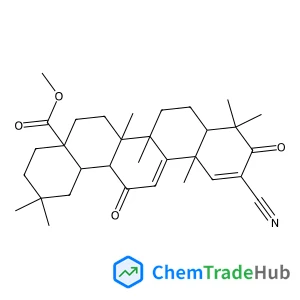
Methyl 2-cyano-3,12-dioxooleana-1,9(11)-dien-28-oate
CAS Number:
218600-53-4
Molecular Formula:
C32H43NO4
Recommended Suppliers




Disclaimer
This page provides academic journal information for reference and research purposes only. We are not affiliated with any journal publishers and do not handle publication submissions. For publication-related inquiries, please contact the respective journal publishers directly.
If you notice any inaccuracies in the information displayed, please contact us at support@chemtradehub.com. We will promptly review and address your concerns.