













In vivo modulation of ubiquitin chains by N-methylated non-proteinogenic cyclic peptides
Literature Information
Publication Date
2020-12-16
DOI
10.1039/D0CB00179A
Impact Factor
0
Authors
Mickal Nawatha, Betsegaw Lemma, Ganga B. Vamisetti, Ido Livneh, Uri Barash, Israel Vlodavsky, Aaron Ciechanover, David Fushman, Hiroaki Suga, Ashraf Brik
View Original
Abstract
Cancer and other disease states can change the landscape of proteins post-translationally tagged with ubiquitin (Ub) chains. Molecules capable of modulating the functions of Ub chains are potential therapeutic agents, but their discovery represents a significant challenge. Recently, it was shown that de novo cyclic peptides, selected from trillion-member random libraries, are capable of binding particular Ub chains. However, these peptides were overwhelmingly proteinogenic, so the prospect of in vivo activity was uncertain. Here, we report the discovery of small, non-proteinogenic cyclic peptides, rich in non-canonical features like N-methylation, which can tightly bind Lys48-linked Ub chains. These peptides engage three Lys48-linked Ub units simultaneously, block the action of deubiquitinases and the proteasome, induce apoptosis in vitro, and attenuate tumor growth in vivo. This highlights the potential of non-proteinogenic cyclic peptide screening to rapidly find in vivo-active leads, and the targeting of ubiquitin chains as a promising anti-cancer mechanism of action.
Related Literature
Surface chemistry of propanal, 2-propenol, and 1-propanol on Ru(001)
Dominic A. Esan, Michael Trenary
2017-03-06
Paper
DOI: 10.1039/C6CP08893G
Back-exchange: a novel approach to quantifying oxygen diffusion and surface exchange in ambient atmospheres
Samuel J. Cooper, Mathew Niania, Franca Hoffmann, John A. Kilner
2017-04-27
Paper
DOI: 10.1039/C7CP01317E
Impact of lipid composition and photosensitizer hydrophobicity on the efficiency of light-triggered liposomal release
Julien Massiot, Ali Makky, Florent Di Meo, David Chapron, Véronique Rosilio
2017-04-04
Paper
DOI: 10.1039/C7CP00983F
Rovibrational spectroscopic constants of the interaction between ammonia and metallo-phthalocyanines: a theoretical protocol for ammonia sensor design
Daniel F. S. Machado, Valter H. Carvalho-Silva, Leonardo G. Paterno, Heibbe Cristhian B. de Oliveira
2017-02-15
Paper
DOI: 10.1039/C6CP07900H
CH stretching excitation promotes its cleavage in the F + CHD3(ν1 = 1) → HF + CD3 reaction at low collision energies
Jiayue Yang, Bo Jiang
2017-04-27
Paper
DOI: 10.1039/C7CP01428G
Determination of paramagnetic concentrations inside a diamagnetic matrix using solid-state NMR
Sébastien Maron, Nadège Ollier, Thierry Gacoin, Géraldine Dantelle
2017-04-11
Paper
DOI: 10.1039/C7CP00451F
A thermodynamic model to predict electron mobility in superfluid helium
Frédéric Aitken, Ferdinand Volino, Luis Guillermo Mendoza-Luna, Klaus von Haeften, Jussi Eloranta
2017-05-23
Paper
DOI: 10.1039/C7CP03067C
Effects of orientation at the phthalocyanine–CdSe interface on the electron transfer characteristics
B. V. Nazarchuk, V. V. Golovanova, N. V. Tkachenko, T. T. Rantala
2017-03-24
Paper
DOI: 10.1039/C7CP00833C
Study of antiradical mechanisms with dihydroxybenzenes using reaction force and reaction electronic flux
Cristina Ortega-Moo, Rocio Durán, Bárbara Herrera, Soledad Gutiérrez-Oliva, Rubicelia Vargas
2017-05-08
Paper
DOI: 10.1039/C7CP01304C
Investigating the optical properties of BOIMPY dyes using ab initio tools
Boris Le Guennic, Giovanni Scalmani, Michael J. Frisch, Adèle D. Laurent
2017-03-28
Paper
DOI: 10.1039/C7CP01190C
You might also like
Compound Q&A
How should waste containing N-Methoxy-N-methyl-1,3-thiazole-5-carboxamide (CAS: 898825-89-3) be handled?
Waste containing N-Methoxy-N-methyl-1,3-thiazole-5-carboxamide (CAS: 898825-89-3...
898825-89-3N-Methoxy-N-methyl-1...
Compound Q&A
How should N-(4-Biphenylyl)dibenzo[b,d]furan-4-amine (CAS: 1318338-47-4) be stored?
N-(4-Biphenylyl)dibenzo[b,d]furan-4-amine should be stored in a tightly sealed c...
1318338-47-4N-(4-Biphenylyl)dibe...
Compound Q&A
What is the market or research trend for 3-Acetamido-5-amino-2,4,6-triiodobenzoic acid (CAS: 1713-07-1)?
The market for 3-Acetamido-5-amino-2,4,6-triiodobenzoic acid (CAS: 1713-07-1) is...
1713-07-13-Acetamido-5-amino-...
Compound Q&A
How should Benzyl 2-O-acetyl-3,4,6-tri-O-benzyl-beta-D-galactopyranoside (CAS: 61820-03-9) be stored?
Benzyl 2-O-acetyl-3,4,6-tri-O-benzyl-beta-D-galactopyranoside (CAS: 61820-03-9) ...
61820-03-9Benzyl 2-O-acetyl-3,...
Compound Q&A
What regulatory guidelines apply to 2-Ethylpiperazine dihydrochloride (CAS: 438050-52-3)?
2-Ethylpiperazine dihydrochloride (CAS: 438050-52-3) is regulated under the Glob...
438050-52-32-Ethylpiperazine di...
Compound Q&A
What regulatory guidelines apply to 1,1'-[1,3-Phenylenebis(methylene)]bis(3-methyl-1H-pyrrole-2,5-dione) (CAS: 119462-56-5)?
1,1'-[1,3-Phenylenebis(methylene)]bis(3-methyl-1H-pyrrole-2,5-dione) (CAS: 11946...
119462-56-51,1'-[1,3-Phenyleneb...
Compound Q&A
Are there alternatives to 5-Fluoro-2-(1-pyrrolidinyl)pyridine (CAS: 1287217-79-1) in synthesis?
Several alternatives can be used in the synthesis of 5-Fluoro-2-(1-pyrrolidinyl)...
1287217-79-15-Fluoro-2-(1-pyrrol...
Compound Q&A
What precautions should be taken when handling 1-((2R,3R,4R,5R)-5-((bis(4-methoxyphenyl)(phenyl)methoxy)methyl)-4-hydroxy-3-methoxytetrahydrofuran-2-yl)-5-methylpyrimidine-2,4(1H,3H)-dione (CAS: 153631-19-7)?
Proper personal protective equipment (PPE) must be worn when handling this compo...
153631-19-71-((2R,3R,4R,5R)-5-(...
Compound Q&A
What precautions should be taken when handling 6-Bromoimidazo[1,2-a]pyridin-8-amine (CAS: 676371-00-9)?
When handling 6-Bromoimidazo[1,2-a]pyridin-8-amine, it is important to wear appr...
676371-00-96-Bromoimidazo[1,2-a...
Compound Q&A
Are there alternatives to (2S,4R)-4-(4-Nitrobenzyl)pyrrolidine-2-carboxylic acid hydrochloride (CAS: 1049740-22-8) in synthesis?
Alternatives to (2S,4R)-4-(4-Nitrobenzyl)pyrrolidine-2-carboxylic acid hydrochlo...
1049740-22-8(2S,4R)-4-(4-Nitrobe...
Source Journal
Recommended Compounds
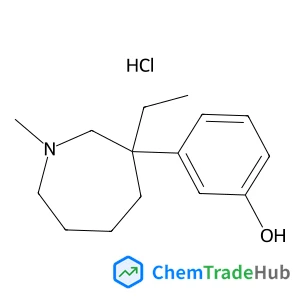
3-(3-Ethyl-1-methyl-3-azepanyl)phenol hydrochloride (1:1)
CAS Number:
59263-76-2
Molecular Formula:
C15H24ClNO
Recommended Suppliers





Disclaimer
This page provides academic journal information for reference and research purposes only. We are not affiliated with any journal publishers and do not handle publication submissions. For publication-related inquiries, please contact the respective journal publishers directly.
If you notice any inaccuracies in the information displayed, please contact us at support@chemtradehub.com. We will promptly review and address your concerns.