












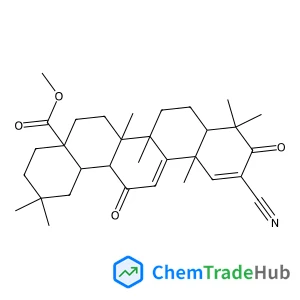
Methyl 2-cyano-3,12-dioxooleana-1,9(11)-dien-28-oate
CAS Number:
218600-53-4
Molecular Formula:
C32H43NO4
Ranjodh Singh, Chung-Shu Wu, Fu-Hsiang Ko
For the design and development of organic electronic devices, the main focus is particularly on the synthesis of new organic semiconductors and dielectric materials. Molecular engineering is another effective strategy, in this direction which has been explored successfully in this study through synthesis of a π-conjugated oligomer CbzTPAU2, with Mw = 2169. This bow shaped oligomer has its core unit made of 2,7-disubstituted carbazole which further has been connected to its end-terminal unit TPAU2 by 1,4-bis(decyloxy)-2,5-diethynylbenzene. The presence of a uracil moiety on end terminals of CbzTPAU2 has triggered the self-assembly of CbzTPAU2 molecules through knitting up of each of these single units through four Uracil–Uracil intermolecular hydrogen bonds (U⋯U) per CbzTPAU2 unit. An Atomic Force Microscope (AFM) study was employed to explore the directionality of hydrogen bonding. Further, the effect of solvent polarity on the stability of U⋯U bonding in CbzTPAU2 oligomers has also been reported here in this study. The potential of these self-assembled CbzTPAU2 oligomers when explored as charge transporting layers in OTFTs has shown p-type behaviour. The OTFT device bottom-gate, top-contact when fabricated on the heavily doped n-type Si wafer with SiO2 as a gate dielectric (200 nm) has shown a good on/off ratio 3.43 × 10³ and with an average hole mobility of 0.167 cm2 V−1 s−1.
Haiying He, Yesukhei Jagvaral
DOI: 10.1039/C7CP00915A
Xiaodan Xu, Lu Cai, Xiaoli Zheng, Qun Xu
DOI: 10.1039/C7CP01277B
P. Anees, M. C. Valsakumar, B. K. Panigrahi
DOI: 10.1039/C6CP08635G
YoungAh Kwon, Junho Lee, Sungnam Park
DOI: 10.1039/C6CP08852J
Z. A. Tian, K. J. Dong, A. B. Yu
DOI: 10.1039/C7CP01152K
Hyun Joon Chang, Myeongsang Lee, Jae In Kim, Sungsoo Na
DOI: 10.1039/C7CP01418J
Mónika Kéri, Zoltán Nagy, Levente Novák, Edit Szarvas, Lajos P. Balogh, István Bányai
DOI: 10.1039/C7CP00875A
Sébastien Maron, Nadège Ollier, Thierry Gacoin, Géraldine Dantelle
DOI: 10.1039/C7CP00451F
Waste containing N-Methoxy-N-methyl-1,3-thiazole-5-carboxamide (CAS: 898825-89-3...
N-(4-Biphenylyl)dibenzo[b,d]furan-4-amine should be stored in a tightly sealed c...
The market for 3-Acetamido-5-amino-2,4,6-triiodobenzoic acid (CAS: 1713-07-1) is...
Benzyl 2-O-acetyl-3,4,6-tri-O-benzyl-beta-D-galactopyranoside (CAS: 61820-03-9) ...
2-Ethylpiperazine dihydrochloride (CAS: 438050-52-3) is regulated under the Glob...
1,1'-[1,3-Phenylenebis(methylene)]bis(3-methyl-1H-pyrrole-2,5-dione) (CAS: 11946...
Several alternatives can be used in the synthesis of 5-Fluoro-2-(1-pyrrolidinyl)...
Proper personal protective equipment (PPE) must be worn when handling this compo...
When handling 6-Bromoimidazo[1,2-a]pyridin-8-amine, it is important to wear appr...
Alternatives to (2S,4R)-4-(4-Nitrobenzyl)pyrrolidine-2-carboxylic acid hydrochlo...

Physical Chemistry Chemical Physics (PCCP) is an international journal co-owned by 19 physical chemistry and physics societies from around the world. This journal publishes original, cutting-edge research in physical chemistry, chemical physics and biophysical chemistry. To be suitable for publication in PCCP, articles must include significant innovation and/or insight into physical chemistry; this is the most important criterion that reviewers and Editors will judge against when evaluating submissions. The journal has a broad scope and welcomes contributions spanning experiment, theory, computation and data science. Topical coverage includes spectroscopy, dynamics, kinetics, statistical mechanics, thermodynamics, electrochemistry, catalysis, surface science, quantum mechanics, quantum computing and machine learning. Interdisciplinary research areas such as polymers and soft matter, materials, nanoscience, energy, surfaces/interfaces, and biophysical chemistry are welcomed if they demonstrate significant innovation and/or insight into physical chemistry. Joined experimental/theoretical studies are particularly appreciated when complementary and based on up-to-date approaches.

![[4-Amino-2-(methylsulfanyl)-5-pyrimidinyl]methanol structure](https://static.chemtradehub.com/structs/588/588-36-3-fc73.webp "[4-Amino-2-(methylsulfanyl)-5-pyrimidinyl]methanol structure")




