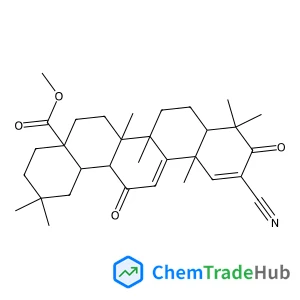
Methyl 2-cyano-3,12-dioxooleana-1,9(11)-dien-28-oate
CAS Number:
218600-53-4
Molecular Formula:
C32H43NO4
Mo Zhang, Yongfa Zhu
C3N4/TiO2 hybrid photocatalysts with highly enhanced photocatalytic performance were prepared by a facile ball milling method. A layered structure of g-C3N4 was formed on the surface of TiO2. The mechanochemical process can promote the dispersion of C3N4 on the surface of TiO2 particles, to form a single layer hybrid structure and a multi-layer core–shell structure. The photocatalytic activities of C3N4/TiO2 under visible and UV light irradiation were 3.0 and 1.3 times those of pure g-C3N4 and TiO2, respectively. Under visible light and UV irradiation, the photocurrent response was up to 2.5 times and 1.5 times as high as that of the pure TiO2 and C3N4, respectively. The evident performance enhancement of g-C3N4–TiO2 was mainly attributed to high separation and migration efficiency of electron–hole pairs.
Ziyun Wang, Christopher Hardacre, Wen-Feng Lin
DOI: 10.1039/C6CP06906A
Pablo Gamallo, Sinan Akpinar, Paolo Defazio, Carlo Petrongolo
DOI: 10.1039/C6CP07756K
Ignacio Fdez. Galván, Daniel Roca-Sanjuán, Erick L. Bastos, Wilhelm J. Baader, Roland Lindh
DOI: 10.1039/C6CP08154A
Sergio Giuffrida, Lorenzo Cordone
DOI: 10.1039/C6CP06848K
Claudio L. A. Berli, Magalí Mercuri, Martín G. Bellino
DOI: 10.1039/C6CP06602J
E. Voss, B. Vigolo, G. Medjahdi, C. Hérold, J.-F. Marêché, J. Ghanbaja, F. Le Normand, V. Mamane
DOI: 10.1039/C6CP08568G
Carlie M. Novak, Ryan C. Fortenberry
DOI: 10.1039/C6CP08140A
Natasha W. Pettinger, Robert E. A. Williams, Jinquan Chen
DOI: 10.1039/C6CP08227K
Dannie J. G. P. van Osch, Laura J. B. M. Kollau, Sari Asikainen, Marisa A. A. Rocha
DOI: 10.1039/C6CP07499E
Shimon Vega
DOI: 10.1039/C6CP07881H
When handling 4-(2-Furylmethyl)thiomorpholine 1,1-dioxide (CAS: 79206-94-3), it ...
When handling 4-Chloro-N-[2-(4-morpholinyl)ethyl]benzamide (CAS: 71320-77-9), it...
Waste containing this compound (CAS: 62921-74-8) should be handled according to ...
Waste containing (S)-Methyl 2-amino-3-cyclohexylpropanoate should be collected i...
This compound can be synthesized using a multi-step process involving the conjug...
There are several alternatives to (2E)-3-(3,4-Dichlorophenyl)acrylic acid in syn...
Ethyl 6-(2-nitrophenyl)imidazo[2,1-b][1,3]thiazole-3-carboxylate (CAS: 925437-84...
Waste containing 2-(1,3-Thiazol-2-yl)ethanamine (CAS: 18453-07-1) should be coll...
Methyl 5-iodo-2-methylbenzoate can be synthesized through the iodination of meth...
5-Chloro[1,2,4]triazolo[1,5-a]pyridine is commonly synthesized via the condensat...

Physical Chemistry Chemical Physics (PCCP) is an international journal co-owned by 19 physical chemistry and physics societies from around the world. This journal publishes original, cutting-edge research in physical chemistry, chemical physics and biophysical chemistry. To be suitable for publication in PCCP, articles must include significant innovation and/or insight into physical chemistry; this is the most important criterion that reviewers and Editors will judge against when evaluating submissions. The journal has a broad scope and welcomes contributions spanning experiment, theory, computation and data science. Topical coverage includes spectroscopy, dynamics, kinetics, statistical mechanics, thermodynamics, electrochemistry, catalysis, surface science, quantum mechanics, quantum computing and machine learning. Interdisciplinary research areas such as polymers and soft matter, materials, nanoscience, energy, surfaces/interfaces, and biophysical chemistry are welcomed if they demonstrate significant innovation and/or insight into physical chemistry. Joined experimental/theoretical studies are particularly appreciated when complementary and based on up-to-date approaches.