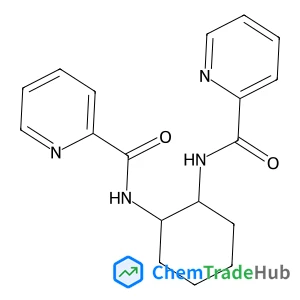
N,N'-(1R,2R)-1,2-Cyclohexanediyldi(2-pyridinecarboxamide)
CAS Number:
218290-24-5
Molecular Formula:
C18H20N4O2
N. A. Nebogatikova, V. Ya. Prinz, I. I. Kurkina, V. I. Vdovin, G. N. Aleksandrov, V. B. Timofeev, S. A. Smagulova, E. R. Zakirov, V. G. Kesler
In the present study, we have examined the interaction between a suspension of graphene in dimethylformamide and an aqueous solution of hydrofluoric acid, which was found to result in partial fluorination of suspension flakes. A considerable decrease in the thickness and lateral size of the graphene flakes (up to 1–5 monolayers in thickness and 100–300 nm in diameter) with increasing duration of fluorination treatment is found to be accompanied by a simultaneous transition of the flakes from the conducting to the insulating state. Smooth and uniform insulating films with a roughness of ∼2 nm and thicknesses down to 20 nm were deposited from the suspension on silicon. The electrical and structural properties of the films suggest their use as insulating elements in thin-film nano- and microelectronic device structures. In particular, it was found that the films prepared from the fluorinated suspension display rather high breakdown voltages (field strength of (1–3) × 106 V cm−1), ultralow densities of charges in the film and at the interface with the silicon substrate in metal–insulator–semiconductor structures (∼(1–5) × 1010 cm−2). Such excellent characteristics of the dielectric film can be compared only to well-developed SiO2 layers. The films from the fluorinated suspension are cheap, practically feasible and easy to produce.
Azam Rahimi Niaraki, Mohammad Reza Saraee, Babak Kaboudin
DOI: 10.1039/C9OB02183C
Parantap Sarkar, Yuya Inaba, Hayato Shirakura, Tomoki Yoneda
DOI: 10.1039/D0OB00501K
Roderick W. Bates, Weiting Ko, Viktor Barát
DOI: 10.1039/C9OB02388G
Xinjie Wu, Ming Jia, Mengmeng Huang, Jung Keun Kim, Zheng Zhao, Junkai Liu, Jinhu Xi, Yabo Li, Yangjie Wu
DOI: 10.1039/D0OB00479K
Amit Bhowmik, Mahesh Yadav, Rodney A. Fernandes
DOI: 10.1039/D0OB00244E
Ronibala Devi Laishram, Yong Yang, Jiayan Li, Dandan Xu, Yong Zhan, Yang Luo, Zhimin Su, Sagar More
DOI: 10.1039/D0OB00103A
Kolle E. Thomas, Christine M. Beavers, Abhik Ghosh
DOI: 10.1039/D0OB00452A
Songtao Cai, Chang Liu, Xiaojie Jiao, Song He, Liancheng Zhao
DOI: 10.1039/C9OB02188D
Yi Ning, Xinwei He, Youpeng Zuo, Jian Wang, Qiang Tang, Mengqing Xie, Ruxue Li, Yongjia Shang
DOI: 10.1039/D0OB00382D
6-Bromo-2-methylimidazo[1,2-a]pyrimidine (CAS: 1111638-05-1) falls under various...
While there are no direct alternatives, similar compounds like 1-Pyrrolidineetha...
4-Methyl-2,6-bis(2-methyl-2-propanyl)phenyl methylcarbamate (CAS: 1918-11-2) is ...
2-(3-Bromo-4-fluorophenyl)-1,3-dioxolane (CAS: 77771-04-1) should be stored in a...
4,5,6,7-Tetrahydro-1H-indazole hydrochloride is a white crystalline solid with a...
(2R)-1-Methoxy-3-phenyl-2-propanamine is a chiral organic compound with the CAS ...
Ethyl 1-(1-phenylethyl)-1H-imidazole-5-carboxylate is used in various industries...
4-[(1E,3S)-1-(4-Hydroxyphenyl)-1,4-pentadien-3-yl]phenol (CAS: 17676-24-3) falls...
(S)-3-Amino-5-phenylpentanoic acid hydrochloride is primarily used in the pharma...
7-Methoxy-1-benzothiophene-2-carboxylic acid is typically synthesized by reactin...

Physical Chemistry Chemical Physics (PCCP) is an international journal co-owned by 19 physical chemistry and physics societies from around the world. This journal publishes original, cutting-edge research in physical chemistry, chemical physics and biophysical chemistry. To be suitable for publication in PCCP, articles must include significant innovation and/or insight into physical chemistry; this is the most important criterion that reviewers and Editors will judge against when evaluating submissions. The journal has a broad scope and welcomes contributions spanning experiment, theory, computation and data science. Topical coverage includes spectroscopy, dynamics, kinetics, statistical mechanics, thermodynamics, electrochemistry, catalysis, surface science, quantum mechanics, quantum computing and machine learning. Interdisciplinary research areas such as polymers and soft matter, materials, nanoscience, energy, surfaces/interfaces, and biophysical chemistry are welcomed if they demonstrate significant innovation and/or insight into physical chemistry. Joined experimental/theoretical studies are particularly appreciated when complementary and based on up-to-date approaches.
![(3aS,6aS)-1-Methyloctahydropyrrolo[3,4-b]pyrrole structure](https://static.chemtradehub.com/structs/877/877212-98-1-9157.webp "(3aS,6aS)-1-Methyloctahydropyrrolo[3,4-b]pyrrole structure")