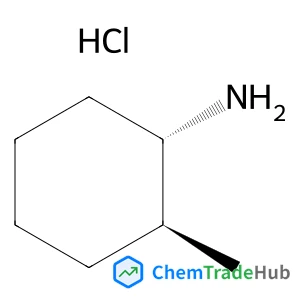
(1R,2R)-2-Methylcyclohexanamine hydrochloride (1:1)
CAS Number:
39558-31-1
Molecular Formula:
C7H16ClN
Zhifeng Jiang, Deli Jiang, A. M. Showkot Hossain, Kun Qian, Jimin Xie
Ag nanoparticles (NPs) are successfully grown in situ on nanoporous Fe2O3 microboxes (Ag/Fe2O3) simply by annealing Prussian blue (PB) in the presence of silver nitrate for the first time. The catalytic activity of the Ag/Fe2O3 microboxes for the reduction of p-nitrophenol (PNP) with NaBH4 is measured by UV-vis spectroscopy. It is found that the composites exhibit bifunctional properties with high magnetization and excellent catalytic activity toward PNP reduction. The high catalytic activity of the catalyst might be attributed to its high surface area and the synergistic effect on the delivery of electrons between Ag NPs and Fe2O3 microboxes. In addition, efficient reduction is observed and found to depend upon the content of Ag in the Ag/Fe2O3 microboxes. The dosage of the catalyst and the reaction temperature were investigated. Furthermore, the catalysts can be easily recycled by applying an external magnetic field while maintaining the catalytic activity without significant decrease even after running six times. The unique properties provide an ideal platform to study various metal/Fe2O3 catalysts which can be potentially applied in a wide variety of fields of catalysis and green chemistry.
Maarten T. P. Beerepoot, Daniel H. Friese, Kenneth Ruud
DOI: 10.1039/C3CP55205E
S. Cabello-Aguilar, A. Abou Chaaya, F. Picaud, M. Bechelany, C. Pochat-Bohatier, S. Yesylevskyy, S. Kraszewski, M. C. Bechelany, F. Rossignol, E. Balanzat, J. M. Janot, P. Miele, P. Dejardin, S. Balme
DOI: 10.1039/C4CP01954G
Rahul P. Hardikar, Deya Das, Sang Soo Han, Kwang-Ryeol Lee, Abhishek K. Singh
DOI: 10.1039/C4CP01412J
Taeseup Song, P. Lakshmipathiraj, Hyungkyu Han, Volodymyr V. Lysak, C. Terashima, Kazuya Nakata, A. Fujishima, Yong Soo Kang
DOI: 10.1039/C4CP02009J
Satoshi Miyatsu, Maiko Kofu, Teppei Yamada, Madhusudan Tyagi, Victoria García Sakai
DOI: 10.1039/C4CP01432D
Jens Giegerich, Jens Petersen, Roland Mitrić, Ingo Fischer
DOI: 10.1039/C3CP53213E
Jung Sang Cho, Jong-Heun Lee, Yun Chan Kang
DOI: 10.1039/C4CP01808G
Daniel Poetzsch, Rotraut Merkle, Joachim Maier
DOI: 10.1039/C4CP00459K
Sandro Jurinovich, Gennaro Pescitelli, Lorenzo Di Bari, Benedetta Mennucci
DOI: 10.1039/C3CP55428G
Guido Saracco, Svetoslava Vankova, Cristina Pagliano, Barbara Bonelli, Edoardo Garrone
DOI: 10.1039/C3CP54896A
(5-Sulfamoyl-3-pyridinyl)boronic acid is primarily used in chemical synthesis, p...
Benzyl 2-methyl-2-(methylsulfonyl)-4-pentenoate is typically synthesized via est...
When handling 8-Fluoroquinolin-6-ol (CAS: 209353-22-0), it is important to use p...
1,3-Dibromo-5-(2-methyl-2-propanyl)benzene (CAS: 129316-09-2) is a crystalline c...
Ethyl 7-chloro-4-oxo-1-(1,3-thiazol-2-yl)-1,4-dihydro-1,8-naphthyridine-3-carbox...
When handling Delta-7-Avenasterol (CAS: 23290-26-8), it is important to wear app...
Proper handling involves the use of personal protective equipment such as gloves...
When handling 2-Methyl-2-proanyl 4-[(2-aminophenyl)amino]-1-piperidinecarboxylat...
N-Methyl-4-chlorobenzylamine hydrochloride (CAS: 65542-24-7) is a organic compou...
[2-(Dodecyloxy)ethoxy]acetic acid (CAS: 27306-90-7) is generally considered safe...

Physical Chemistry Chemical Physics (PCCP) is an international journal co-owned by 19 physical chemistry and physics societies from around the world. This journal publishes original, cutting-edge research in physical chemistry, chemical physics and biophysical chemistry. To be suitable for publication in PCCP, articles must include significant innovation and/or insight into physical chemistry; this is the most important criterion that reviewers and Editors will judge against when evaluating submissions. The journal has a broad scope and welcomes contributions spanning experiment, theory, computation and data science. Topical coverage includes spectroscopy, dynamics, kinetics, statistical mechanics, thermodynamics, electrochemistry, catalysis, surface science, quantum mechanics, quantum computing and machine learning. Interdisciplinary research areas such as polymers and soft matter, materials, nanoscience, energy, surfaces/interfaces, and biophysical chemistry are welcomed if they demonstrate significant innovation and/or insight into physical chemistry. Joined experimental/theoretical studies are particularly appreciated when complementary and based on up-to-date approaches.
![5-Chloropyrrolo[2,1-f][1,2,4]triazin-4(3H)-one structure](https://static.chemtradehub.com/structs/888/888720-60-3-4f7c.webp "5-Chloropyrrolo[2,1-f][1,2,4]triazin-4(3H)-one structure")